
WEX Inc. in 2026: Transaction Scale, Capital Allocation, and Resilience Pressures in Financial Services
WEX Inc. reported strong Q3 2026 revenue and earnings, underlining its scale in payment and fleet management solutions. The company's ability to sustain margins amid macroeconomic and competitive pressures will determine its next phase.
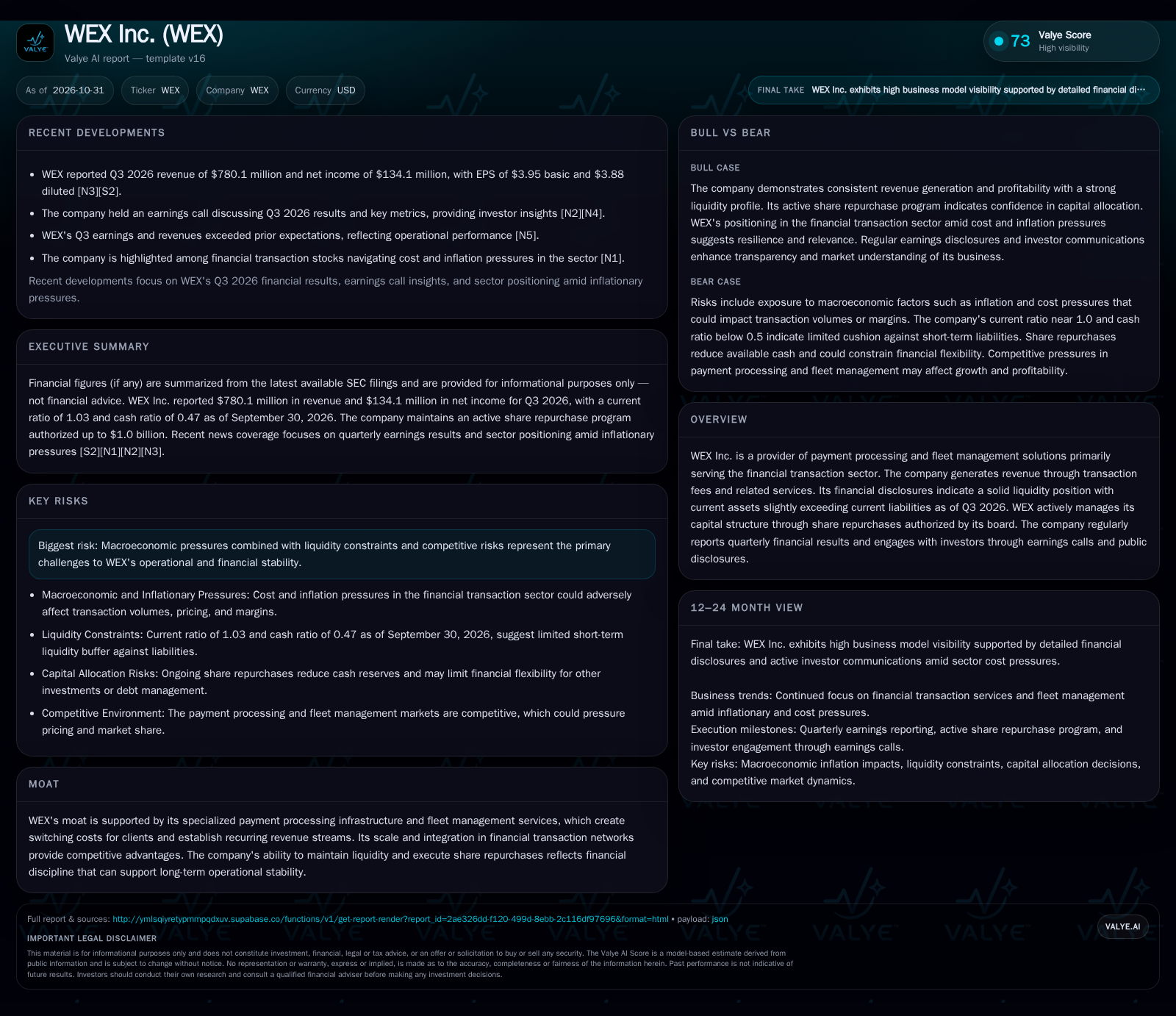
WEX Inc. posted $780.1 million in Q3 2026 revenue and $134.1 million in net income, continuing its track record in payment and fleet management services. The company’s competitive moat relies on service integration and switching costs, but ongoing inflation and sector competition may test pricing and margin durability. Watch for evidence of margin resilience, cash flow generation, and retention of major clients as key thesis tests. [S2] [N2] [N3] [N4] [N5]
WEX Inc., a stalwart in payment processing and fleet management, delivered another quarter of solid financial results, with Q3 2026 revenues and earnings surpassing expectations. As the sector faces persistent inflation and cost pressures, WEX’s ability to balance capital returns with operational flexibility will be critical. The next phase for WEX hinges on sustaining its competitive advantages and margin profile in a market where both clients and rivals are increasingly sensitive to costs and service value.
Q3 2026 Results Highlight Strengths—But Also Liquidity Constraints
WEX Inc. reported $780.1 million in revenue and $134.1 million in net income for the quarter ended September 30, 2026, with basic EPS at $3.95 and diluted EPS at $3.88. These results reflect ongoing profitability and scale in the payment processing and fleet management domains. Notably, the company’s current assets stood at $11.54 billion, only modestly higher than its $11.25 billion in current liabilities, yielding a current ratio of 1.03 and a cash ratio of 0.47. These figures indicate that while WEX is operationally robust, its liquidity cushion relative to short-term obligations is thin. In addition, WEX executed repurchases of over 1 million shares in Q3, part of a $1.0 billion authorized buyback program with no expiration date, signaling an emphasis on shareholder returns even as liquidity remains tight. [S2] [N2] [N3]
Transaction-Driven Revenue Model and the Capital Intensity of Scale
WEX generates the bulk of its revenue from transaction fees and related services, primarily targeting businesses requiring payment solutions and fleet management. The company’s economics are characterized by high transaction volume and relatively low incremental costs per transaction, yielding attractive operating leverage as fixed infrastructure is spread over a growing base. However, payment processing and fleet management can be capital-intensive, especially as customers demand integration, security, and data analytics—necessitating ongoing investment in technology and compliance.
Revenue growth is typically tied to client transaction volumes and the mix of services provided. Price per transaction is influenced by competitive dynamics and customer bargaining power, and inflationary pressures can compress margins if WEX cannot pass along higher costs. The company’s balance sheet shows substantial short-term investments, but the reported cash ratio and active share repurchases suggest a deliberate trade-off between near-term liquidity and capital returns. Sustaining high returns on capital will depend on maintaining transaction volume, controlling costs, and balancing investment needs against shareholder distributions. [S2]
The capital intensity inherent in scaling payment and fleet management operations also implies a nuanced balance between growth investments and profitability. As WEX expands its technological capabilities—particularly in areas like cybersecurity, fraud detection, and real-time analytics—the company must allocate capital efficiently to avoid diminishing returns. Incremental investments in infrastructure may yield nonlinear benefits if they enable higher transaction throughput or unlock premium service tiers. Conversely, overextension in capital spending without commensurate revenue gains could pressure margins and cash flow. Thus, the timing and prioritization of capital deployment become critical, especially under macroeconomic uncertainty where cost of capital and access to funding may fluctuate.
Switching Costs and Sector Integration—But Competitive Pressures Mount
WEX’s moat is built on deep integration into client payment workflows, proprietary infrastructure, and bundled fleet management services. These features could increase switching costs: clients face operational friction and potential data migration risks if they move to a competitor. The company’s scale and sector reputation further reinforce its position, as does its ability to offer value-added analytics and compliance solutions.
However, the payment processing and fleet management sectors are highly competitive, with both legacy players and fintech entrants targeting the same business clients. Competitors may offer lower pricing, more flexible terms, or advanced digital features, eroding WEX’s differentiation. Substitution risk is also rising as corporate clients reassess cost structures and explore alternative providers or in-house solutions, especially in an inflationary environment where every basis point of margin counts. The question is whether WEX’s integration and service breadth are enough to offset these pressures—or if price and feature competition will drive churn or margin compression.
Moreover, client behavior in response to competitive pressures will likely be heterogeneous, influenced by factors such as industry vertical, transaction complexity, and regulatory environment. For example, clients in highly regulated sectors may value compliance and security features more, reinforcing switching costs, while those with simpler payment needs might be more price-sensitive and open to alternatives. WEX’s ability to segment its offerings and tailor solutions accordingly could mitigate attrition risks. Additionally, partnerships or ecosystem integrations with complementary fintech providers could enhance value propositions, creating network effects that further entrench client relationships. Failure to adapt service models to evolving client preferences or technological trends could accelerate churn and margin erosion.
Margin Expansion if WEX Converts Scale into Pricing Power
A favorable outcome for WEX would see its integrated services model driving higher retention, enabling the company to selectively raise prices or upsell analytics and compliance offerings. If clients view WEX as mission-critical and switching costs remain high, the company could expand margins even as inflation raises input costs. Share repurchases would further boost per-share metrics if cash flow remains robust and core transaction volumes grow or remain stable.
Confirming evidence for this scenario would include sustained or rising gross and operating margins, positive net client additions, and disclosure of successful price increases or new premium service adoption. A reduction in churn and evidence of major contract renewals would also support the thesis. Conversely, if margins stagnate, client losses rise, or price competition intensifies, this upside scenario would be falsified.
Sustained Profitability but Margin Pressure as Sector Dynamics Weigh
The most plausible path is continued revenue and earnings growth, but with heightened sensitivity to cost pressures and competitive dynamics. WEX is likely to maintain profitability and its role as a core provider of transaction and fleet solutions, supported by recurring revenues and integration in client operations. However, margin expansion may be limited as the company absorbs higher costs and faces pricing pressure from both legacy rivals and digital-first entrants.
This middle scenario would be confirmed by stable or slightly declining margins, continued share repurchases, and regular client retention rates without major contract losses. Falsification would require a material margin squeeze, sharp slowdown in transaction volumes, or evidence of client churn to alternative providers.
In this scenario, WEX’s operational resilience would depend on its capacity to streamline costs without compromising service quality, leveraging automation and process optimization to offset inflationary impacts. The company might also explore selective price adjustments calibrated to client segments’ willingness to pay, balancing retention with margin preservation. Incremental revenue from value-added services could partially compensate for transactional pricing pressure, though competitive dynamics may cap upside potential. Maintaining a disciplined capital allocation framework—prioritizing investments with clear return profiles while sustaining shareholder returns at manageable levels—would be essential to navigate this environment. Monitoring shifts in client payment behavior or emerging regulatory requirements would further inform strategic adjustments.
Liquidity Strain and Competitive Losses Amplify Downside Risk
If transaction volumes contract or major clients defect, the company may be forced to curtail buybacks, reduce investment, or seek external funding under less favorable terms.
Evidence confirming this scenario would include a notable deterioration in the current ratio or cash ratio, suspension or reduction of the buyback program, negative net client change, or a sharp drop in transaction volumes. A downgrade in credit ratings or negative outlook from rating agencies would also point to increased financial stress. If WEX maintains liquidity and retains major clients despite sector headwinds, the downside would be less likely.
Milestones That Will Determine WEX’s Resilience and Margin Profile
Quarterly gross and operating margin trends—evidence of margin expansion, stability, or compression would clarify margin resilience under cost pressure.
Net client additions, retention rates, or major contract renewals—if disclosed, these metrics would indicate the strength of WEX’s competitive moat and switching costs.
Transaction volume growth relative to sector trends—a useful metric would be to benchmark WEX’s volume growth versus overall market expansion or contraction.
Cash flow from operations and free cash flow—continued generation would support capital returns and investment flexibility; a decline would signal emerging constraints.
Buyback pace and remaining authorization—sustained repurchases would indicate management confidence, but any pause or slowdown could suggest precautionary liquidity management.
Disclosure of pricing actions or premium service adoption—upward price adjustments or new high-value service uptake would bolster the margin narrative.
Sector M&A or new competitive entrants—external developments could reshape the client landscape or intensify pricing pressure.
Disclaimer: This is research-only, informational analysis and not investment advice. It may include AI-generated interpretation and general industry context. Always verify important details using primary sources.

Comments