
Stagwell’s AI Strategy: Can This Challenger Network Surpass Established Marketing Leaders?
Stagwell Inc’s integration of AI and digital platforms across its global marketing network has driven recent operational gains and raised EBITDA guidance. But in a fragmented, rapidly evolving industry, the company’s ability to translate technology investment into durable margins and client stickiness will define its next chapter.
The company’s strategy focuses on leveraging proprietary technology and global brand collaboration to challenge legacy marketing networks, but execution risks and intense competition remain central to the thesis. Monitoring AI product adoption, client retention, and working capital trends will be critical for assessing the sustainability of its growth trajectory. [N2] [N3]
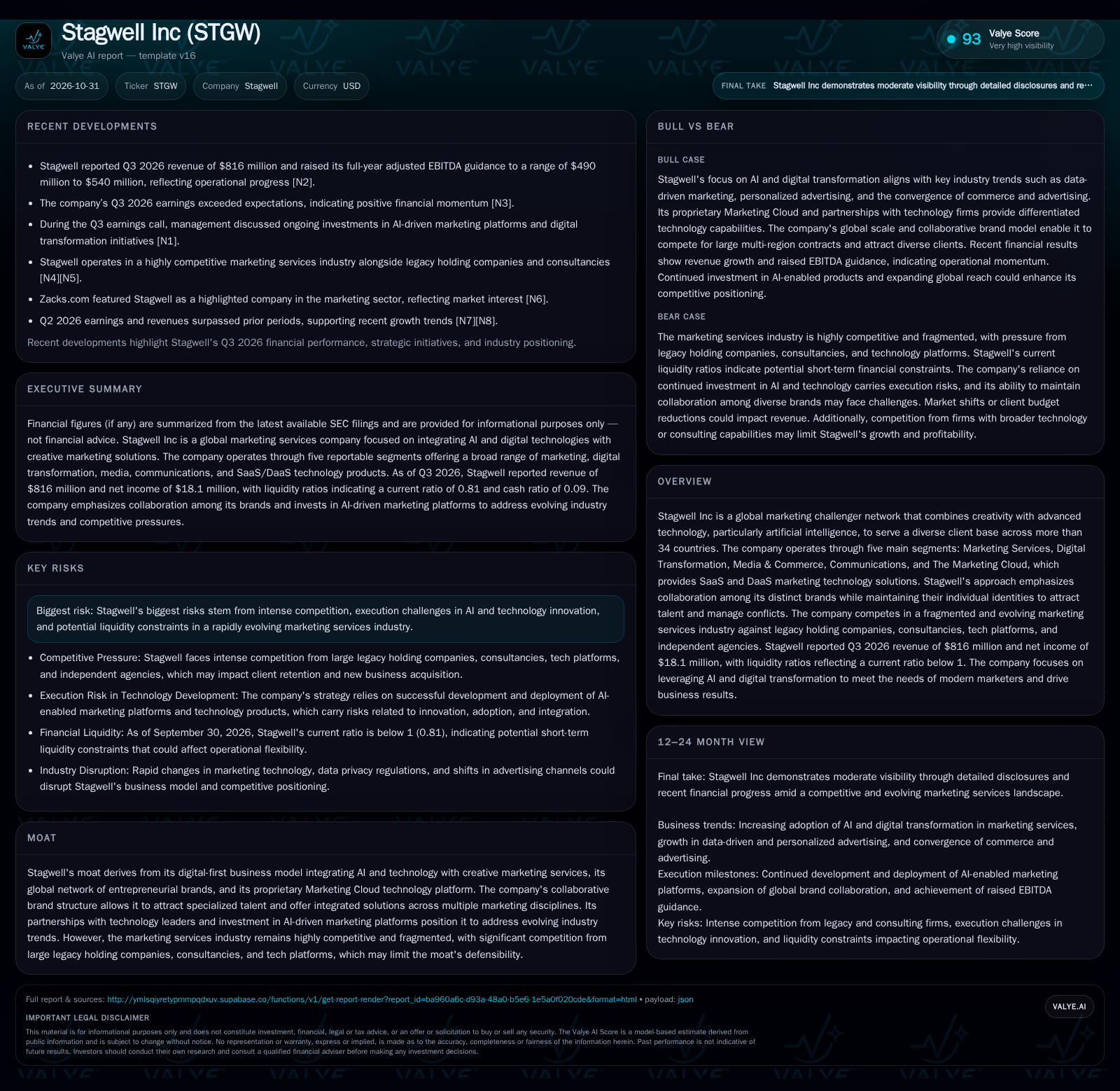
Stagwell Inc has positioned itself as a digital-first challenger in the global marketing services industry, emphasizing the integration of artificial intelligence and advanced analytics into its broad suite of offerings. With Q3 2026 results showing revenue of $816 million and a raised EBITDA outlook, Stagwell’s focus on proprietary technology and global brand collaboration appears to be gaining traction with clients demanding more data-driven, personalized solutions. However, the company’s below-par liquidity ratios and the relentless pace of industry change pose real tests for its model—leaving the core question whether Stagwell can convert its tech-forward vision into lasting commercial and margin advantages in a landscape crowded with both legacy giants and nimble digital specialists. [N2] [N3] [S2]
Snapshot of Recent Financial Results and Strategic Priorities
Stagwell Inc reported Q3 2026 revenue of $816 million and net income of $18.1 million, with management raising the company’s full-year adjusted EBITDA guidance to a range of $490 million to $540 million. This upward revision follows back-to-back quarters of earnings and revenue that exceeded expectations, suggesting operational momentum and market receptivity to Stagwell’s offerings. [N2] [N3]
Strategically, Stagwell’s investments remain concentrated in AI-driven marketing platforms and digital transformation initiatives, leveraging partnerships with technology leaders such as Palantir and Adobe. This focus on proprietary technology and digital integration is central to the company’s challenge to industry incumbents. [N1]
Stagwell’s Integrated Approach as a Path to Margin Improvement
Stagwell’s business model is built around integrating creative marketing services with technology, particularly artificial intelligence, across five reportable segments: Marketing Services, Digital Transformation, Media & Commerce, Communications, and The Marketing Cloud. The company generates revenue through a mix of project-based and retainer contracts, with incremental SaaS/DaaS revenue emerging from its Marketing Cloud offerings. While the exact commercial mechanics—such as contract duration, client concentration, or renewal rates—are not disclosed, the model aims to create recurring, higher-margin revenue streams as clients adopt more embedded technology solutions.
The company’s AI-enabled platforms and analytics tools offer the potential for operating leverage: as proprietary products scale, incremental margins could expand due to relatively low variable costs for software-driven services compared to traditional agency labor models. However, realizing these economics depends on successful client adoption, effective cross-selling among segments, and the ability to charge premium pricing for differentiated technology solutions.
Capital needs are shaped by ongoing investment in product development, talent acquisition, and technology partnerships.
Market Landscape and Competitor Dynamics Facing Stagwell
Stagwell operates in a fragmented marketing services industry that is undergoing rapid transformation due to digital innovation, data proliferation, and the convergence of advertising and commerce. The company faces competition from several fronts: legacy holding companies (e.g., WPP, Omnicom, Publicis), global consultancies (such as Accenture and Deloitte), digital-native tech platforms (like Google and Meta), and independent agencies.
Stagwell’s potential advantages include its digital-first orientation, the proprietary Marketing Cloud, and a collaborative network of brands that can combine creative and technical expertise. The company’s multi-brand model is designed to attract specialized talent, offer integrated solutions, and manage conflicts of interest—factors that may help win large, multi-region contracts. On the other hand, larger incumbents benefit from scale, established client relationships, and deeper resources, while tech platforms increasingly capture digital advertising spend through self-serve tools and closed ecosystems.
Switching frictions in this sector are moderate: while integrated technology platforms can create some stickiness, clients often retain multiple agencies or partners. Stagwell’s challenge is to deepen client integration—especially via its AI-enabled tools—so as to build higher retention and justify premium pricing.
Potential for Growth Fueled by AI Integration and Global Partnerships
The most favorable scenario for Stagwell is one in which its ongoing investments in AI-powered marketing platforms and data-driven tools lead to accelerated adoption by both existing and new clients. If the Marketing Cloud and related SaaS/DaaS offerings achieve critical mass, Stagwell could shift a growing share of its revenue mix toward higher-margin, recurring technology streams, reducing reliance on traditional project-based fees.
Operationally, this would require not just product development but also effective cross-segment collaboration and global execution. Partnership-driven innovations—such as those with Adobe and Palantir—could enhance Stagwell’s perceived value and help land large, multi-region contracts, especially if the company demonstrates clear ROI for clients through automation, personalization, and analytics.
Evidence that would confirm this scenario includes rapid growth in Marketing Cloud revenue (if disclosed), increasing share of SaaS/DaaS contracts, improved client retention rates, and sustained margin expansion reflected in future EBITDA guidance raises.
Managing Industry Changes with Steady Progress and Execution Challenges
The most plausible path is for Stagwell to deliver steady, if unspectacular, revenue and profit growth by gradually increasing the share of technology-enabled services within its overall mix, while maintaining its core creative and media offerings. In this scenario, AI and digital transformation initiatives drive incremental margin improvement, but the company continues to face strong competition for both talent and clients, limiting pricing power and requiring ongoing investment to keep pace with industry innovation.
Financially, Stagwell’s working capital constraints may persist, requiring active management of receivables, payables, and discretionary spending. The company avoids major shocks but does not achieve a decisive shift to recurring, high-margin revenue, resulting in moderate EBITDA growth and periodic earnings volatility.
Confirmation would come from stable or gradually rising EBITDA margins, ongoing investments in technology partnerships, and incremental increases in the share of revenue attributable to digital and SaaS/DaaS offerings—without a step-change in client concentration or contract duration.
Risks from Cash Flow Constraints, Competition, and Margin Pressure
If client budgets tighten or macroeconomic conditions worsen, project-based revenues could decline faster than SaaS/DaaS adoption ramps up, leading to revenue pressure and operating deleverage.
Execution risk is amplified if new AI products fail to gain traction or if integration across brands stalls, undermining the promise of a more unified, technology-driven offering. In this environment, Stagwell could face higher client churn, margin compression, and potentially the need for external financing under less favorable terms.
Confirmation would include declining or flat revenue, shrinking or negative EBITDA guidance revisions, deteriorating working capital, and evidence of missed product delivery or client losses.
Factors Influencing Stagwell’s Future Market Position
Growth rate and mix of Marketing Cloud and SaaS/DaaS revenue (if disclosed), as a signal of technology adoption and margin potential.
Trends in client retention and average contract size, especially in digital and AI-enabled service lines; a useful metric would be disclosed renewal rates.
Updates to adjusted EBITDA guidance and realized margins, indicating the effectiveness of operating leverage and cost management.
Evidence of new multi-region or enterprise-scale contract wins, especially those tied to proprietary AI or analytics platforms.
Integration milestones or product launches resulting from technology partnerships (e.g., with Palantir, Adobe), demonstrating innovation cadence.
Competitive moves by legacy holding companies, consultancies, or tech platforms that may alter client acquisition dynamics or pricing environments.
Any management commentary or disclosure on capital allocation priorities, particularly regarding investment in technology versus debt reduction or M&A.
Disclaimer: This is research-only, informational analysis and not investment advice. It may include AI-generated interpretation and general industry context. Always verify important details using primary sources.

Comments