
MicroVision’s Lidar Ambitions: Funding Pressure, Customer Concentration, and the Test of Commercial Scale
MicroVision is pushing to commercialize advanced lidar and perception solutions, leveraging recent acquisitions and a new technology roadmap.
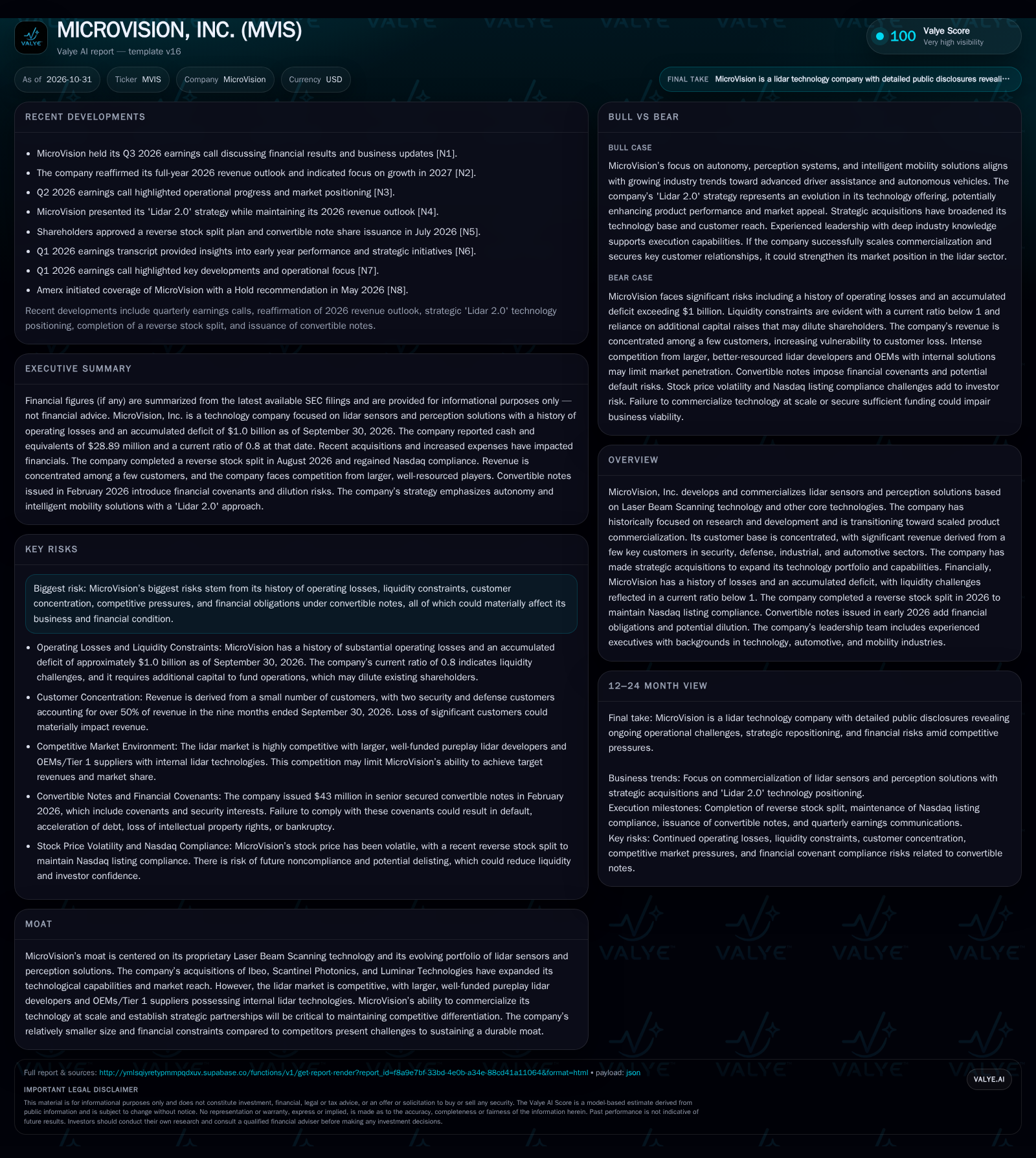
MicroVision is pushing to commercialize advanced lidar and perception solutions, leveraging recent acquisitions and a new technology roadmap. Its ability to secure new customers, achieve scale, and manage capital needs will determine whether it can translate its technology into durable market presence or face further financial strain. [S2]
MicroVision, Inc. stands at a pivotal moment: armed with a newly articulated ‘Lidar 2.0’ strategy and an expanded technology portfolio from three major acquisitions, the company is striving to break out of its long history of operating losses by commercializing lidar and perception solutions for automotive, industrial, and mobility applications. MicroVision’s future now hinges on its ability to convert technical assets and partnerships into scalable, recurring revenue—before financial pressures force difficult choices. [S2]
Recent Acquisitions and Financial Pressure Define MicroVision’s 2026 Landscape
MicroVision’s operational context in late 2026 is shaped by several high-impact developments. [S2] In early 2026, MicroVision issued $43 million in senior secured convertible notes, introducing both financial covenants and potential shareholder dilution. [S2] The company also completed three acquisitions—Scantinel Photonics (January 2026), Ibeo (January 2023), and Luminar Technologies (February 2026)—which have expanded its lidar and perception technology base but driven up expenses and headcount. [S2] Finally, MicroVision executed a 1-for-15 reverse stock split in August 2026 to regain Nasdaq compliance, a move reflecting sustained stock price volatility and the need to maintain listing eligibility. [S2]
How MicroVision Could Turn Lidar R&D Into Scalable Revenue Streams
MicroVision’s core business model aims to transition from R&D-centric operations to scalable commercialization of lidar sensors and perception software for automotive (notably ADAS and autonomy), industrial, and security applications. The economics of lidar hardware are shaped by a mix of high up-front R&D costs, moderate-to-high unit manufacturing costs (especially at low volumes), and the potential for high-margin software or perception stack add-ons if the company can move up the value chain.
Revenue concentration among a few customers increases volatility and risk, as a lost contract or delayed deployment could materially impact results. If MicroVision can secure multi-year supply agreements with automotive OEMs or Tier 1 suppliers, it could create a recurring revenue base and improve planning visibility. However, no such arrangements are currently established in the recent fact set. [S2]
Operating leverage is theoretically favorable in this sector: once R&D and fixed costs are absorbed, incremental lidar unit sales and software licenses could drive margin expansion. However, MicroVision’s ongoing losses and the expanded cost base from recent acquisitions mean that reaching breakeven will likely require significant volume ramp and/or premium pricing—both of which depend on winning major contracts in a highly competitive field.
Capital needs remain acute. [S2] The company’s cost of capital is likely elevated given its history of losses and the restrictive covenants attached to its convertible notes, which may further constrain flexibility and raise the risk of dilution if equity is issued at depressed valuations.
Technology Portfolio Expansion Meets Competitive Reality in the Lidar Arena
MicroVision’s competitive position is defined by its proprietary Laser Beam Scanning (LBS) technology and, more recently, the integration of assets from Ibeo, Scantinel Photonics, and Luminar Technologies. This broader technology base potentially enables the company to serve a wider range of lidar applications (from long-range, high-resolution sensors for automotive autonomy to compact, cost-sensitive units for industrial and security uses).
Despite this, competitive pressure is intense. The lidar sector is crowded with both pureplay developers (some of which are now public and better capitalized) and large automotive OEMs/Tier 1 suppliers who are increasingly developing lidar sensors in-house. These larger players benefit from scale, established customer relationships, and (often) the ability to cross-subsidize R&D across multiple product lines.
MicroVision’s smaller scale and limited financial resources may hinder its ability to match competitors on price, delivery timelines, or the ability to absorb delays. Customer concentration further amplifies risk: the loss of a single large automotive or industrial contract could materially erode revenue, while the company’s ability to win new business is unproven at scale. The ‘Lidar 2.0’ strategy is intended to position MicroVision as a full-stack perception solution provider, but success will depend on demonstrating superior performance, reliability, or cost relative to better-resourced rivals.
Winning Major OEM Contracts Could Transform MicroVision’s Trajectory
The bullish scenario for MicroVision rests on successfully leveraging its expanded technology portfolio and ‘Lidar 2.0’ positioning to secure large-scale contracts with automotive OEMs or Tier 1 suppliers. If the company can translate pilot programs or technical evaluations into multi-year supply agreements, it may achieve the scale needed for positive operating leverage and improved gross margins.
Confirmation of this scenario would come from announcements of new customer wins (especially in automotive), evidence of multi-year or recurring revenue contracts, and a visible ramp in production volumes. Additional signs would include a broadening customer base, reduced revenue concentration, and indications that operating losses are narrowing as fixed costs are absorbed.
This pathway would also likely require ongoing capital raises—ideally at improving equity valuations—to fund working capital and production scale-up. If the company can demonstrate competitive product performance and reliability, and if the lidar adoption curve in automotive accelerates, MicroVision could shift from a high-risk R&D story to a credible commercial technology supplier.
Commercialization Proceeds in Fits and Starts as Capital and Customer Risks Loom
A middle-ground scenario sees MicroVision gradually expanding its customer base and product deployments, but struggling to achieve the scale or contract visibility needed for sustained profitability. The company may win some industrial, security, or smaller-scale automotive supply contracts, but revenue remains lumpy and dependent on a handful of relationships.
Under this scenario, operating losses persist and incremental capital raises (via ATM, equity, or additional debt) are required to bridge the gap to breakeven. The risk of dilution remains high, and the company’s ability to comply with convertible note covenants could come under pressure if milestones are missed or revenue ramps more slowly than anticipated.
Evidence confirming this scenario would include continued volatility in quarterly results, ongoing reliance on a few major customers, and repeated financing events. Falsifying evidence would be a rapid broadening of the customer base and clear operating leverage reflected in margin improvement.
Liquidity Stress and Customer Attrition Could Force Restructuring or Asset Sales
The adverse scenario for MicroVision is triggered if the company is unable to secure sufficient new business to support its expanded cost base, or if one or more key customers reduce or delay orders.
If MicroVision cannot raise additional capital on acceptable terms, it may be forced to restructure, sell assets, or pursue strategic alternatives under distress. Breach of convertible note covenants could trigger acceleration of debt or other creditor remedies, including loss of intellectual property rights. Stock price volatility and potential Nasdaq noncompliance would further erode investor confidence and access to capital.
Confirmation of this scenario would include missed debt payments, public disclosures of covenant breaches, emergency financings at punitive terms, or the announcement of layoffs, asset sales, or restructuring efforts. A moderate warning would be persistent negative operating cash flow without signs of revenue or customer diversification.
Milestones That Will Determine MicroVision’s Commercialization Outcome
Announcement of new multi-year or recurring revenue contracts, especially with automotive OEMs or Tier 1 suppliers, would be a key test of commercial momentum.
Disclosure of customer concentration trends or customer churn—if available—would help assess revenue stability and dependency risk.
Quarterly updates on gross margin progression and operating expense trends would clarify whether the company is achieving scale and operating leverage.
Evidence of successful integration and synergies from the Ibeo, Scantinel, and Luminar acquisitions would validate the technology expansion thesis.
Updates on compliance with convertible note covenants and any related default or waiver events would indicate potential financial flexibility or stress.
Any new equity, debt, or ATM financings—including terms and dilution impact—should be scrutinized for their effect on shareholder value and operational runway.
Progress reports or customer testimonials regarding the ‘Lidar 2.0’ solution’s performance and differentiation would help test product-market fit.
If disclosed, unit shipment volumes and revenue mix by end market (automotive, industrial, security) would provide insight into adoption curves and market penetration.
Disclaimer: This is research-only, informational analysis and not investment advice. It may include AI-generated interpretation and general industry context. Always verify important details using primary sources.

Comments