
Cactus, Inc.: Oilfield Cyclicality Meets Strength in Pressure Control and Spoolable Pipe Segments
Despite recent revenue and margin headwinds driven by weaker oilfield activity and tariff pressures, Cactus, Inc. remains a key supplier to the unconventional onshore oil and gas market. Its dual-segment model, broad field-service footprint, and capacity to adjust pricing and costs provide both resilience and exposure to the volatility of drilling cycles and input costs.
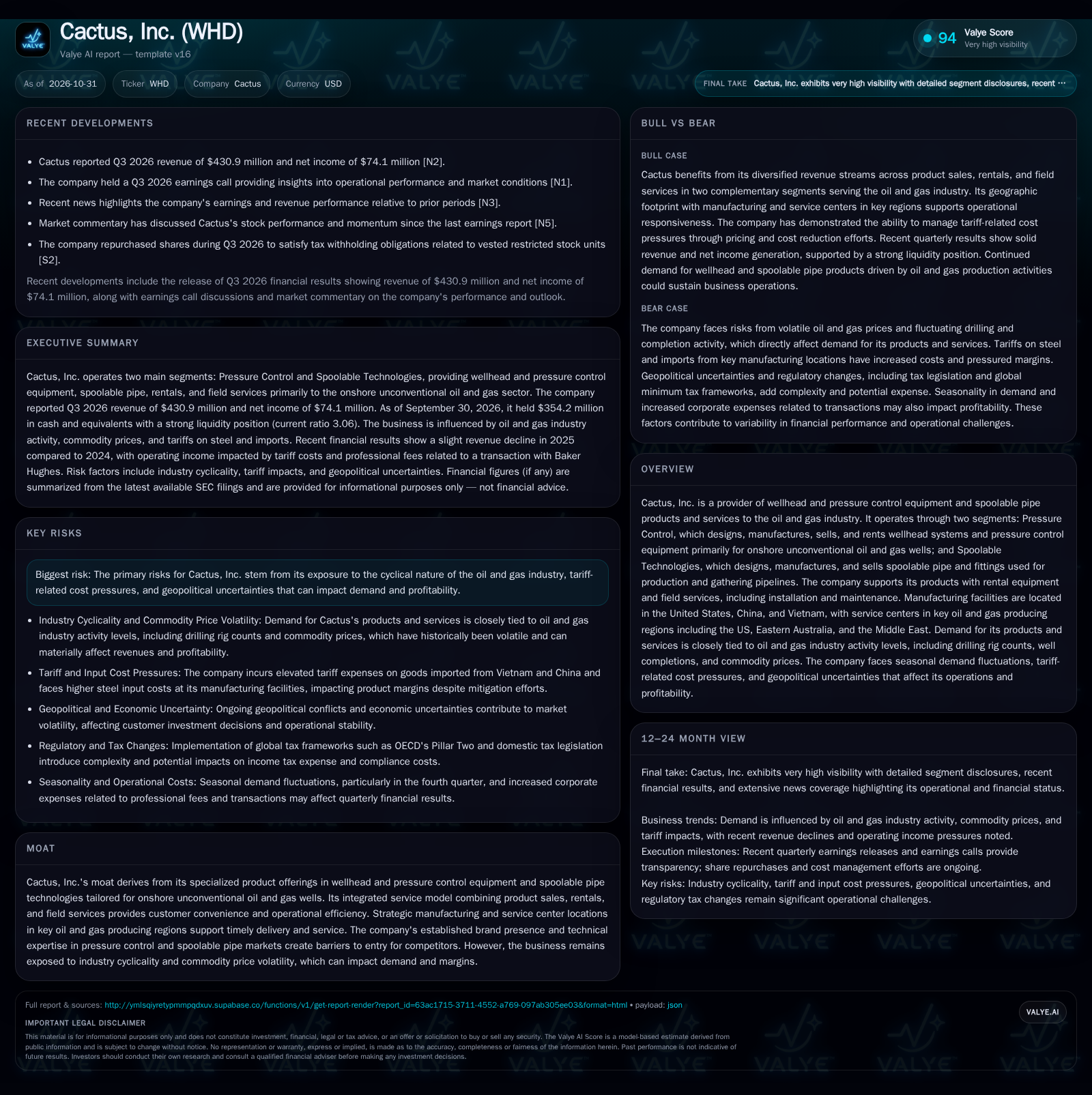
Cactus, Inc. reported Q3 2026 revenue of $430.9 million and net income of $74.1 million, continuing to navigate a challenging environment shaped by lower oil prices, reduced rig counts, and input cost inflation. Its Pressure Control and Spoolable Technologies segments serve critical oilfield needs but remain highly sensitive to industry activity levels and input tariffs. Watch for signs of drilling activity recovery, further cost management, and the impact of tariffs on future profitability. [N2] [S1] [S2]
Cactus, Inc. stands at the intersection of U.S. unconventional oilfield activity and global supply chain pressures. As a manufacturer and servicer of wellhead, pressure control, and spoolable pipeline equipment, the company’s fortunes are closely tied to drilling, completion, and production cycles. The company’s ability to defend margins through pricing and cost actions, alongside its broad field-service network, remains central to its long-term positioning, but the outlook is inextricably linked to commodity and rig-count volatility. [N2] [S1] [S2]
Recent Performance Highlights Resilience Amid Industry Headwinds
Cactus, Inc. reported Q3 2026 revenue of $430.9 million and net income of $74.1 million, a snapshot of robust operational execution despite a broader slowdown in oilfield activity. However, for full-year 2025, revenue declined 4.5% to $1.079 billion, with the Pressure Control segment down 0.9% and Spoolable Technologies down 9.5%—reflecting diminished drilling and completion activity. Operating income fell 13.5% year-over-year, pressured by both lower volumes and increased corporate expenses, notably professional fees linked to the Baker Hughes transaction. Tariffs on steel and imports from China and Vietnam have further increased input costs, only partially mitigated by cost reductions and price adjustments. As of September 30, 2026, Cactus maintained $354.2 million in cash and equivalents, with a current ratio of 3.06. [S1] [S2] [N2]
Dual-Segment Model Drives Revenue Diversity but Exposes Margin Leverage
Cactus’s business model is centered on two complementary segments: Pressure Control (wellhead systems, production trees, rentals, and field services) and Spoolable Technologies (FlexSteel spoolable pipe, fittings, rentals, and services). Both segments monetize through a mix of equipment sales, rentals, and recurring field services. This structure provides a measure of revenue stability—field services and rentals typically lag initial product sales and can smooth out cyclicality. However, both segments remain highly sensitive to drilling and completion volumes, which are dictated by oil and gas prices and rig counts.
The company’s manufacturing footprint—spanning the U.S., China, and Vietnam—enables cost flexibility but also exposes it to tariff risk and supply-chain volatility. Fixed costs in manufacturing and field-service infrastructure mean that revenue declines can quickly compress margins, as seen in 2025’s 13.5% operating income drop on a 4.5% revenue decline. Variable costs, particularly steel and imported components, are subject to global price swings and tariff policies. The ability to pass through these costs—via price increases or product mix shifts—is a crucial margin determinant.
Capital needs are moderate for a manufacturer of this scale, with maintenance and modest growth capex supporting equipment fleets and facility upgrades. The company reported cash and liquidity metrics for the period; these figures do not by themselves establish operating runway, investment capacity, financial flexibility, or financing capacity.
Operational Footprint and Service Integration Offer Differentiation, but Industry Cyclicality Remains a Core Threat
Cactus competes with a range of oilfield equipment manufacturers, rental companies, and service providers targeting unconventional onshore wells. Its competitive advantages stem from its integrated offering—combining proprietary wellhead and spoolable pipe products with field services and rentals—supported by strategic manufacturing and service center locations in the U.S., Eastern Australia, and the Middle East. This footprint enables rapid response to customer needs and supports long-term relationships, particularly in the North American shale market.
Technical expertise and brand reputation in pressure control and spoolable pipe markets create barriers to entry for less specialized competitors. However, the sector is exposed to technology substitution risks (e.g., new completion techniques or alternative pipeline materials) and customer bargaining power, especially during downturns. Larger oilfield service providers and vertically integrated competitors can bundle offerings or absorb margin pressures for longer periods, posing a persistent challenge to mid-sized specialists like Cactus.
Tariff and regulatory risks, coupled with the potential for consolidation among both customers and competitors, may alter the competitive landscape. The question is whether Cactus’s product innovation, service integration, and geographic reach will be sufficient to sustain pricing power and customer stickiness through industry cycles.
Recovery in Drilling Activity Could Amplify Operating Leverage and Drive Margin Rebound
A plausible upside scenario is predicated on a cyclical recovery in U.S. drilling and completion activity, potentially driven by higher oil prices or a rebound in land rig counts. In such a scenario, both Pressure Control and Spoolable Technologies would benefit from increased equipment sales, higher rental utilization, and greater demand for field services. Cactus’s fixed manufacturing and service infrastructure would allow for incremental revenue to flow through at higher margins, amplifying operating leverage.
Evidence confirming this scenario would include a sustained uptick in U.S. land rig counts, rising customer orders for wellhead and spoolable pipe systems, and sequential improvement in both segment revenues and consolidated operating margins. Successful pass-through of input cost inflation—demonstrated by stable or expanding segment margins despite higher steel/tariff costs—would further validate the thesis. Additional upside could come from market share gains if Cactus’s service responsiveness or product innovation outpaces peers.
Conversely, if drilling activity remains subdued or if Cactus is unable to capitalize on volume recovery due to competitive pricing pressure or supply chain constraints, the upside scenario would be falsified.
Industry Cyclicality Drives Modest Volatility and Margin Compression, with Recovery Tied to Oilfield Activity
The most plausible scenario for Cactus over the next 12-24 months is continued modest volatility, with performance tracking the broader U.S. onshore drilling and completion cycle. Revenue may fluctuate in line with rig counts and commodity prices, while margins remain pressured by elevated tariffs and input costs. The dual-segment, multi-channel model should provide some cushion against sharp downturns, but the company is unlikely to escape the gravitational pull of industry cyclicality.
Confirmation of this middle path would come from quarterly results showing revenue and operating income moving roughly in line with industry activity indicators, with no major share gains or losses. Stable or gradually improving field-service and rental utilization rates, coupled with disciplined cost management, would support the base case. Falsifying evidence would include a sharp, sustained decline in market share, inability to control costs, or a demand shock from sudden commodity price drops or regulatory changes.
Prolonged Weakness in Oilfield Activity and Sustained Tariff Pressures Threaten Profitability
A downside scenario would materialize if oil and gas prices remain depressed, leading to further reductions in drilling and completion activity and, consequently, lower demand for both wellhead equipment and spoolable pipe. In this environment, Cactus could face underutilized manufacturing and service assets, driving negative operating leverage and sharper margin compression. Tariff and steel cost inflation would exacerbate the situation if the company is unable to pass these costs through to customers.
Further downside risks include regulatory or geopolitical shocks—such as new tariffs, sanctions, or tax changes—that increase input costs or reduce customer investment. Evidence supporting the downside would be consecutive quarters of revenue and margin declines, reduced cash flow generation, or signs of pricing concessions to retain business. If Cactus is forced to curtail capital expenditures, reduce headcount, or restructure operations, it would confirm deeper cyclical stress.
Milestones and Metrics That Will Clarify Cactus’s Resilience Through the Cycle
Quarterly trends in U.S. land rig counts and well completions as leading indicators of demand for both Pressure Control and Spoolable Technologies.
Sequential changes in segment revenues and gross/operating margins, especially the ability to maintain or expand margins in the face of input cost inflation.
Utilization rates for rental equipment and field services—higher utilization would confirm activity recovery and operating leverage.
Evidence of successful cost pass-through, such as customer acceptance of higher prices or mix shifts toward premium products.
Cash flow from operations and changes in net cash position—especially important if revenue volatility persists.
Customer concentration and contract win/loss disclosures, if provided, to gauge market share stability.
Tariff and input cost developments—monitoring both external policy changes and Cactus’s ability to source alternative materials or suppliers.
Any updates on the Baker Hughes transaction’s impact on corporate expenses, integration progress, or strategic positioning.
Disclaimer: This is research-only, informational analysis and not investment advice. It may include AI-generated interpretation and general industry context. Always verify important details using primary sources.

Comments