
ASGN Inc (Everforth) in Late 2026: Rebranding, Revenue Mix Shifts, and the Stakes of IT Consulting Scale
ASGN Inc, soon to operate as Everforth, is navigating a complex IT services landscape with a dual-segment model spanning commercial and federal government clients. Recent results highlight modest revenue growth but margin compression, underscoring the strategic challenge of balancing scale, talent, and contract mix amid rebranding and evolving technology demand.
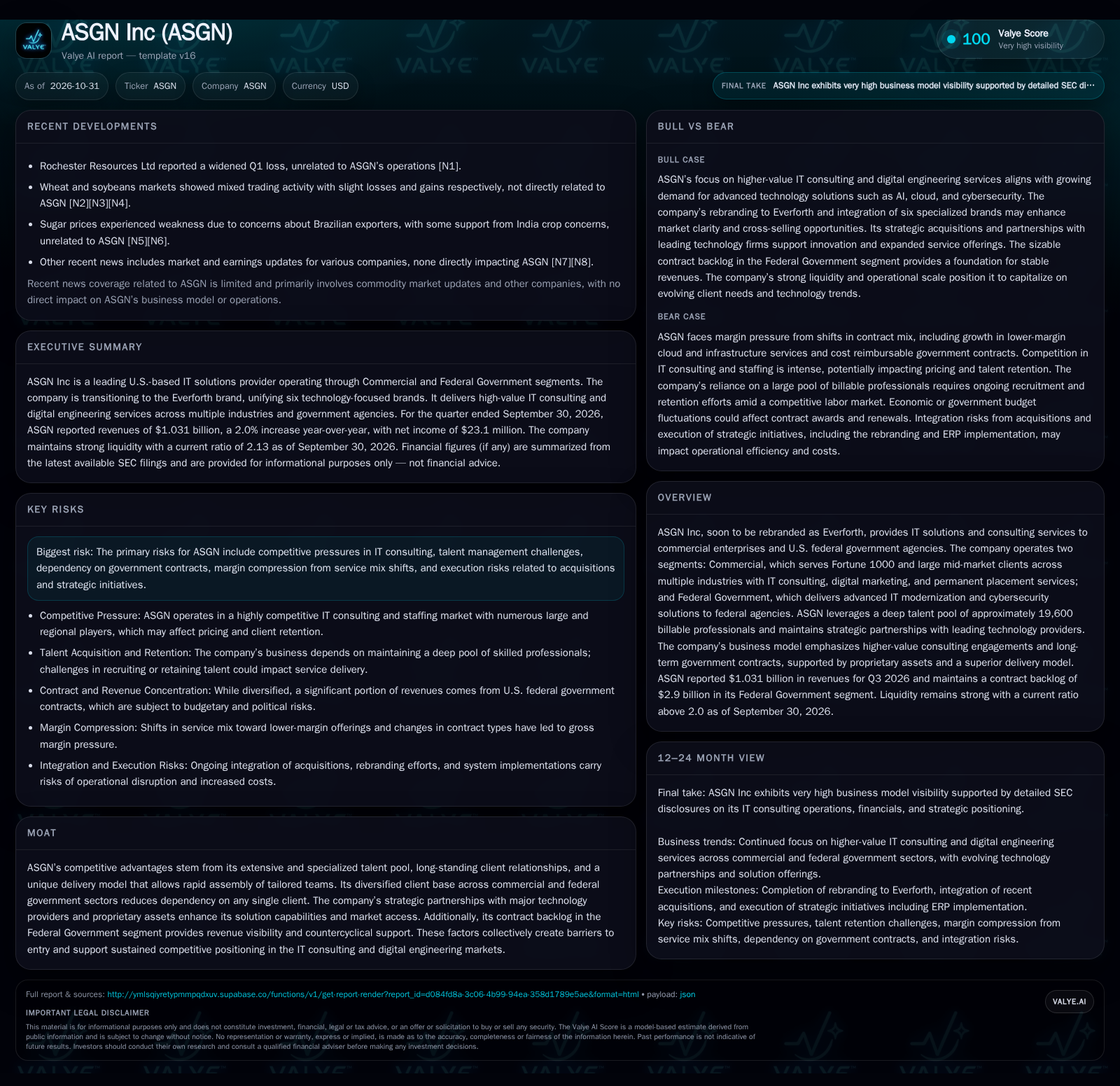
ASGN Inc (transitioning to Everforth) reported flat year-over-year revenues near $3 billion for the first nine months of 2026, with Commercial and Federal Government segments contributing roughly 70% and 30%, respectively. Gross margin fell 110 basis points year-over-year in Q3, reflecting service mix and contract type shifts. The company is executing a major rebranding to unify six brands, with Federal backlog at $2.9 billion and a contract coverage ratio of 2.5:1, supporting revenue visibility but raising questions on margin trajectory and long-term differentiation. [S1] [S2]
ASGN Inc, soon to be unified under the Everforth brand, stands at a strategic crossroads in late 2026. The company operates a dual-engine model: a large Commercial segment serving Fortune 1000 and mid-market clients across six IT solution areas, and a Federal Government business anchored by a multi-billion dollar backlog and long-term contracts. Recent financials show modest top-line growth but significant margin compression, as the business absorbs the impact of evolving contract structures and repositions itself through a major rebranding. The core question is whether Everforth can translate its scale, talent depth, and technology partnerships into sustainable margin expansion and competitive resilience amid intensifying industry headwinds.
Revenue Growth, Margin Compression, and the Everforth Rebrand: What’s Changing Now
ASGN reported $1.031 billion in revenue for Q3 2026, up 2.0% year-over-year, with Commercial segment revenues rising 1.2% and Federal Government revenues up 3.8% [S2]. However, gross margin fell to 28.3%, down 110 basis points from the prior year, and net income declined to $23.1 million from $38.1 million. Management attributes margin compression to shifts in contract mix and service lines, particularly in cloud, infrastructure, and certain federal contract types [S2]. The company is executing a sweeping rebranding to Everforth, consolidating six specialized brands into a unified identity to enhance market clarity and cross-segment integration [S1]. Federal backlog remains sizable at $2.9 billion as of year-end 2025, with a contract coverage ratio of 2.5:1, suggesting continued revenue visibility [S1] [S2]. Liquidity metrics remain stable, including $161.2 million in cash and a current ratio of 2.13 at quarter-end [S2].
Decoding the Economics of Scale and Service Mix in IT Consulting
ASGN’s business model is built on high-value IT consulting and digital engineering solutions, leveraging a workforce of approximately 19,600 billable professionals and 2,800 internal employees [S1]. Revenue is driven by a blend of project-based consulting, recurring services, and permanent placement fees, with the Commercial segment focused on Fortune 1000 and large mid-market clients and the Federal segment anchored by multi-year government contracts.
The revenue mix is critical: Commercial business tends to be more cyclical and competitive, often commanding premium pricing on specialized projects but facing pressure on commoditized services. Federal Government contracts—typically 3-5 years in length—provide revenue stability and countercyclical support, but often at lower margins due to cost-reimbursable and time-and-materials structures.
Gross margin compression in Q3 2026 reflects a higher proportion of lower-margin services, such as cloud infrastructure and certain federal contract types. Fixed costs—primarily internal staff, technology infrastructure, and proprietary tools—enable some operating leverage, but the model remains talent-intensive and variable cost-heavy. Capital needs are moderate, with working capital requirements and occasional technology investments, but no evidence of asset-heavy expansion or material leverage. The key economic challenge is maintaining premium pricing and utilization rates for specialized talent while containing wage inflation and service delivery costs.
Strategic Partnerships and Talent Depth: Barriers and Counterforces in a Crowded Market
ASGN’s competitive positioning is anchored by its deep pool of specialized IT professionals and longstanding relationships with both commercial and federal clients [S1]. The company’s delivery model emphasizes rapid team assembly and tailored solutioning, supported by partnerships with leading technology providers such as AWS, Microsoft, Google, Salesforce, and others [S1]. These relationships enhance solution breadth and credibility, particularly when bidding for complex transformation projects.
However, the IT consulting and staffing landscape is intensely competitive, with global consulting firms, federal IT contractors, and specialized digital agencies all vying for the same talent and contracts. Switching costs for clients may be modest outside of long-term federal engagements, as buyers increasingly seek flexibility, cost efficiency, and multi-vendor ecosystems. The rebranding to Everforth aims to differentiate the company as a unified technology partner, but integration risks and cultural complexity could offset some of these advantages if execution falters.
Substitution risk remains elevated as automation, AI-driven platforms, and offshore delivery models evolve, potentially compressing margins in commoditized service lines. The company’s ability to cross-sell advanced digital solutions and maintain high retention among top talent will be central to sustaining its moat.
If Brand Integration and Technology Partnerships Drive Higher-Value Growth
In a favorable scenario, the Everforth rebranding and brand integration unlock new cross-selling opportunities across both segments, allowing ASGN to win larger, more complex digital transformation contracts. Stronger partnership alignment with cloud hyperscalers and enterprise software providers could position the company as a go-to integrator for AI, data, and cybersecurity solutions—areas of secular demand growth.
Margin expansion would require a sustained shift toward higher-value consulting, proprietary digital assets, and multi-year managed services contracts, reducing reliance on lower-margin, commoditized work. Evidence that would confirm this trajectory includes: a rising proportion of revenue from advanced digital engineering and AI solutions, improvement in gross margin trends, and larger average contract values. Additionally, workforce retention and professional development metrics would need to show improvement, signaling that ASGN is succeeding in both talent engagement and delivery excellence.
Stable Revenue, Mixed Margins: The Most Likely Outcome in 2026–2027
Absent a step-change in commercial win rates or a major shift in federal funding, ASGN is likely to deliver steady revenues with continued modest growth in both segments. The sizable federal backlog and long-term contract structures support revenue visibility, cushioning the business during cyclical softness in commercial demand. However, ongoing margin pressures from contract mix—particularly growth in cost-reimbursable government work and cloud/infrastructure services—may limit near-term profit expansion.
The company’s ability to integrate its six brands under the Everforth banner without major operational disruption will be pivotal. Confirmation of this scenario would include: continued revenue stability, stable or slightly declining gross margins, and limited volatility in headcount or client retention. Any improvement in mix toward higher-value consulting could provide modest upside, while failure to execute on integration or talent retention could drive incremental downside.
Margin Erosion, Talent Friction, and Integration Risk: What Could Go Wrong
A negative scenario could unfold if margin compression accelerates due to persistent mix shifts, wage inflation, or pricing pressure in both segments. Failure to deliver on the Everforth integration—whether due to cultural misalignment, technology disruption, or client confusion—could drive client attrition and internal turnover.
Competitive intensity may further increase as large IT services and consulting firms double down on automation and AI-driven delivery, putting additional pressure on pricing and utilization rates. Federal contract delays, budget cuts, or loss of key accounts would exacerbate revenue and margin volatility.
Downside confirmation would come from further sequential declines in gross margin, negative trends in net income, elevated turnover among billable professionals, and evidence of lost or delayed major contracts. Unexpected working capital needs or project overruns could also pressure liquidity, despite a currently reported balance sheet position.
Milestones and Metrics to Gauge Everforth’s Execution and Resilience
Quarterly gross margin trends and their attribution by segment and service line, to monitor for further compression or early signs of recovery.
Federal Government segment contract wins, backlog replenishment, and changes in contract coverage ratio, as evidence of sustained revenue visibility.
Revenue mix by solution area (e.g., proportion from advanced digital engineering, data, and AI versus lower-margin infrastructure), if disclosed.
Billable professional headcount and voluntary turnover rates, which would indicate success or challenges in talent retention and engagement.
Average contract value and length in both Commercial and Federal segments, as a proxy for solution complexity and client stickiness.
Progress and costs associated with the Everforth rebranding and integration, including any client attrition or operational disruption.
Utilization rates for billable professionals and changes in realized billing rates, if reported, as key levers for margin improvement.
Updates on technology partnership depth and new service launches with major providers (AWS, Microsoft, etc.), as signals of solution expansion.
Disclaimer: This is research-only, informational analysis and not investment advice. It may include AI-generated interpretation and general industry context. Always verify important details using primary sources.

Comments