
Scientist Home Future Health: Proprietary Health Products, Expansion Ambitions, and the Stakes of Channel
Scientist Home Future Health Ltd is attempting to carve out a differentiated position in the Hong Kong health supplement and topical cream market, leveraging proprietary products and integrated physical health centers.
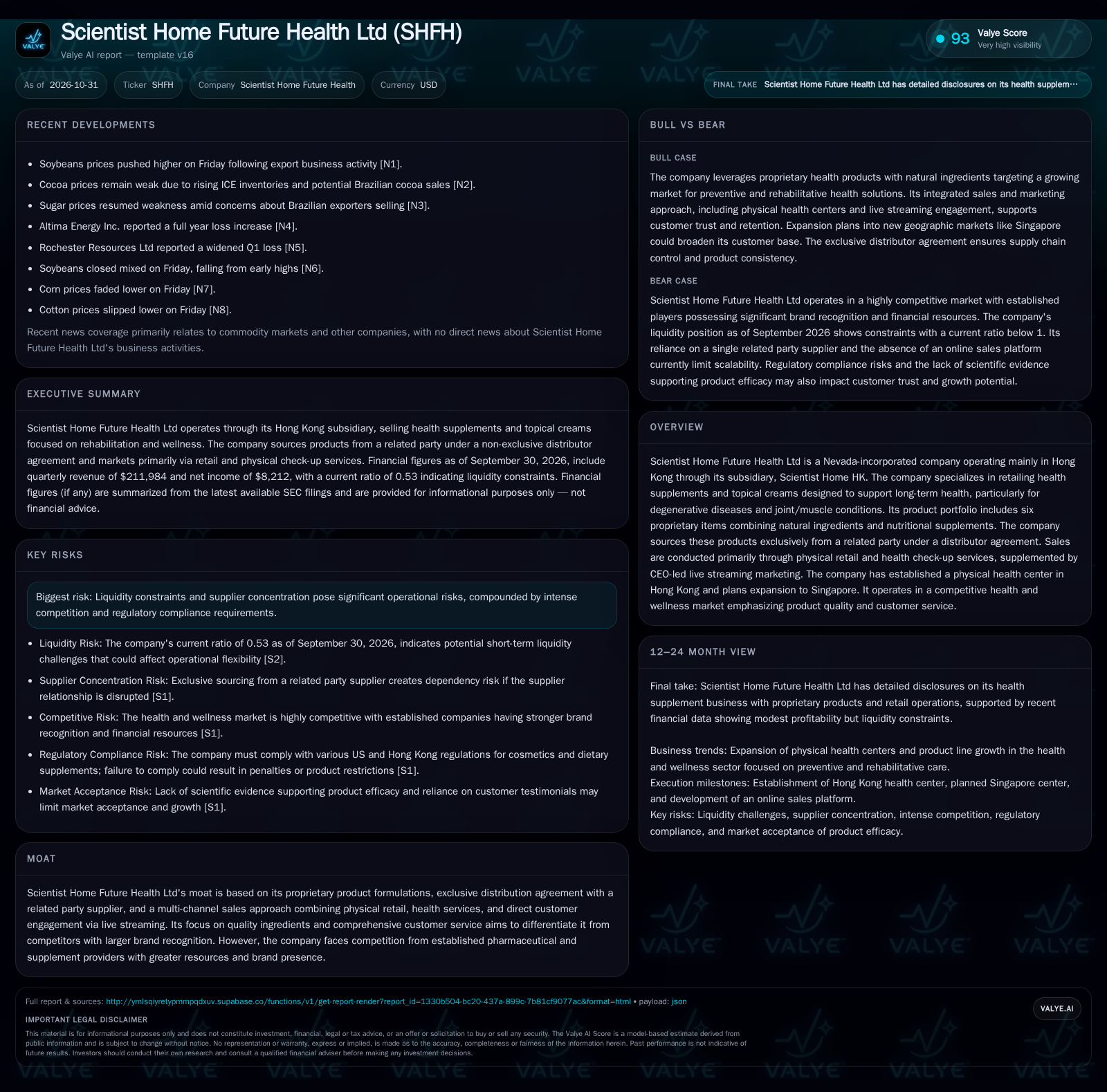
Scientist Home Future Health Ltd sells proprietary health supplements and topical creams through its Hong Kong subsidiary, focusing on degenerative disease rehabilitation and wellness. The company operates a physical health center, plans further expansion, and leverages direct marketing including live streaming.
Scientist Home Future Health Ltd is a newcomer to the competitive health and wellness sector, offering proprietary supplements and topical creams aimed at rehabilitation and preventive care through its Hong Kong subsidiary. As it contemplates geographic and channel expansion, the question is whether its integrated model, differentiated product formulations, and offline customer engagement can offset the operational and competitive headwinds it currently faces.
Recent Financials and Operational Footprint Shape Immediate Prospects
The company reported cash and liquidity metrics for the period; these figures do not by themselves establish operating runway, investment capacity, financial flexibility, or financing capacity. [S2] The company operates through its Hong Kong subsidiary, selling proprietary health supplements and topical creams primarily via a single physical health center established in November 2025. Plans for a Singapore expansion are contingent on additional funding. Product sourcing is entirely from a related-party supplier under a non-exclusive distributor agreement, and no online sales platform exists yet—though it is a stated goal. These facts highlight the company’s early-stage business model, its reliance on offline channels, and a constrained financial profile that could limit flexibility and growth initiatives [S1] [S2].
Revenue Streams, Cost Structure, and the Leverage Challenge
Scientist Home Future Health’s revenue is currently driven by retail sales of proprietary supplements and topical creams as well as physical check-up services at its Hong Kong health center. Pricing power appears limited by intense competition and the lack of unique clinical evidence, suggesting that volume rather than premium pricing will likely be the primary driver of growth. The cost structure is influenced by exclusive sourcing from a related party, which may provide some supply stability but also reduces bargaining flexibility. With only seven employees, fixed costs are currently modest, but payroll and facility expenses are set to rise if geographic or channel expansion occurs.
Operating leverage could improve if the company successfully scales its health centers or launches an online sales platform, allowing incremental sales to flow through with limited additional fixed costs. The company reported a current ratio of 0.53 for the period. The absence of e-commerce means customer acquisition and retention are labor- and facility-intensive, limiting scalability relative to digital-first competitors. If the company can shift more sales online, it could potentially improve gross margins and reduce customer acquisition costs—but this remains a future possibility, not a present reality.
The company’s reliance on a related-party supplier under a non-exclusive agreement introduces a nuanced risk-reward dynamic. While this relationship may facilitate preferential terms or product customization, it also concentrates supply risk, limiting the company’s ability to negotiate price reductions or source alternative ingredients if market conditions shift. Additionally, the absence of vertical integration means that any supply chain disruptions—be it raw material shortages or logistical constraints—could directly impair product availability and revenue continuity. The cost structure, therefore, is not only a function of fixed and variable expenses but also contingent on the stability and terms of this supplier relationship, which could constrain margin expansion as the company scales.
From a revenue perspective, the current physical-only sales approach inherently caps market penetration and customer acquisition velocity. Physical health centers require significant fixed investment and ongoing operational costs, including rent, utilities, and trained staff, which can compress margins if sales volumes do not scale proportionally. The planned online platform, if successfully implemented, could introduce a more variable cost structure with potentially higher gross margins due to lower incremental fulfillment costs and broader geographic reach. However, transitioning to or integrating digital sales channels also demands upfront investment in technology, digital marketing expertise, and customer service infrastructure, which could temporarily pressure profitability before economies of scale are realized.
Navigating a Crowded Wellness Market: Differentiators and Structural Disadvantages
Scientist Home Future Health operates in a highly competitive landscape crowded with established supplement brands, pharmaceutical companies, and local health providers. Its proprietary formulations and direct-to-consumer engagement through live streaming and health centers offer some differentiation, particularly in customer relationship-building and education. However, its lack of brand recognition, absence of clinical trial-backed efficacy, and reliance on offline retail significantly limit defensibility.
Competitors with deeper pockets can outspend on marketing, offer broader product portfolios, and leverage established distribution channels. The exclusive distributor agreement with a related party may ensure product consistency but does not block rivals from accessing similar ingredients or launching competing products. In addition, the planned move into Singapore would expose the company to new regulatory hurdles and entrenched incumbents. The current lack of an online channel leaves the company vulnerable to digital-native brands that can scale rapidly and acquire customers at lower marginal cost.
How Integrated Care and Digital Expansion Could Drive Step-Change Growth
A favorable scenario would see Scientist Home Future Health successfully launch its online sales platform, enabling it to reach a much broader customer base beyond its physical health centers. Coupled with increased customer engagement through live streaming and health education, the company could build a loyal community that values its proprietary products and integrated service approach. Expansion into Singapore, if funded, could diversify revenue and validate the model in a new geography.
Evidence that would confirm this scenario includes a successful online store launch with growing digital sales as a share of revenue, improved operating margins due to greater scale and reduced per-unit acquisition costs, and positive customer retention metrics. A workforce expansion and new center openings, funded without significant equity dilution or debt stress, would further support this narrative. Additional third-party validation—such as positive clinical studies or regulatory approvals—would enhance credibility and pricing power, strengthening the competitive position.
Physical-First Model Sustains Slow Growth Amid Liquidity and Channel Constraints
The most plausible near-term scenario is that Scientist Home Future Health continues to operate primarily through its Hong Kong health center, with incremental growth from local word-of-mouth and live streaming marketing.
Confirmation of this scenario would be continued single-digit revenue growth, maintenance of a small workforce, and slow progress toward Singapore expansion or digital channel launch. A lack of major changes in supplier relationships or regulatory status would further support this steady-state outcome. Falsifying evidence would include a sudden spike in digital sales, a major funding event, or a disruptive regulatory or supplier development.
Liquidity Pressures and Supplier Dependence Threaten Operational Continuity
In an adverse scenario, Scientist Home Future Health’s liquidity constraints intensify, forcing the company to delay payroll, reduce inventory, or curtail marketing and expansion efforts. Reliance on a single related-party supplier could become problematic if the agreement is disrupted or if the supplier raises prices or faces its own operational challenges. The lack of an online channel leaves the company exposed to demand shocks or local competitive pressures that cannot be offset by broader geographic reach.
Evidence supporting this scenario would include declining revenue, negative net income, workforce reductions, or disclosure of overdue payables or supplier disputes. Regulatory setbacks or negative publicity about product efficacy could further weaken customer trust and sales momentum. Inability to secure new funding or renegotiate supplier terms would compound the risk of operational contraction or, in the worst case, business discontinuity.
Testing the Thesis: Expansion, Cash, Channel, and Customer Traction
Progress on launching the online sales platform—timing, functional capabilities, and digital revenue mix—would help test the scalability of the model.
Any new funding events, such as equity raises, debt agreements, or strategic investments, would indicate capacity to execute expansion plans.
Expansion milestones, including the opening of a Singapore health center or additional Hong Kong locations, would serve as tangible indicators of growth execution.
Supplier relationship disclosures—renewal terms, pricing changes, or disruptions—would shed light on concentration risk and supply chain resilience.
Customer acquisition and retention metrics, if disclosed, would help assess the effectiveness of live streaming and physical engagement strategies.
Regulatory developments, such as new compliance requirements or product approvals/rejections, could materially affect market access and trust.
Gross margin trends and per-unit economics, if reported, would illuminate the profitability of scaling through digital versus physical channels.
Disclaimer: This is research-only, informational analysis and not investment advice. It may include AI-generated interpretation and general industry context. Always verify important details using primary sources.

Comments