
Regional Management Corp. in 2026: Credit Risk Leadership, Consumer Finance Economics, and the Stakes of Portfolio Quality
The company’s performance, communication cadence, and risk management infrastructure shape the thesis—but portfolio quality, regulatory exposure, and macroeconomic sensitivity remain central variables.
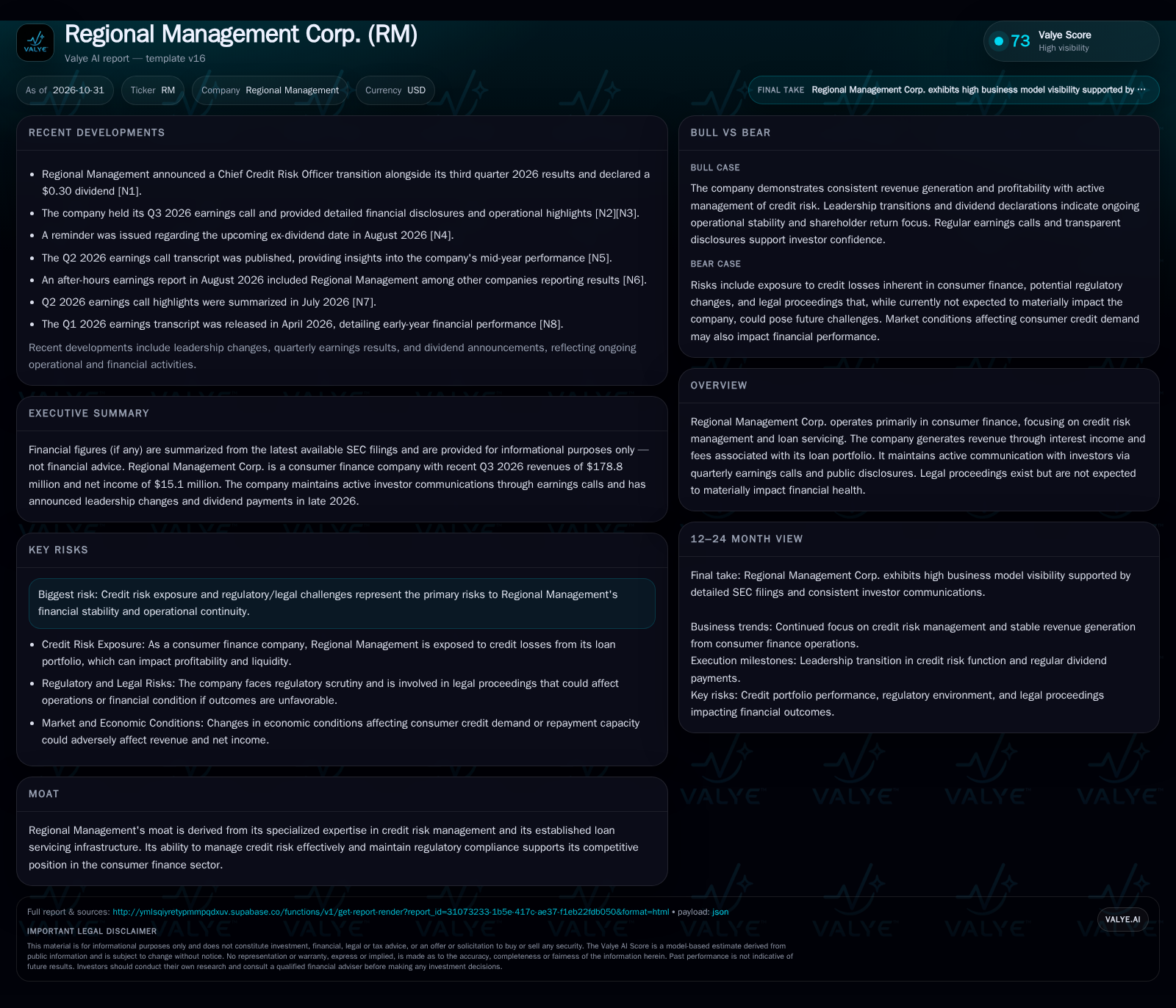
Regional Management Corp. (RM) delivered solid Q3 2026 results with $178.8 million in revenue and $15.1 million in net income, alongside a Chief Credit Risk Officer transition and a $0.30 dividend. The company’s business model is anchored in consumer lending, where disciplined credit risk management, cost of funds, and borrower resilience are vital. The near-term outlook hinges on portfolio performance and regulatory dynamics, with leadership changes and macro conditions as key wildcards. [S2] [N1]
Regional Management Corp. enters the final quarter of 2026 with consistent profitability, reporting $178.8 million in Q3 revenue and $15.1 million in net income. The core investment question is whether Regional Management’s infrastructure, discipline, and adaptability can sustain returns through potential credit cycles and regulatory shifts.
Leadership Change and Financial Performance Define the Current Landscape
Regional Management Corp. reported revenue of $178.776 million and net income of $15.113 million for the third quarter of 2026, translating to diluted earnings per share of $1.61 [S2]. These results reflect continued profitability in a sector where credit risk and cost of capital are persistent headwinds. In parallel, the company announced a Chief Credit Risk Officer transition in October 2026, highlighting an inflection point in risk oversight and portfolio strategy [N1]. The board also declared a $0.30 per share dividend, reinforcing its commitment to returning capital to shareholders [N1]. The cited source reports dividend-related activity; that disclosure alone does not establish dividend-policy continuity, management confidence, or a material constraint on capital flexibility.
How Consumer Finance Economics Drive Regional Management’s Returns
Regional Management’s core business is originating, servicing, and collecting consumer loans, with revenue primarily derived from interest income and associated fees. The fundamental economics rest on the spread between loan yields and funding costs, less credit losses and operating expenses. Pricing power is shaped by risk-based underwriting, customer segmentation, and the competitive landscape. Volume is a function of consumer demand, credit availability, and macroeconomic conditions. Mix considerations—such as secured versus unsecured loans, term structure, and ancillary product attachment—can influence both risk-adjusted returns and regulatory exposure.
Operating leverage is present, but not unlimited: while branch infrastructure and servicing platforms offer some scale benefits, the cost base includes significant variable components tied to loan origination, servicing, and collections. Credit losses are the largest swing factor in profitability, with even modest shifts in portfolio quality having an outsized impact on net income. Capital requirements are meaningful, as consumer lenders must maintain equity cushions and access to wholesale or securitization funding. The cited source reports dividend-related activity; that disclosure alone does not establish dividend-policy continuity, management confidence, or a material constraint on capital flexibility.
An additional dimension to consider is the sensitivity of Regional Management’s loan portfolio to shifts in macroeconomic variables such as interest rates, employment levels, and consumer confidence. For example, rising interest rates could increase funding costs and reduce borrower affordability, compressing net interest margins unless offset by repricing strategies. Conversely, a stable or declining rate environment might support loan demand but could also intensify competition and pressure on yields. Moreover, the geographic and demographic concentration of the loan book can amplify or mitigate these effects, as localized economic downturns or sector-specific shocks may disproportionately impact portfolio performance. Understanding these sensitivities is crucial for assessing the resilience of the business model under varying economic conditions.
Another important factor is the role of technological investment in enhancing operational efficiency and underwriting accuracy. As consumer finance evolves, leveraging data analytics and machine learning can improve risk segmentation, enabling more precise pricing and early identification of credit deterioration. While such investments may increase near-term expenses, they could yield long-term benefits through reduced credit losses and improved customer experience. However, the pace of technology adoption and integration with legacy systems can be a limiting factor, potentially impacting the company’s ability to compete with more agile fintech entrants. Therefore, the balance between innovation and operational stability is a key consideration in evaluating future profitability.
Competitive Moat and the Realities of Consumer Lending Substitution
Regional Management’s competitive position is grounded in its credit risk management expertise and established loan servicing infrastructure. This can create a modest moat in markets where underwriting discipline, regulatory compliance, and branch operations are barriers to entry. However, the consumer finance sector is intensely competitive, with traditional banks, credit unions, fintech lenders, and alternative finance providers all targeting overlapping customer segments. Substitution risk is real: digital lenders may offer faster approval and broader reach, while banks can compete on price and convenience.
Switching frictions for consumers are moderate—borrowers may be sensitive to approval criteria, speed, and perceived fairness, but can shop across multiple providers, especially in non-prime segments. Regulatory scrutiny is a constant, as consumer lending faces evolving state and federal oversight. Regional Management’s transparency in investor communications and regular public disclosures may help build trust with both regulators and customers, but does not fully insulate the business from competitive and regulatory shocks.
If Portfolio Quality Holds and Credit Demand Recovers, Operating Leverage Emerges
In a favorable scenario, Regional Management’s recent leadership transition brings renewed discipline to credit underwriting and portfolio monitoring, resulting in stable or improving asset quality. If macroeconomic conditions support consumer borrowing and repayment capacity—such as low unemployment, stable wage growth, and benign inflation—the company could see modest loan growth with manageable credit losses. Operating leverage would become more pronounced as fixed servicing costs are spread over a larger, healthier loan book.
Evidence of expanded customer acquisition or cross-sell, if disclosed, would further support the upside. Conversely, any sign of rising delinquencies or reserve actions would quickly challenge this scenario.
Most Likely: Credit Cycle Volatility Moderated by Risk Controls and Incremental Growth
The most plausible path is that Regional Management delivers steady but unspectacular results, with credit losses fluctuating within historical ranges and loan growth tracking broader consumer finance trends. The new Chief Credit Risk Officer may refine underwriting and collections, but transformative change is unlikely absent a major macro or regulatory shock.
This scenario would be confirmed by stable net charge-off rates, absence of outsized reserve actions, and modest fluctuations in revenue and net income quarter to quarter. Signs of increased regulatory scrutiny, if disclosed, or abrupt shifts in credit policy would challenge the base case.
A Deteriorating Credit Environment and Regulatory Pressure Could Erode Profitability
In a negative scenario, macroeconomic headwinds—such as rising unemployment, inflation spikes, or consumer stress—drive higher delinquencies and net charge-offs across Regional Management’s loan portfolio. If the Chief Credit Risk Officer transition coincides with operational missteps or delayed risk recognition, losses could accelerate before policy responses are enacted. Regulatory changes, whether federal or state-level, could impose new compliance costs, restrict lending practices, or trigger adverse legal outcomes.
Evidence of this scenario would include a spike in provision for loan losses, dividend suspension or cut, adverse legal developments, or sudden changes in management commentary on credit quality. Early warning signs would be rising early-stage delinquencies, negative earnings surprises, or a shift in funding costs reflecting perceived portfolio risk.
Milestones and Data Points That Will Reveal the Sustainability of Regional Management’s Model
Net charge-off and delinquency rates: Sequential and year-over-year trends in credit losses, if disclosed, are the most direct test of portfolio quality.
Provision for loan losses: Increases or decreases relative to loan growth would signal management’s view of forward risk.
Net interest margin and yield on portfolio: Stability or expansion would indicate pricing discipline and funding cost management.
Loan origination growth and mix: Evidence of sustainable volume growth or shifts toward higher-risk products would materially impact the outlook.
Legal or regulatory developments: Any new proceedings or compliance disclosures could quickly alter the risk/reward equation.
Management commentary on credit environment: Transcripts and earnings calls (if disclosed) will reveal whether leadership sees risk rising or abating.
If disclosed, customer acquisition cost and retention rates: These would help test the efficiency and stickiness of the company’s lending platform.
Disclaimer: This is research-only, informational analysis and not investment advice. It may include AI-generated interpretation and general industry context. Always verify important details using primary sources.

Comments