
Gates Industrial in 2026: Aftermarket Momentum, Innovation Advances, and Industrial Cycle Impacts
Gates Industrial’s Q3 2026 outperformance and raised guidance highlight the resilience of its aftermarket-driven business model, but long-term value creation depends on sustaining product innovation and navigating industrial demand cycles that shape both opportunity and risk.
Gates Industrial posted higher Q3 2026 income and raised its full-year outlook, supported by strong aftermarket revenue streams and new product introductions. However, exposure to industrial demand cycles and competitive pressures remain key variables shaping future performance. Watch for evidence of aftermarket retention, product adoption, and end-market trends as signals of thesis confirmation or risk.
Gates Industrial’s third quarter of 2026 marked a period of financial outperformance and improved guidance, underscoring the company’s ability to leverage its aftermarket orientation and product innovation—even as broader industrial end markets remain unpredictable. With more than a century of brand equity and a portfolio spanning power transmission and fluid power solutions, Gates is positioned to benefit from recurring maintenance cycles and customer reliance on mission-critical components. Yet, the interplay between industrial demand swings, competitive pressure, and the need for ongoing technology leadership will shape whether this resilience translates into sustained shareholder value.
Q3 2026 Results Reflect Strength in Aftermarket Amid Recovery
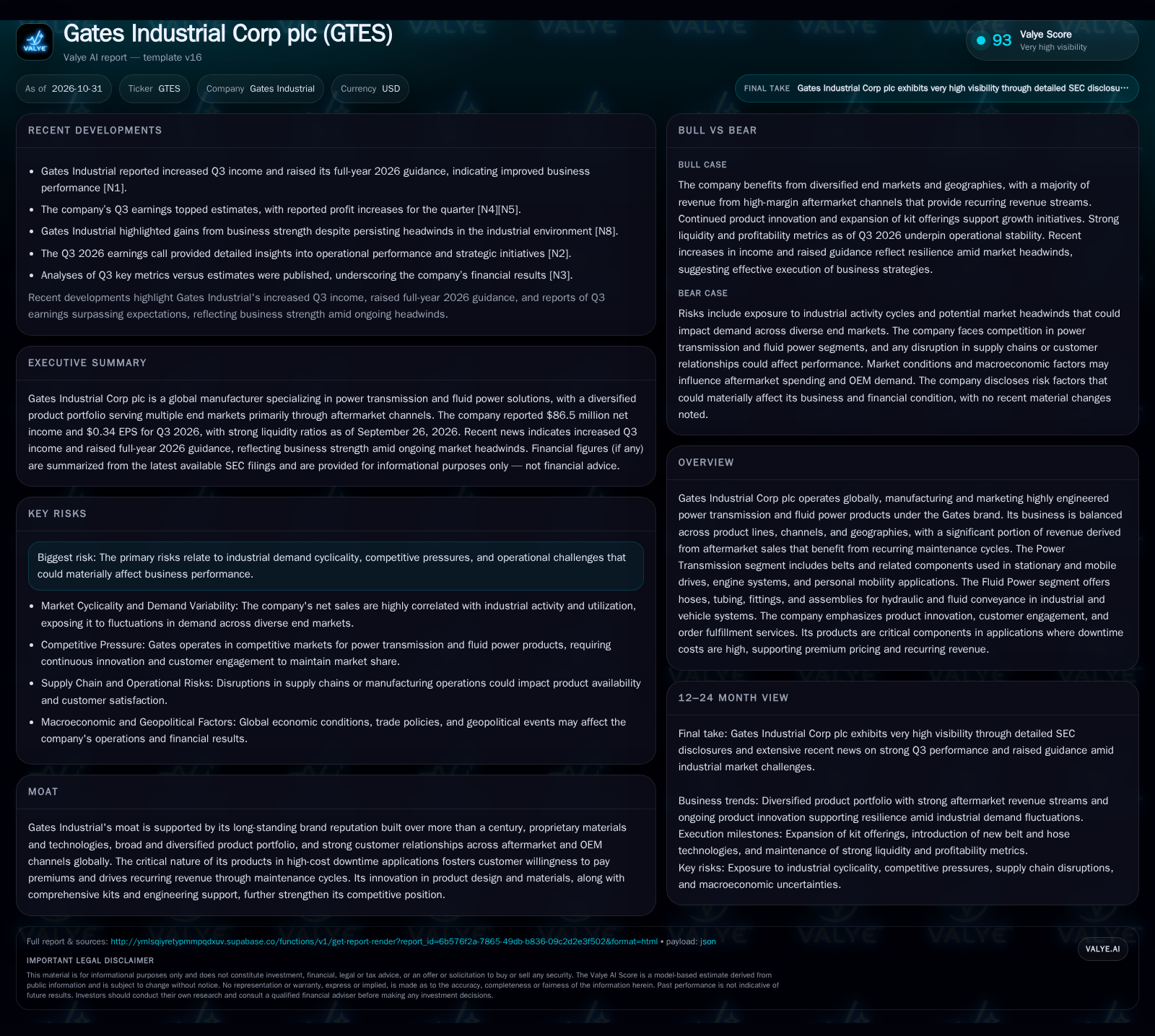
Gates Industrial reported net income of $86.5 million and basic and diluted EPS of $0.34 for the quarter ended September 26, 2026, with cash and equivalents standing at $830.8 million and a current ratio of 3.41 [S2]. The company raised its full-year 2026 guidance following stronger-than-expected Q3 results, attributed to improved business performance and strengthening industrial demand [N1] [N8]. The company reported cash and liquidity metrics for the period; these figures do not by themselves establish operating runway, investment capacity, financial flexibility, or financing capacity.
Gates’ Value Proposition: Recurring Aftermarket Revenue Coupled with Product Innovation
Gates Industrial’s core economics are defined by a high proportion of sales through aftermarket channels, which are typically less volatile than OEM channels and benefit from recurring replacement and maintenance cycles [S1]. This structure supports higher margins, as aftermarket products often command price premiums and face less direct pricing pressure than large-scale OEM contracts. The company’s two main segments—Power Transmission (62% of fiscal 2025 net sales) and Fluid Power (38%)—offer exposure to a wide range of industrial and vehicular applications [S1].
Operating leverage is likely favorable, as fixed costs are spread over a large installed base, and incremental sales—particularly in the aftermarket—can drive margin expansion when volumes rise. Recent product innovations, such as the Quad-Power™ 4 belt and PRO™ Series ProFlex™ hydraulic hose, may enable Gates to defend or enhance pricing, especially where proprietary materials or performance differentiation are valued [S1]. However, the company’s exposure to industrial cycles means that end-market contractions can pressure both volume and mix, with the risk that fixed cost absorption becomes a headwind in downturns.
Capital needs are moderate for a mature, asset-intensive manufacturer, with ongoing investment required to support product development, manufacturing capacity, and supply chain resilience.
Competitive Edge Rooted in Brand Strength, Technology, and Distribution Reach
Gates Industrial’s competitive position is anchored in its century-old brand, proprietary materials and technologies, and broad portfolio across power transmission and fluid power solutions [S1]. Its products are mission-critical in applications where downtime is costly, driving customer willingness to pay for reliability and supporting long-term relationships in both OEM and aftermarket channels. The company’s innovation track record—demonstrated by recent launches such as the CoolRunner™ and G-Force™ CVT belts—suggests an ability to stay relevant as industrial needs evolve.
However, the market for belts, hoses, and related components remains competitive, with global and regional manufacturers offering both branded and generic alternatives. Potential substitutes include new materials, integrated drive systems, or electrification trends that could bypass traditional mechanical components in some applications. Gates’ ability to bundle products, offer kits, and provide engineering support may create switching frictions, but these advantages are not insurmountable if competitors match on innovation or customer service.
Ultimately, the company’s defensibility rests on a combination of brand trust, deep channel relationships, and continued investment in differentiated technologies. If Gates can maintain its premium positioning and defend share in core aftermarket categories, it could continue to out-earn less entrenched rivals.
Growth Potential from Expanding Aftermarket and Accelerating Innovation Uptake
A favorable scenario emerges if Gates leverages its installed base and brand to increase share in high-margin aftermarket categories, while new product launches gain traction and command premium pricing. The causal chain would involve: (1) industrial demand stabilizing or growing, fueling maintenance cycles; (2) successful adoption of innovations like Quad-Power™ 4 and ProFlex™ hoses by both OEMs and aftermarket distributors; (3) cross-selling or bundling of kits could support larger baskets; and (4) disciplined cost control enabling operating leverage.
Evidence that would confirm this scenario includes sustained or accelerating aftermarket revenue growth (if disclosed), positive gross margin trends, rising adoption rates for new products, and customer win announcements or expanded distribution partnerships. Falsification would come from stagnating aftermarket sales, margin compression despite new launches, or evidence of lost share to competitors or substitutes.
Near-Term Outlook Hinges on Industrial Demand Fluctuations
The most plausible scenario is one where Gates tracks the broader industrial macro cycle, with aftermarket sales providing a partial buffer against OEM volatility but not fully offsetting end-market swings. The company continues to introduce new products and defend share, but competitive intensity and input cost fluctuations periodically pressure margins. Incremental gains from innovation are offset by pockets of demand softness, with revenue and profit growth tracking modestly above GDP or industrial production indices.
Confirmation of this scenario would come from stable or gradually rising aftermarket revenue, moderate gross margin improvement, and steady—but not rapid—adoption of recent product launches. Evidence to the contrary would include sharp swings in revenue tied to industrial slowdowns, significant margin erosion, or signs of channel/customer attrition.
Risks from Downturns, Aftermarket Margin Pressure, and Innovation Challenges
A negative scenario could unfold if global industrial demand contracts sharply, reducing both OEM and aftermarket volumes as operators defer maintenance and capital spending. In this environment, competitive pressure might force Gates to discount or lose share, eroding the margin premium associated with its aftermarket business. If recent product innovations fail to achieve market acceptance or are rapidly commoditized by rivals, the company could face a squeeze on both pricing and volume.
Downside confirmation would include declining aftermarket revenue, margin compression, inventory buildups, or news of lost major customer relationships. Additional red flags would be delays or shortfalls in new product rollouts, or evidence of supply chain disruptions impacting service levels.
Factors Influencing the Durability of Gates Industrial’s Aftermarket Advantage
Aftermarket sales growth rate (if disclosed), as this metric would directly test the stickiness and resilience of the replacement-driven revenue stream.
Gross margin trends, especially in relation to new product introductions and mix shifts between aftermarket and OEM channels.
Adoption and sales penetration rates for recent product launches such as Quad-Power™ 4 and PRO™ Series ProFlex™ hoses (if disclosed).
Customer retention or win/loss data in both aftermarket and OEM channels, particularly in regions or segments experiencing volatility.
Inventory and working capital changes, which may signal either demand strength or emerging channel stress.
Updates on end-market demand, especially in sectors like industrial machinery, automotive, and mobile hydraulics where Gates is exposed.
Competitive pricing dynamics and reported actions by key global or regional rivals, as these could pressure Gates’ ability to sustain its premium.
Any disclosed changes in supply chain resilience or input cost pressures, which could affect profitability or service levels.
Disclaimer: This is research-only, informational analysis and not investment advice. It may include AI-generated interpretation and general industry context. Always verify important details using primary sources.

Comments