
Illumina’s Clinical Sequencing Expansion: Growth, Moat, and the Stakes of Execution
Illumina’s raised 2026 guidance and Q3 profitability highlight robust demand in genomics, but future value hinges on deepening clinical adoption, competitive technology cycles, and the execution of its integrated product ecosystem.
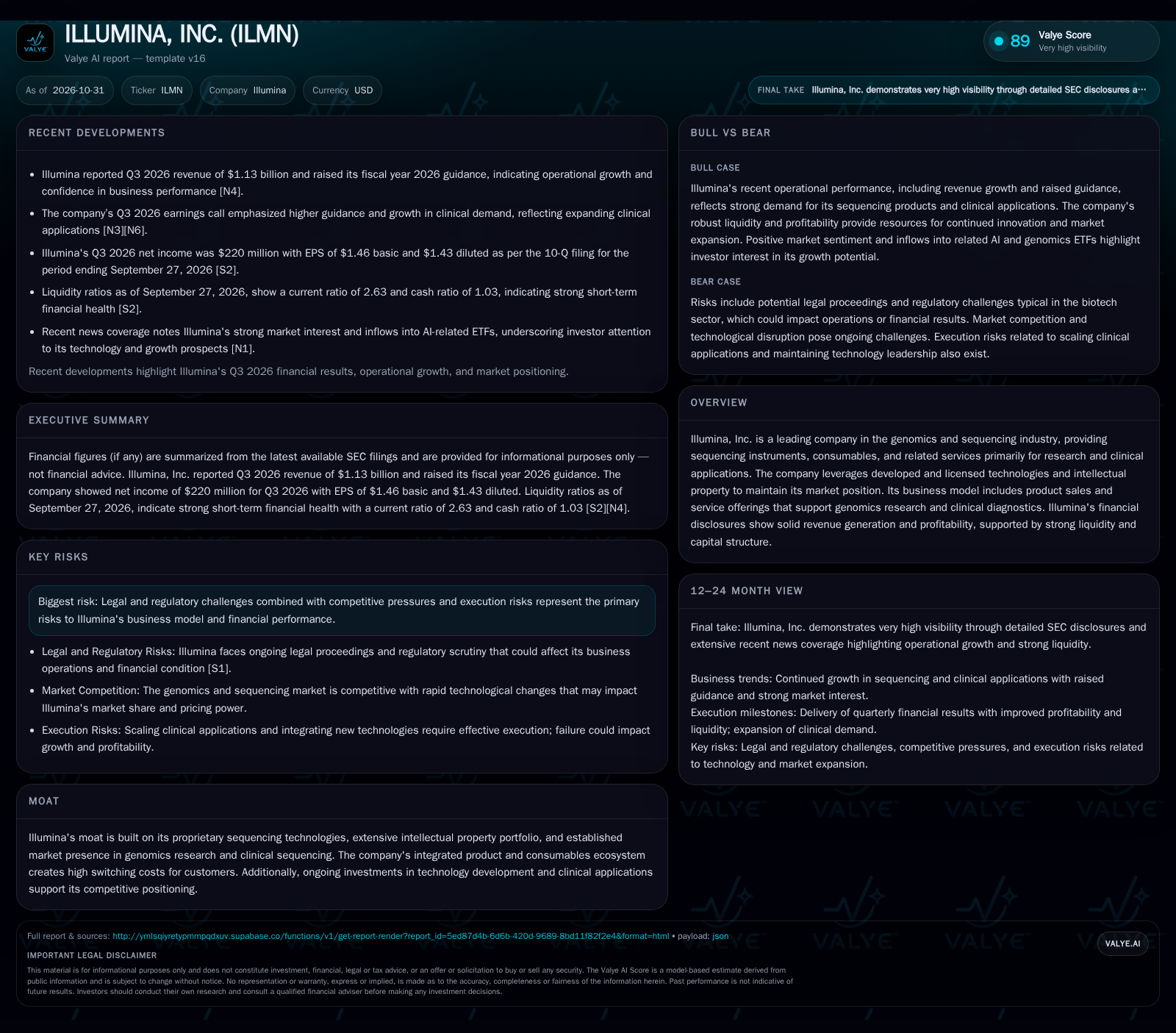
Illumina raised its 2026 guidance after reporting Q3 revenue of $1.13 billion and net income of $220 million, reflecting operational growth and strong profitability. The company’s reported liquidity position, with $1.144 billion in cash and a current ratio of 2.63. Recent calls emphasized expanding clinical demand, but legal, regulatory, and competitive pressures remain material risks. The key question is whether Illumina can sustain its moat and deliver on clinical adoption amid rapid technology change.
However, the next phase of value creation will be determined not just by topline growth, but by Illumina’s ability to defend its technological and ecosystem advantages while navigating regulatory scrutiny and the fast-moving competitive landscape.
Raised Guidance and Clinical Growth: The Latest Operating Inflection
Illumina reported Q3 2026 revenue of $1.13 billion and net income of $220 million, translating to a diluted EPS of $1.43. Management responded to this performance by raising full-year 2026 guidance, citing operational momentum and confidence in ongoing business strength [S2] [N4]. The company’s liquidity profile includes $1.144 billion in cash and a current ratio of 2.63 as of September 27, 2026 [S2]. Notably, recent earnings calls emphasized higher clinical demand as a driver for this upgraded outlook, suggesting that expansion into clinical sequencing is now a visible growth engine [N3] [N6]. These developments matter because they indicate both near-term execution and a potential inflection in the end-market mix, with clinical applications likely increasing as a share of revenue.
Sequencing Economics: Hardware, Consumables, and the Leverage of Installed Base
Illumina’s business model combines sales of sequencing instruments (hardware), recurring consumables, and associated services. While upfront instrument sales generate initial revenue spikes, the economics of the installed base hinge on ongoing consumable usage—often at higher margins and with greater predictability if customers are locked into Illumina’s ecosystem. This model offers the potential for attractive operating leverage: as more instruments are placed, consumables revenue can grow with limited incremental cost. The mix between research and clinical applications may also influence pricing and volume dynamics. Clinical diagnostics typically command higher regulatory scrutiny, but if Illumina succeeds in driving adoption here, per-test volumes and stickiness could rise over time. Capital intensity is moderate; while R&D and manufacturing investments are significant, large recurring consumables revenue can help fund future innovation. Future profitability will depend on maintaining high utilization rates, defending pricing, and expanding the installed base into new clinical domains.
The sequencing business model’s resilience largely depends on Illumina’s ability to maintain a high attachment rate of consumables to installed instruments, which creates a recurring revenue stream with relatively predictable margins. However, this dynamic is sensitive to technological obsolescence and competitive pricing pressures. If alternative sequencing platforms emerge with lower per-test costs or improved throughput, Illumina may face pressure to adjust consumable pricing or enhance value propositions to preserve utilization rates. Additionally, the shift toward clinical applications introduces regulatory complexities that can impact reimbursement levels and adoption speed, potentially affecting consumable volumes. Therefore, sustaining operating leverage requires not only expanding the installed base but also ensuring that consumables consumption per instrument grows in line with clinical testing intensity and complexity.
Moat Mechanics: Intellectual Property, Ecosystem Lock-In, and Technology Cycles
Illumina’s competitive position is rooted in several mutually reinforcing factors: a broad IP portfolio around sequencing technologies, deep integration between instruments and consumables, and a large installed base in both research and clinical labs. These elements create switching frictions for customers, who may face high costs in transitioning to alternative platforms due to workflow disruption and validation requirements. The company’s scale and track record also support its ability to invest in next-generation sequencing and adjacent applications. However, the genomics market remains intensely competitive, with new entrants and established players alike pursuing technological leapfrogs—such as alternative sequencing chemistries, single-molecule techniques, or integration with AI-driven analytics. The key question is whether Illumina can sustain its technology lead and ecosystem advantages as competitors attempt to commoditize hardware or offer open-platform solutions.
Illumina’s moat is reinforced by the high switching costs customers face, which stem from both technical and operational factors. Transitioning to a new sequencing platform often requires extensive validation, retraining of laboratory personnel, and reconfiguration of bioinformatics pipelines, all of which can delay adoption and increase upfront costs. However, this lock-in is not absolute; if competitors develop platforms that significantly reduce total cost of ownership or offer superior integration with emerging clinical workflows, customers may gradually reconsider their options. Furthermore, ecosystem lock-in benefits Illumina only if it continues to innovate across multiple dimensions simultaneously—hardware performance, reagent chemistry, software analytics, and regulatory compliance. A failure to keep pace in any of these areas could erode the perceived value of the integrated solution and weaken customer retention.
Clinical Adoption Accelerates, Driving Compounding Consumables Growth
If Illumina successfully expands its clinical footprint—particularly in oncology, rare disease diagnostics, and population genomics—recurring consumables revenue could accelerate as clinical labs ramp test volumes and require ongoing reagent purchases. Confirmation would come from sustained double-digit growth in clinical segment revenues, new regulatory approvals, and reference lab partnerships. Further, if Illumina’s platforms become the standard of care across major clinical workflows, the company could enjoy durable pricing power and high customer retention. Evidence supporting this scenario would include a rising proportion of revenue from clinical applications, increasing utilization rates per installed instrument, and announcements of multi-year contracts with major healthcare systems or payors. Falsification would be signaled by stagnant or declining clinical growth, customer migration to alternative platforms, or regulatory setbacks delaying adoption.
Sustained Leadership, Incremental Growth, and Competitive Jockeying
The most plausible path is that Illumina maintains its leadership in sequencing, with steady expansion in both research and clinical markets. Revenue growth is supported by a mix of new instrument placements, consumables uptake, and incremental clinical adoption, but competitive pricing and the need for ongoing innovation cap margin expansion. Execution risks—such as regulatory hurdles, integration of new technologies, and customer support—remain manageable but ever-present. Confirmation would be found in continued revenue and EPS growth at or above market rates, stable or modestly improving gross margins, and regular product launches or feature enhancements. Falsification would occur if market share erodes, R&D productivity declines, or legal/regulatory issues materially disrupt operations.
Disruption from Competitors, Regulatory Setbacks, or Clinical Adoption Delays
A negative outcome could result if a competitor launches a disruptive sequencing platform—offering lower costs, superior performance, or open-system flexibility—prompting customers to reconsider Illumina’s ecosystem. Alternatively, regulatory or reimbursement barriers could delay or curtail clinical adoption, especially if payors resist covering new genomic tests or if legal proceedings constrain Illumina’s ability to market key products. Evidence of this scenario would include declining instrument placements, shrinking consumables revenue per installed base, loss of major customer relationships, or adverse regulatory/legal outcomes. Early warning signs could also include pricing pressure, negative margin trends, or a spike in customer churn.
Regulatory setbacks could have a cascading effect beyond delayed clinical adoption, potentially undermining Illumina’s ability to justify premium pricing and maintain consumables volume growth. For example, if regulatory agencies impose stricter validation requirements or limit the scope of approved tests, clinical laboratories might opt for alternative platforms with broader or faster approvals. Additionally, reimbursement challenges—such as payors’ reluctance to cover expensive genomic tests without clear clinical utility—could suppress demand growth even if the technology is superior. In competitive terms, the rise of open-platform sequencing solutions could fragment the market and commoditize key components, eroding Illumina’s pricing power and margins. Early detection of these trends requires close monitoring of instrument placement trends, consumables consumption rates, and customer feedback on platform flexibility and cost-effectiveness.
Milestones and Metrics That Will Shape Illumina’s Value Creation Narrative
Growth rate and share of revenue from clinical applications, especially oncology and population genomics—if disclosed, this would indicate depth of clinical market penetration.
Consumables revenue per installed instrument, which would clarify customer retention, utilization intensity, and the stickiness of Illumina’s platform.
Gross margin trends, reflecting the company’s ability to maintain pricing and cost discipline amid competitive and mix shifts.
Regulatory milestones, such as new assay or platform approvals in major markets, which are prerequisites for clinical adoption expansion.
Updates on legal and regulatory proceedings—any new disclosures that suggest increased risk or possible operational constraints.
Major competitive product launches or customer wins elsewhere in the industry, as these could signal technology leapfrogs or market share threats.
R&D productivity and cadence of new product releases, which would demonstrate Illumina’s capacity to sustain its technology lead.
Capital allocation choices—such as M&A, R&D investment, or share repurchases—would help gauge management’s confidence and strategic priorities.
Disclaimer: This is research-only, informational analysis and not investment advice. It may include AI-generated interpretation and general industry context. Always verify important details using primary sources.

Comments