
RBC Bearings: Aerospace Momentum, Industrial Diversification, and the Stakes of Customer Concentration
RBC Bearings’ recent operational strength is powered by aerospace and defense demand, but the company’s exposure to concentrated customers and cyclical industrial markets shapes the risk profile. The durability of its moat—rooted in engineering integration and long-term OEM relationships—will be tested by competitive pressure, procurement dynamics, and the evolution of end-market capital spending.
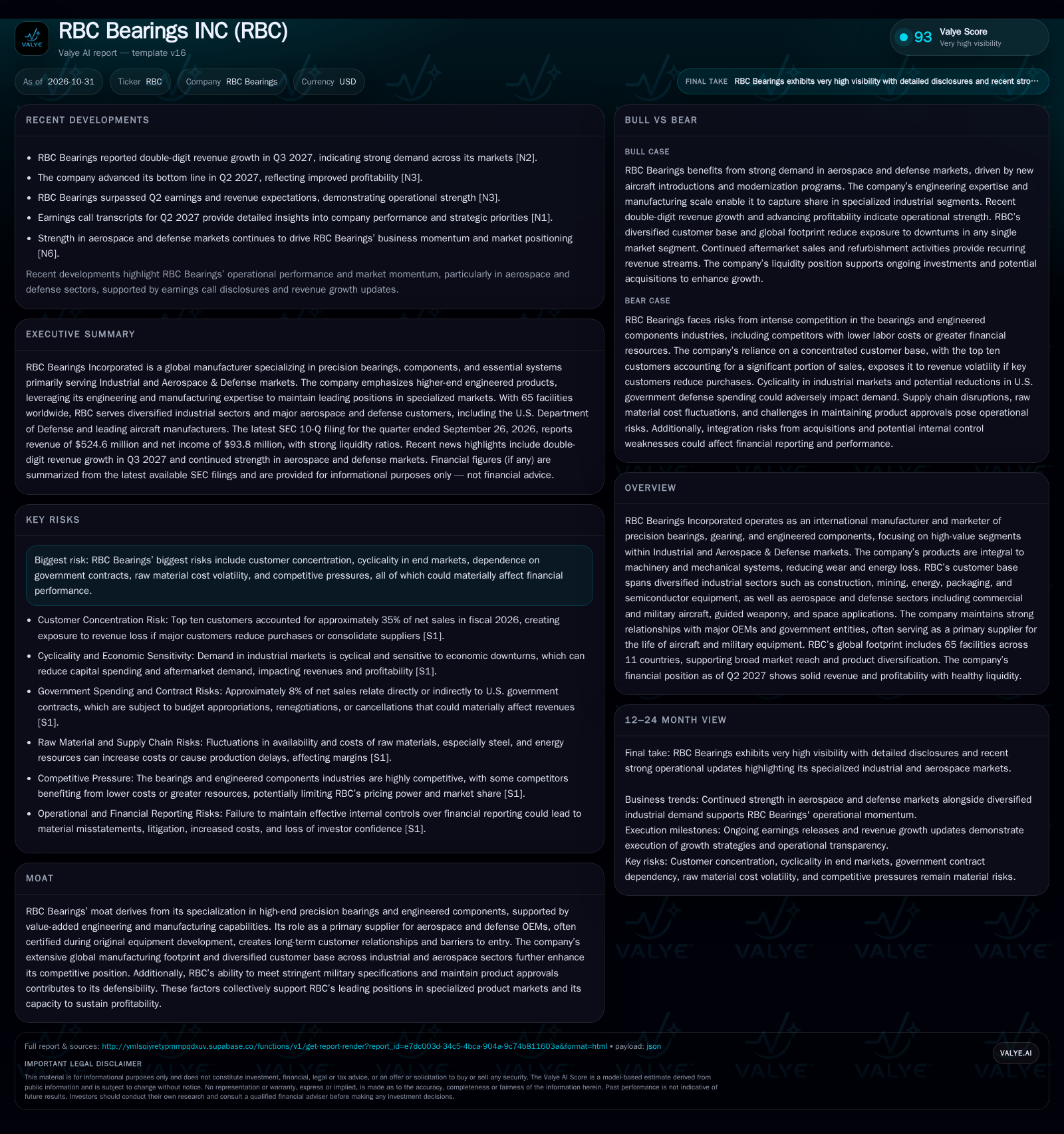
RBC Bearings’ Q2 2027 results highlight robust profitability and revenue outperformance, driven by strength in aerospace and defense. The company’s position as a primary supplier for major OEMs and its global manufacturing footprint underpin its defensibility, but customer concentration and industrial cyclicality remain material risks. The ability to maintain pricing power, secure long-term contracts, and manage input costs will determine whether recent momentum can be sustained amid sector headwinds and shifting procurement strategies. [S1] [S2] [N3] [N6]
RBC Bearings is delivering strong operational results on the back of continued demand from aerospace and defense customers, with Q2 2027 earnings surpassing expectations and reinforcing the company’s reputation for execution in specialized, high-barrier markets. Its global manufacturing network and status as a key supplier to major OEMs provide competitive insulation, but the company’s risk profile is shaped by customer concentration and the cyclicality of industrial demand. The question is whether RBC can sustain its current trajectory as competitive and macroeconomic pressures evolve, especially given its reliance on a handful of large customers and exposure to input cost fluctuations.
Recent Performance Anchored by Aerospace and Defense Demand
RBC Bearings reported Q2 2027 revenue of $524.6 million and net income of $93.8 million, exceeding analyst expectations and reflecting improved profitability [S2] [N3]. This outperformance is attributed largely to strength in the aerospace and defense segment, a trend confirmed by multiple recent sources [N6]. The company’s business mix for the fiscal year ended March 2026 was 58% industrial and 42% aerospace & defense, illustrating meaningful exposure to both cyclical and countercyclical sectors [S1]. [S2] The company’s position as a primary supplier for the life of aircraft platforms continues to support long-term revenue visibility in aerospace [S1].
How RBC Bearings’ Business Model Converts Engineering into Profits
RBC Bearings’ revenue is driven by the sale of highly engineered bearings, components, and systems, with pricing power stemming from technical integration, application-specific design, and qualification processes—especially in aerospace. Products certified during original equipment development often lock in RBC as the primary supplier for the life of an aircraft or system, which can span decades. This dynamic fosters recurring aftermarket sales, particularly in aerospace, where maintenance cycles and refurbishment are critical.
In industrial markets, the company serves a wide array of sectors—ranging from construction and mining to packaging and semiconductor equipment—resulting in a diversified but economically sensitive customer base. Pricing and margins in industrial segments are typically less robust than in aerospace, given lower switching costs and more commoditized competition.
The company’s 65 facilities across 11 countries support both cost leverage and supply-chain flexibility. Fixed manufacturing costs are amortized over long production runs, providing operating leverage as volumes rise. However, variable costs, especially raw materials like steel and energy, can compress margins if not offset by pricing or efficiency gains. Capital requirements are material, given the need for ongoing investment in precision manufacturing equipment and compliance with stringent aerospace and defense standards.
Moat Mechanics: Integration, Qualification, and the Challenge from Lower-Cost Rivals
RBC’s defensibility in aerospace and defense markets is anchored by its deep integration with OEM engineering teams and the lengthy, costly certification processes required for flight-critical components. Once qualified, a supplier is difficult to dislodge due to the regulatory and operational risks associated with switching, creating high switching costs and long-tail aftermarket revenue streams.
In industrial markets, differentiation relies more on engineering support, reliability, and breadth of offering, but competitive pressure is higher. RBC faces competition from both global conglomerates and lower-cost regional players, some of whom may benefit from scale, geographic proximity, or labor cost advantages. While RBC’s broad product line and technical expertise are strengths, price-based competition and procurement-driven vendor consolidation remain persistent threats.
Substitution risk exists in both segments—alternative materials, additive manufacturing, or new drivetrain technologies could, over time, erode the need for traditional bearings or change the supplier landscape. However, the pace of such change is typically slow in mission-critical applications, giving RBC time to adapt.
Aerospace Supercycle and Aftermarket Expansion Drive Sustained Outperformance
The most favorable scenario for RBC Bearings is one in which aerospace and defense demand continues to outpace expectations, fueled by new aircraft introductions, fleet modernization, and robust aftermarket activity. If RBC can deepen its position as a supplier on next-generation platforms and expand its content per aircraft, revenue visibility and margin resilience would increase. Additional upside could come from winning new aerospace programs, capturing more aftermarket share, or successfully leveraging its engineering expertise to expand into adjacent high-value industrial niches.
Confirmation of this scenario would include continued double-digit revenue growth in the aerospace segment, the announcement of new multi-year contracts or sole-source supplier agreements, and evidence of expanding aftermarket sales as a share of total revenue. Margin expansion—especially if gross margin improvement is driven by product mix rather than just volume—would further validate this upside thesis. Evidence against this scenario would include a slowdown in aerospace orders, loss of key program positions, or a shift in procurement strategy among major OEMs.
Navigating Cyclical Industrial Demand Amid Stable Aerospace Platform Revenue
The most plausible medium-term outcome is that RBC Bearings maintains its strong aerospace platform positions while experiencing moderate growth in industrial segments, with periodic headwinds from macroeconomic slowdowns or capital spending pauses. The company’s global manufacturing footprint and broad customer base provide some insulation, but industrial revenues remain exposed to cyclical swings in end-market demand.
In this scenario, aerospace revenue continues to provide a stable foundation, but operating leverage is capped by flat or only modestly growing industrial sales. Margins remain healthy but are pressured periodically by input cost volatility and competitive pricing. Confirmation would include steady aerospace sales, stable or slightly increasing industrial revenue, and manageable fluctuations in operating margins. Falsification would be marked by a sharp drop in industrial orders, material margin compression without a corresponding surge in aerospace, or evidence of customer attrition among key industrial or aerospace clients.
Customer Consolidation, Industrial Downturn, and Input Cost Shocks Threaten Momentum
Adverse outcomes could materialize if major customers reduce orders or consolidate suppliers, a risk given that RBC’s top ten customers account for about 35% of net sales [S1]. A downturn in industrial capital spending—resulting from recessionary conditions or sector-specific weakness—would amplify revenue volatility, particularly if not offset by aerospace strength. Simultaneously, a spike in raw material or energy costs could compress margins if RBC is unable to pass through these increases or achieve offsetting efficiencies.
Additional downside could arise from procurement-driven margin pressure, loss of program positions at key aerospace OEMs, or operational disruptions (including supply chain or quality issues). Confirmation of this scenario would include declining revenue from major customers, margin contraction beyond historical norms, and increased customer concentration risk. Falsification would require evidence of new customer wins, stable or growing sales across both segments, and margin stability despite input cost movements.
Testing the RBC Bearings Thesis: What Will Confirm or Break the Narrative?
Trends in aerospace and defense revenue growth, especially for next-generation platforms and aftermarket services, would clarify the durability of recent momentum.
Disclosure of contract wins, multi-year supplier agreements, or sole-source designations—if provided—would help test the strength of RBC’s moat and revenue visibility.
Changes in customer concentration, such as the share of revenue from the top ten customers, would indicate vulnerability or diversification progress.
Gross margin trends, particularly relative to input cost movements, would reveal the company’s pricing power and cost-control effectiveness.
Industrial segment order rates and backlog (if disclosed) would provide insight into cyclical exposure and near-term revenue risk.
Capital expenditure levels and commentary on investment priorities would indicate management’s posture on growth versus maintenance.
Any disclosure of supply chain disruptions, raw material shortages, or quality/compliance incidents would signal operational risk or resilience.
Movement in working capital—especially inventory and receivables—could provide an early warning of demand or supply chain imbalances if disclosed.
Disclaimer: This is research-only, informational analysis and not investment advice. It may include AI-generated interpretation and general industry context. Always verify important details using primary sources.

Comments