
Atomera’s Licensing Model: Navigating Semiconductor Innovation Cycles and the Adoption Hurdle
Atomera’s proprietary MST technology promises node-like performance gains for semiconductor manufacturers without disruptive capital expense, but capturing recurring royalties hinges on overcoming the notoriously slow and risk-averse adoption cycles of advanced materials in chip fabrication.
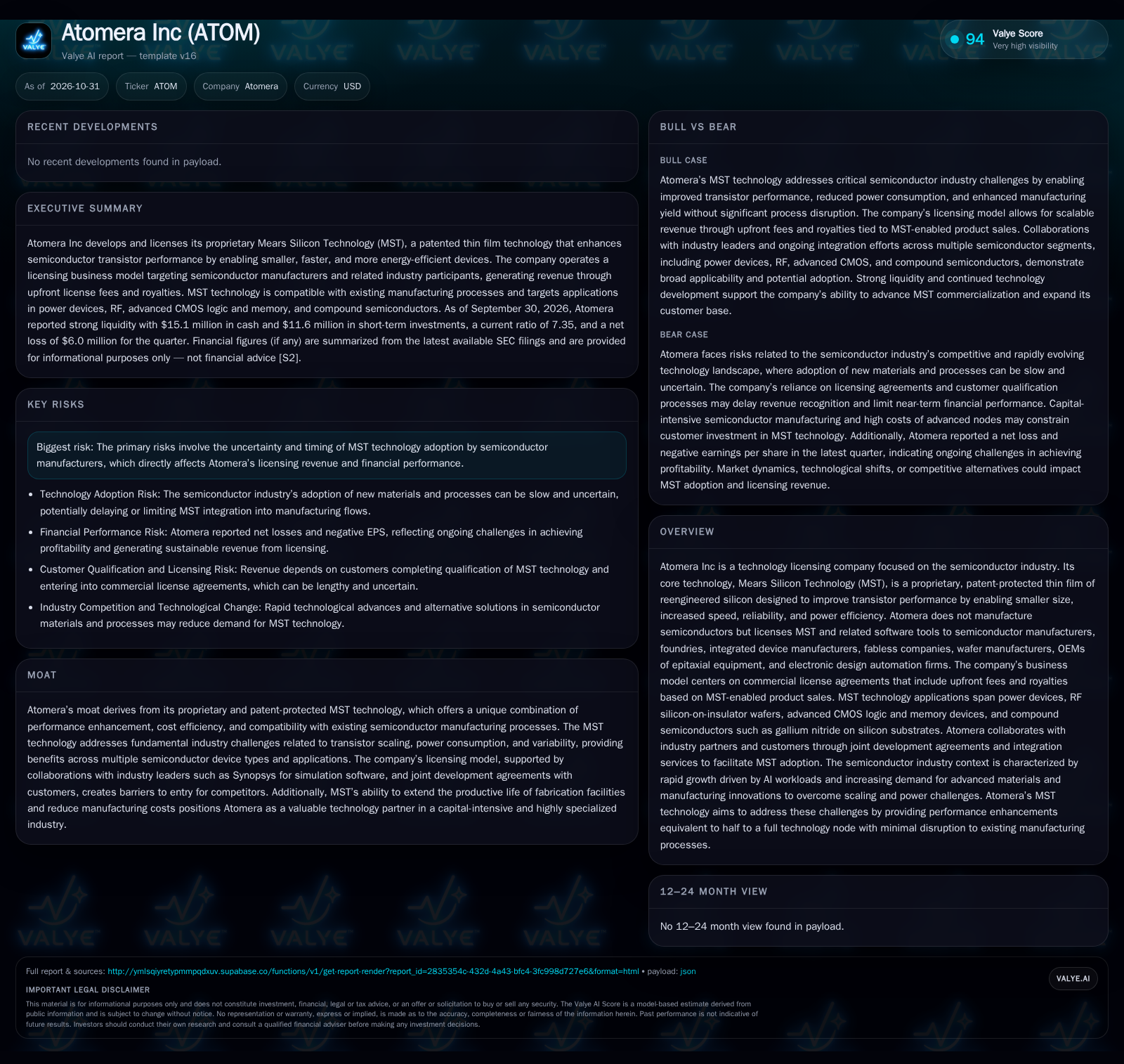
Atomera licenses its Mears Silicon Technology (MST)—a thin silicon film that enhances chip performance—to semiconductor manufacturers, aiming for upfront fees and royalties. Current reported liquidity position, but profitability remains elusive, with a $6M net loss last quarter. The real test is whether MST can move from integration trials to high-volume production, as industry adoption cycles are lengthy and competitive alternatives abound [S1] [S2].
Atomera Inc is positioning its Mears Silicon Technology (MST) as a cost-effective, easily integrated solution for semiconductor manufacturers seeking incremental performance gains amid the slowing pace of Moore’s Law. The company’s licensing-only model avoids the capital intensity of chipmaking, but persistent net losses and lengthy customer qualification timelines highlight the central risk: will MST become a standard feature in next-generation chips, or will it remain in the slow lane of advanced material adoption? The answer will define whether Atomera’s large addressable market translates into recurring, high-margin revenues—or continued struggle for commercial scale [S1] [S2].
Where Atomera Stands: Liquidity, Losses, and the Commercialization Gap
As of September 30, 2026, Atomera holds $15.1 million in cash and $11.6 million in short-term investments, with current assets of $35.4 million and current liabilities of $4.8 million—resulting in a reported current ratio of 7.35 and a cash ratio of 5.54 [S2]. This provides the company with potential financial flexibility for ongoing R&D and business development, but not indefinite runway if commercial inflection remains distant. Atomera continues to report net losses, with a $6.0 million loss and negative EPS (-$0.15) in the recent quarter [S2]. The company’s principal business activity remains the licensing of MST technology, with revenue dependent on upfront fees and royalties from customers moving MST-enabled products into commercial manufacturing [S1]. The company reported cash and liquidity metrics for the period; these figures do not by themselves establish operating runway, investment capacity, financial flexibility, or financing capacity.
How the MST Licensing Model Could Unlock Operating Leverage
Atomera’s economics are fundamentally those of a pure-play intellectual property licensor: low marginal costs, high gross margins once technology is commercialized, and significant operating leverage if MST achieves broad adoption. Revenue is structured as a mix of upfront R&D or installation fees (for qualification and integration) and ongoing royalties from high-volume manufacturing (HVM) licenses once MST is deployed in commercial chip production [S1]. This model minimizes capital intensity and inventory risk; Atomera does not build or operate fabs, nor does it carry the working capital burden of hardware inventory.
However, the path to scale is nonlinear. The licensing model’s strength—scalability and high margins—relies entirely on customers moving from internal evaluation to multi-generation, multi-fab deployment. The industry’s risk aversion and qualification complexity mean that even promising technology can remain in pilot phases for years. Atomera’s MST, while compatible with existing processes and promising node-like improvements, must clear not only technical but also economic adoption hurdles. If MST is proven to deliver yield, performance, or cost gains that outweigh licensing and integration fees, royalties could scale rapidly with little incremental cost. Otherwise, Atomera’s cost base (R&D, engineering support, SG&A) will continue to outpace revenue.
Assessing Atomera’s Position in a Crowded, Cautious Semiconductor Ecosystem
Atomera’s competitive proposition is built on proprietary, patent-protected MST technology that can be integrated into existing semiconductor manufacturing flows with minimal disruption [S1]. This compatibility, together with performance enhancements equivalent to a half-to-full technology node, is a meaningful selling point for manufacturers facing diminishing returns from traditional scaling. MST’s value is strongest where customers seek incremental improvements without the capital outlay or risk of a full node transition.
However, Atomera faces both direct and indirect competition. Alternative materials, process enhancements, and design-level optimizations are all vying for a share of manufacturers’ limited attention and R&D budgets. Large EDA and process-equipment firms, as well as in-house R&D at major foundries and IDMs, represent entrenched interests. Switching frictions are significant: qualifying new materials in high-volume environments is slow, expensive, and carries yield risk. MST’s additive nature and software simulation collaborations (e.g., with Synopsys) may lower some barriers, but the commercial question is whether MST’s benefits are sufficiently differentiated and non-disruptive to break through this inertia.
If MST Becomes a potentially leading Industry Standard: The Flywheel of Royalty Scale
The most attractive scenario for Atomera is one in which MST is validated by multiple leading semiconductor manufacturers, incorporated into high-volume manufacturing flows, and becomes a standard feature for next-generation power, RF, or CMOS devices. In this world, Atomera’s upfront fees are dwarfed by recurring royalties as MST-enabled chips are produced at scale across multiple fabs and product families. The company’s operating model would deliver high gross margins and positive cash flow, with minimal incremental cost to support new licensees.
Evidence that would confirm this scenario includes public announcements of high-volume manufacturing (HVM) licenses, visible MST-enabled product launches by major customers, and a step-change in recognized royalty revenue. Additional confirmation would come from disclosures of multi-year, multi-product commercial contracts, and a rapid increase in the number of customers moving from pilot to production phases. Falsification would be signaled by continued delays in qualification, lack of HVM deals, or customer attrition after pilot phases.
Most Likely Trajectory: Incremental Progress, Extended Timelines
The most plausible scenario is that Atomera continues to make incremental progress: securing new R&D and integration agreements, moving select customers through pilot and qualification phases, but with the majority of revenue still coming from upfront fees rather than material royalties. This reflects the semiconductor industry’s slow adoption cycles for new materials and the rigorous qualification needed for high-volume production.
Confirmation of this scenario would include a steady cadence of new evaluation agreements, periodic but modest increases in upfront or integration revenue, and slow growth in royalty streams. Falsification would be indicated by either a sudden acceleration into HVM agreements (moving toward the upside scenario) or stagnation in customer pipeline and partnership activity (moving toward the downside).
Prolonged Qualification, Competitive Displacement, and Cash Runway Compression
In the adverse scenario, Atomera struggles to convert pilot or R&D licenses into high-volume commercial agreements. Customers either fail to qualify MST, find insufficient incremental benefit, or opt for internal or competing solutions. The result is a business stuck in perpetual evaluation mode, with revenue insufficient to offset ongoing R&D and SG&A costs. As cash burn continues, Atomera’s liquidity cushion erodes, forcing either dilutive capital raises, cost cuts, or strategic pivots.
Evidence confirming this downside path would include persistent net losses, little or no royalty revenue growth, repeated mentions of extended customer qualification timelines, and declining cash reserves. Further negative signals would be customer exits, competitive technology adoption, or industry shifts that render MST’s value proposition less relevant. A falsification of the downside would be any material inflection in commercial licensing activity or royalty revenue.
Milestones That Will Define MST’s Commercial Trajectory
Public disclosure of high-volume manufacturing (HVM) license agreements, especially with major semiconductor manufacturers, would be a leading indicator of commercial inflection.
Growth in recognized royalty revenue—distinct from upfront or integration fees—would directly test whether MST has moved into production-scale adoption.
The number of customers progressing from R&D or pilot phases to commercial qualification (if disclosed) would help gauge conversion efficiency in the sales funnel.
Customer concentration metrics, or diversification of the licensee base across geographies and market segments, would indicate resilience and breadth of adoption.
Updates on MST-enabled product launches or public endorsements by leading foundries/IDMs would validate the technology’s perceived value.
Trends in cash burn relative to revenue growth, and the timing of any needed capital raises, would reveal the strain or sustainability of Atomera’s operating model.
Competitive announcements regarding alternative materials or process technologies, and any resulting customer churn, would test MST’s differentiation and stickiness.
Disclosures about the impact of the MSTcad software partnership with Synopsys—such as increased customer engagement or improved integration timelines—would clarify the value-add of Atomera’s broader offering.
Disclaimer: This is research-only, informational analysis and not investment advice. It may include AI-generated interpretation and general industry context. Always verify important details using primary sources.

Comments