
nVent Electric: AI Data Center Demand, Backlog Strength, and the Stakes of Execution in Specialty Electrical Infrastructure
nVent Electric’s $2.6 billion backlog and expansion into AI data center cooling position it for growth, but execution and cyclical exposure remain pivotal. This analysis explores the business’s economic drivers, competitive landscape, and scenario logic as the company scales its specialized electrical solutions.
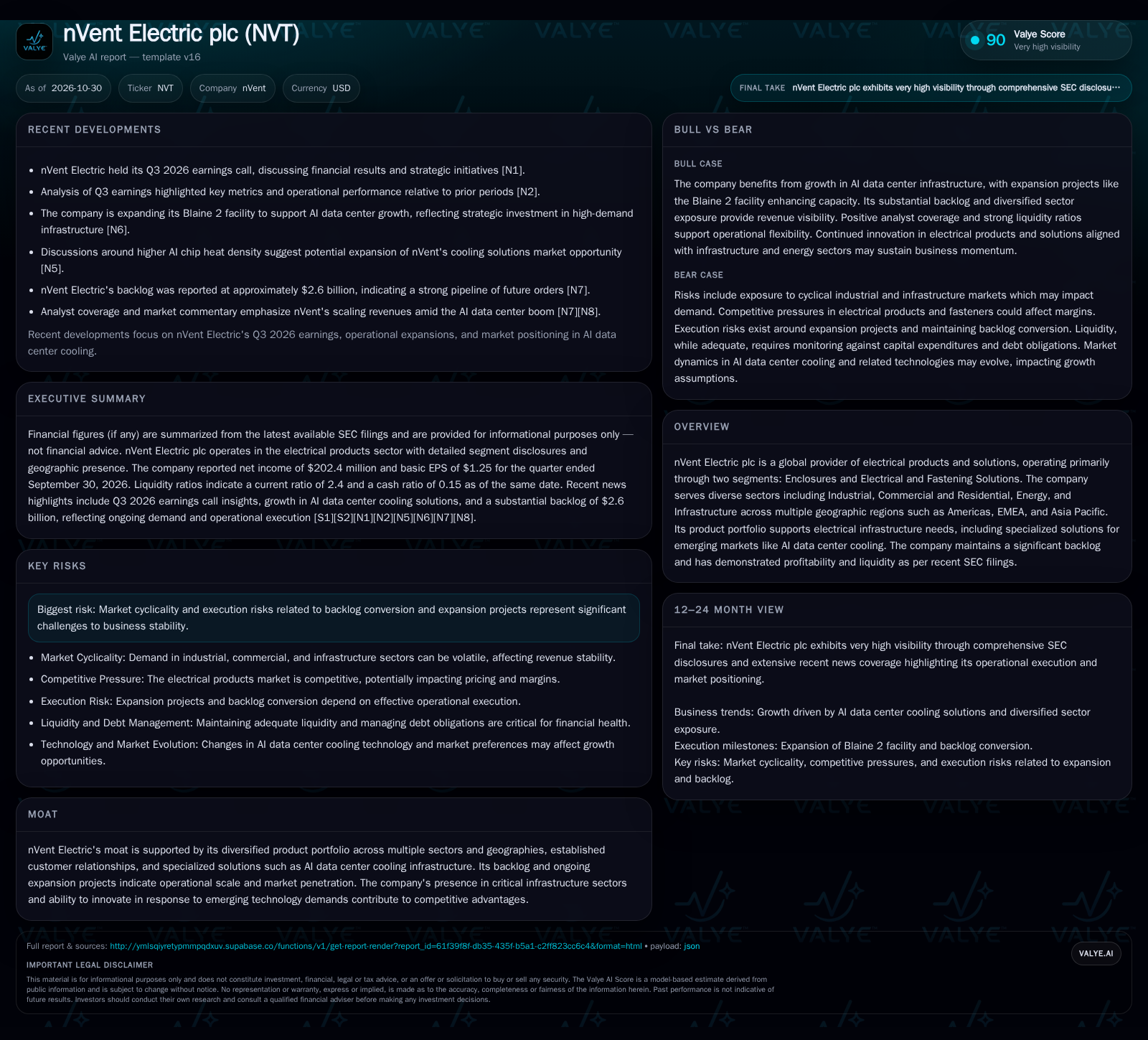
nVent Electric’s strong backlog, ongoing Blaine 2 facility expansion for AI data center cooling, and broad sector exposure suggest revenue visibility and growth potential. However, execution risks and exposure to cyclical end markets create meaningful uncertainty, particularly around backlog conversion and sustaining margin strength as competition and technology evolve. Watch backlog trends, AI project wins, and margin trajectory for thesis confirmation or challenge. [S1] [S2] [N5] [N6] [N7]
nVent Electric stands at a strategic crossroads as demand for AI data center infrastructure reshapes the electrical products landscape. With a $2.6 billion backlog and targeted investments like the Blaine 2 facility expansion, nVent is positioned to capitalize on specialized cooling and electrical solutions for next-generation data centers. The company’s profitability and diversified sector reach provide near-term stability, but execution on backlog conversion, margin sustainability, and adaptation to rapid technology shifts will determine whether nVent can convert its pipeline into durable economic advantage.
Backlog, Profitability, and Expansion Define nVent’s 2026 Position
As of October 2026, nVent Electric reported a $2.6 billion backlog, underlining strong demand and a significant pipeline of future orders. This backlog spans industrial, commercial, energy, and infrastructure sectors, reflecting the company’s diversified end-market exposure. [N7]
Net income for the quarter ended September 30, 2026, was $202.4 million, with basic earnings per share of $1.25, demonstrating ongoing profitability. [S2]
The company is actively expanding its Blaine 2 facility to meet demand from AI data center cooling solutions, signaling a strategic push into a high-growth niche. [N6]
The company reported cash and liquidity metrics for the period; these figures do not by themselves establish operating runway, investment capacity, financial flexibility, or financing capacity. [S2]
How nVent Makes Money: Segment Dynamics and Operating Leverage
nVent’s revenue model is anchored in two core segments: Enclosures and Electrical and Fastening Solutions, supplying products essential for electrical infrastructure across industrial, commercial, energy, and data center applications. The company’s economics are driven by a mix of project-based and ongoing infrastructure demand, with product breadth allowing for cross-selling and specification-driven sales.
Pricing power is often tied to the complexity, customization, and mission-critical nature of solutions—particularly in sectors like AI data centers, where specialized cooling or enclosure systems can command premium pricing if they demonstrably solve high-density heat or reliability challenges. However, much of the broader electrical products market remains competitive and subject to price-based procurement, limiting pricing flexibility outside niche solutions.
Volume drivers include capital expenditure cycles in end-markets, regulatory and code changes, and secular infrastructure upgrades. The growing AI data center segment introduces a higher-margin, potentially more resilient demand stream, but its scale relative to legacy industrial and commercial volumes is still emerging.
Operating leverage exists as nVent scales production and leverages fixed infrastructure, but the capital intensity of facility expansions (such as Blaine 2) and the need to maintain inventory and working capital across geographies can temper free cash flow conversion, especially if backlog conversion slows or mix shifts unfavorably.
Specialization, Diversification, and the Challenge from Substitutes
nVent’s competitive position is built on a diversified product portfolio, established customer relationships, and technical credibility in sectors where reliability and safety are non-negotiable—such as data centers and critical infrastructure. Its ability to innovate around emerging needs, like AI chip heat density, enhances its value proposition in fast-evolving segments. [N5]
However, the electrical products and enclosures market is fragmented, with numerous global and regional players offering standard and customized solutions. Scale advantages matter for procurement and distribution, but low switching costs and procurement-driven purchasing in commodity categories keep pricing pressure high.
Substitution risk arises from both incumbent rivals and new entrants leveraging modular or integrated solutions, as well as from adjacent technologies (e.g., advanced building automation or alternative cooling technologies) that could bypass traditional enclosure or fastening needs. The question is whether nVent’s investments in innovation and facility expansion can stay ahead of these shifts and maintain specification advantage with large customers.
If AI Data Center Demand Accelerates and Backlog Converts Efficiently
The most favorable scenario for nVent is one in which AI data center infrastructure investment continues to surge, driving sustained demand for advanced cooling and enclosure solutions with premium pricing and margin uplift. The successful expansion and ramp-up of the Blaine 2 facility would enable nVent to capture a greater share of this high-growth market, turning backlog into accelerated revenue and operating leverage.
In this case, strong backlog conversion, margin expansion, and further customer wins in AI and infrastructure would confirm the thesis. Evidence would include sequential backlog growth, rising gross margin percentage, and new contract announcements tied to major data center projects.
Diversified Exposure Supports Stability, but Execution Remains Central
The most plausible path is that nVent continues to benefit from a diversified sector footprint and steady backlog conversion, with AI data center growth providing a tailwind but not fully insulating the company from cyclical swings in industrial and infrastructure demand. Expansion projects like Blaine 2 are executed on schedule, supporting incremental growth without major margin volatility.
Confirmation would come from stable order intake, backlog maintenance or modest growth, and steady to modestly improving margins. If backlog conversion lags, or if AI-related orders plateau, the base scenario could see revenue growth moderate and margin expansion flatten, but without a sharp reversal.
Cyclical Weakness or Execution Missteps Undermine Backlog and Margins
A negative scenario would see a slowdown in industrial or infrastructure capital spending, reducing order intake and leading to backlog depletion. If the AI data center wave proves less durable, or if nVent faces execution challenges in scaling its new facility or integrating new product lines, revenue growth could stall or reverse.
Downside confirmation would be visible in shrinking backlog, missed expansion milestones, margin compression from price competition or cost overruns, and increased pressure on working capital. A sharp rise in debt or constrained liquidity to support ongoing projects could further amplify risks.
What Will Determine Whether nVent Converts Its Pipeline into Durable Advantage?
Backlog trends: Quarterly changes in total backlog and book-to-bill ratios would help assess demand sustainability and order momentum, especially in AI and infrastructure verticals.
Backlog conversion rate: If disclosed, the speed at which backlog is converted into revenue is critical for testing operational execution.
Gross and operating margin trajectory: Margin expansion or compression, especially in the context of facility ramp-up and product mix shifts, would clarify pricing power and cost control.
AI data center project wins: Announcements of new contracts or partnerships in the AI data center vertical would indicate continued penetration and customer validation.
Capital expenditures and project timelines: Monitoring capex related to Blaine 2 and other expansions, as well as actual versus planned commissioning dates, will test execution reliability.
Order intake by segment and geography: Segment- and region-specific order trends, if disclosed, would help attribute growth to end-market or geographic drivers.
Disclaimer: This is research-only, informational analysis and not investment advice. It may include AI-generated interpretation and general industry context. Always verify important details using primary sources.

Comments