
TXNM Energy: Capital Intensity, Regulatory Headwinds, and the Stakes of Modernizing a Regulated Utility
The company’s future will hinge on its ability to secure timely cost recovery, adapt to declining per-customer electricity usage, and maintain operational resilience in a changing energy landscape.
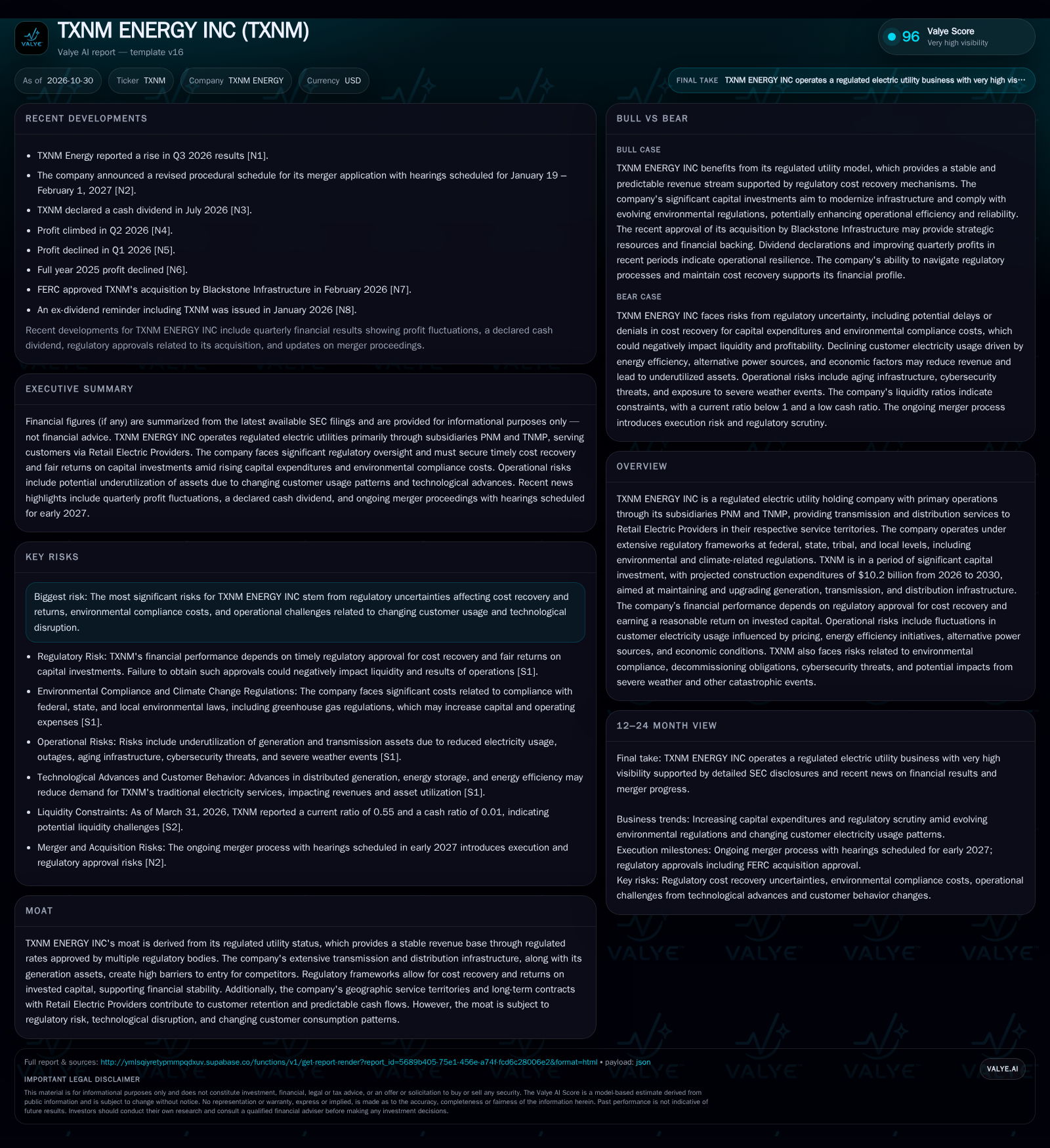
TXNM Energy is entering a capital-intensive phase, planning over $10 billion in infrastructure investment through 2030. Dividend continuity and recent profit improvements suggest resilience, but downside risks are elevated if cost recovery lags or demand falls further. [S1] [S2] [N1] [N3]
TXNM Energy stands at a strategic crossroads as it commits to an ambitious $10.2 billion infrastructure program over the next five years. With its regulated utility subsidiaries PNM and TNMP, the company’s fortunes are closely bound to regulatory approval for cost recovery and the economic realities of shifting electricity demand. Liquidity is currently tight, raising the stakes for execution and timely rate relief. Amid these constraints, TXNM’s ability to modernize its grid, manage environmental compliance, and respond to technological and customer behavior changes will determine whether it can deliver stable returns or faces margin compression and operational strain.
Why TXNM’s Next Five Years Will Set Its Strategic Trajectory
TXNM Energy is embarking on a $10.2 billion capital expenditure program between 2026 and 2030, focused on maintaining and upgrading its electric transmission, distribution, and generation infrastructure. This investment cycle is occurring in the context of declining customer electricity usage—driven both by energy efficiency measures and increased adoption of alternative power sources—which could reduce throughput and strain asset utilization. The company reported a current ratio of 0.55 for the period. Despite these constraints, TXNM has declared recent dividends and reported improved profits in Q2 and Q3 2026, signaling a degree of operational resilience even as it prepares for major capital outlays. [S1] [S2] [N1] [N3]
Beyond the immediate capital intensity and liquidity considerations, TXNM must also navigate evolving regulatory expectations around environmental and social governance (ESG) factors. Increasingly, regulators and stakeholders demand transparent reporting on sustainability initiatives and resilience planning, which can influence rate case outcomes and public perception. If TXNM can proactively integrate ESG criteria into its capital planning and operational strategies, it may strengthen its regulatory positioning and access to capital. Conversely, failure to meet these emerging standards could invite regulatory scrutiny or delays, compounding financial and operational risks.
Capital Investment, Rate Recovery, and the Economics of a Regulated Utility
TXNM’s revenue model is anchored in regulated transmission and distribution services, which typically provide stable cash flows through cost-of-service rate structures. These structures allow recovery of prudently incurred costs and a regulated return on invested capital, but only if regulatory bodies (such as NMPRC and PUCT) approve timely rate increases. The planned $10.2 billion in capital expenditures will increase the company’s rate base, but also heighten exposure to regulatory lag—the delay between investment and recognition in customer rates. If cost recovery is slow or denied, TXNM could see margin compression and balance-sheet stress.
The scale of planned investment means fixed costs will rise, increasing operating leverage. If customer demand remains flat or declines, per-unit costs could increase, pressuring profitability. Conversely, efficient project execution and favorable regulatory outcomes could yield higher allowed returns. The company’s capital needs are significant, and with low liquidity, external financing will be essential, potentially at higher interest rates given current market conditions. Variable-rate debt further exposes TXNM to interest rate risk. Ultimately, the company’s economics will be shaped as much by regulatory and capital market environments as by its own operational execution. [S1] [S2]
The interplay between capital investment and regulatory approval creates a timing risk that can significantly affect TXNM’s financial health. Regulatory lag not only compresses margins but can also distort investment incentives, potentially leading to underinvestment or misallocation of capital if the company anticipates delayed recovery. Moreover, the structure of rate cases—such as the use of formula rates versus traditional rate cases—can influence the predictability and speed of cost recovery. If regulatory frameworks evolve to incorporate performance-based ratemaking or decoupling mechanisms, TXNM’s revenue stability could improve by reducing dependence on volumetric sales, thus mitigating the impact of declining customer usage.
Regulatory Barriers and Emerging Substitutes: Defining TXNM’s Competitive Moat
As a regulated utility, TXNM’s primary moat is its exclusive franchise over transmission and distribution within its territories—an advantage protected by regulatory barriers that prevent direct competition. The company’s extensive grid infrastructure and long-term relationships with Retail Electric Providers create high switching costs and customer stickiness. However, the moat is not invulnerable: technological advances in distributed generation (rooftop solar, battery storage), energy efficiency, and demand response are eroding traditional load growth and shifting value away from centralized utilities.
Peer competition is less about traditional rivals and more about the pace at which alternative energy providers and new technologies can substitute for grid-delivered power. Regulatory mandates around renewable integration and environmental compliance also force TXNM to adapt or risk stranded assets. The company’s ability to work constructively with regulators and proactively invest in modernization will determine whether its moat remains robust or narrows under external pressure. [S1]
TXNM’s competitive moat is also contingent on its ability to innovate within the constraints of a regulated environment. For instance, investments in advanced grid technologies—such as smart meters, automated distribution management, and integrated energy storage—can enhance operational efficiency and customer engagement. However, the regulatory approval process for such investments can be complex and time-consuming, requiring robust cost-benefit justification. If TXNM can demonstrate that modernization efforts reduce long-term costs and improve reliability, it may secure more favorable regulatory treatment and reinforce its franchise value. Failure to innovate, however, risks accelerating customer defection to alternatives and regulatory pressure to divest or restructure.
How Timely Rate Relief and Grid Modernization Could Unlock Shareholder Value
If TXNM secures prompt regulatory approval for cost recovery on its capital program, the resulting increase in rate base could drive higher allowed earnings and long-term dividend capacity. Successful execution of infrastructure upgrades—particularly those that enable grid resilience, renewable integration, and operational efficiency—could mitigate the impact of declining per-customer usage and position the company for a constructive regulatory relationship.
Signs that would confirm this scenario include expedited regulatory dockets with minimal disallowances, improved allowed ROEs, consistent dividend growth, and evidence that capital projects are completed on time and within budget. If customer attrition to alternative providers slows or stabilizes, and TXNM is able to demonstrate grid reliability and value-added services, its long-term cash flows could exceed current expectations. [S1] [N1] [N3]
Managing Through Tight Liquidity and Slow Demand—A Plausible Operating Reality
The most likely outcome is that TXNM experiences a mix of regulatory wins and delays, with some cost recovery lag and moderate disallowances on its capital program. Customer electricity usage continues to decline incrementally, offset in part by rate increases and cost control. The company remains operationally resilient, but tight liquidity requires careful working capital management and ongoing reliance on external financing.
Dividend continuity is preserved, but growth is modest. Profitability fluctuates quarter to quarter based on timing of rate cases, fuel costs, and weather-driven demand swings. Capex proceeds as planned, but the company’s balance sheet remains stretched, and future rate relief becomes increasingly important to avoid credit stress. Confirmation of this scenario would come from steady, if unremarkable, financial performance, stable (but low) liquidity ratios, and regulatory filings that reflect incremental, rather than transformative, progress. [S1] [S2] [N1] [N3]
When Regulatory Lag and Demand Erosion Combine to Stress the Model
The adverse scenario materializes if regulatory bodies delay or deny significant portions of TXNM’s requested rate increases, leaving the company unable to fully recover its capital outlays. If distributed generation and energy efficiency accelerate more rapidly than expected, customer usage could fall sharply, resulting in underutilized infrastructure and higher per-unit costs.
In this case, liquidity tightens further, forcing asset sales, dividend cuts, or dilutive capital raises. Operational risks—such as outages, cyberattacks, or severe weather—compound the financial strain, especially if deferred maintenance or underinvestment becomes necessary. Signals confirming this downside would include extended regulatory proceedings, rate case disallowances, rising debt service costs, declining dividend payouts, and adverse revisions to earnings guidance. [S1] [S2]
Benchmarks for TXNM: What Will Test the Investment Thesis Over the Next 24 Months
Progress and outcomes of rate case filings, including the size and timing of cost recovery approvals for major capital projects.
Quarterly customer usage volumes and trends in average revenue per customer—if disclosed—to gauge the impact of energy efficiency and distributed generation.
Execution metrics for the $10.2 billion capex plan: on-time, on-budget delivery, and any project deferrals or overruns.
Regulatory developments related to environmental compliance and mandates for renewable integration.
Incidence and financial impact of operational disruptions, such as outages, cyber events, or weather-related damage.
Updates on the merger application process and potential implications for capital structure or regulatory strategy.
Disclaimer: This is research-only, informational analysis and not investment advice. It may include AI-generated interpretation and general industry context. Always verify important details using primary sources.

Comments