
Adamas Trust, Inc.: Mortgage REIT Dynamics, Proprietary Origination, and the Stakes of Active Risk Management
Recent results show operational consistency, yet sustained value creation depends on dynamic risk management and market adaptation.
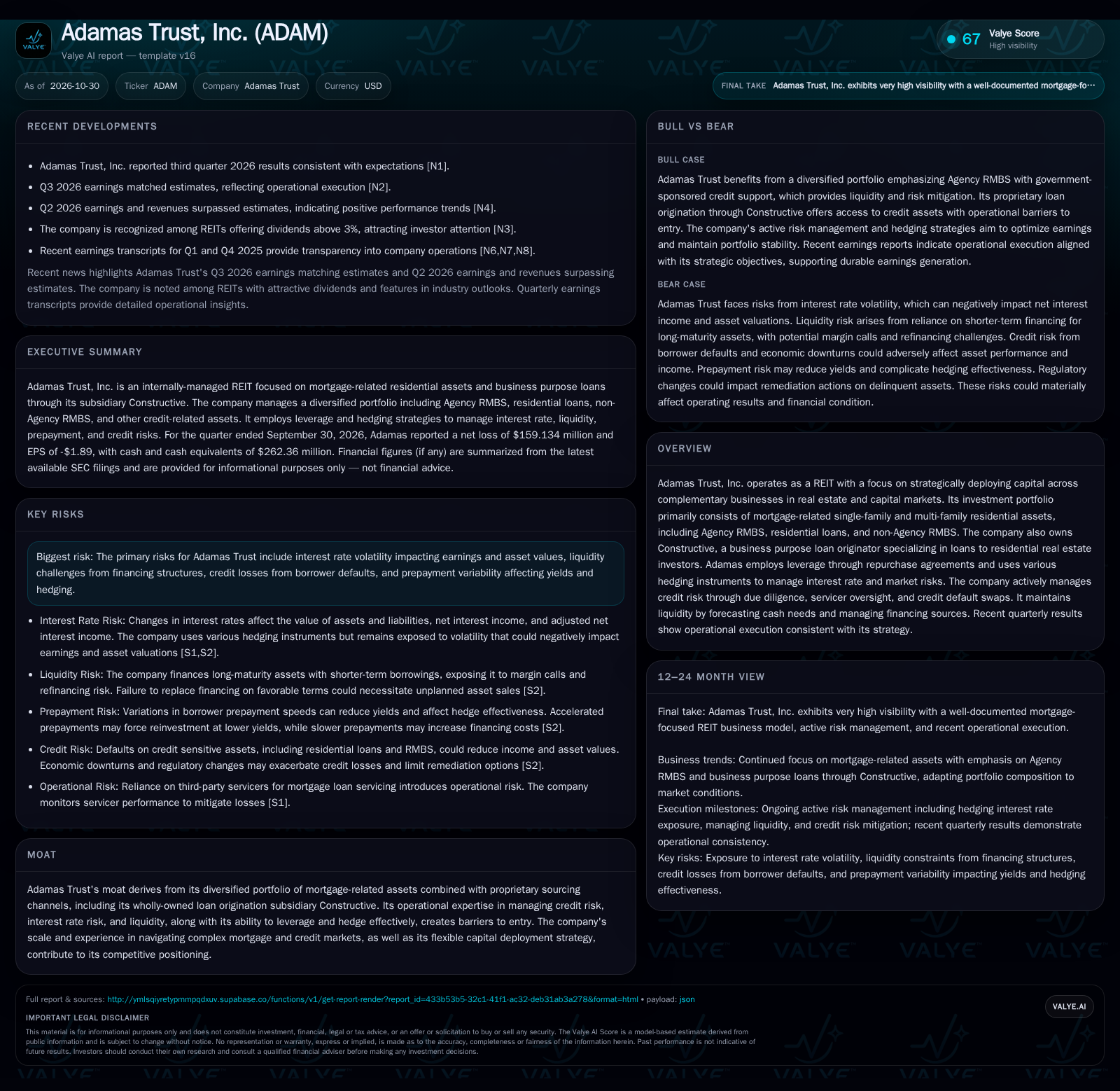
Adamas Trust, Inc. operates as a mortgage-focused REIT with a portfolio spanning Agency and non-Agency RMBS, residential loans, and a proprietary loan origination platform. Q3 2026 results aligned with expectations, but the company posted a net loss of $159.1 million. Its business model leverages short-term borrowing against long-duration assets, requiring robust hedging and liquidity management. The path forward hinges on navigating interest rate shifts, refinancing risks, and credit performance, especially as market volatility persists. [S2] [N1] [N2]
Adamas Trust, Inc. stands out among mortgage REITs by pairing a diversified book of Agency and non-Agency mortgage assets with a proprietary business-purpose loan origination arm. While its Q3 2026 results met expectations and reflect disciplined execution, the company reported a significant net loss, underscoring the sector’s susceptibility to interest rate spikes, credit swings, and structural liquidity mismatches. The central question is whether Adamas’s active risk management and flexible capital deployment can consistently generate value amid persistent market volatility and evolving macroeconomic headwinds. [S2] [N1] [N2]
Recent Results Reveal Operational Discipline, but Losses Highlight Structural Exposures
For the quarter ending September 30, 2026, Adamas Trust reported a net loss of $159.134 million and earnings per share of -$1.89, alongside cash and cash equivalents totaling $262.36 million. While Q3 results matched analyst estimates and were consistent with management’s operational focus, the scale of the loss underscores the inherent volatility and risk embedded in mortgage REIT business models, particularly during periods of rising rates or spread widening. [S2] [N1] [N2]
The company’s portfolio remains anchored in Agency RMBS, non-Agency RMBS, residential loans, and business-purpose loans sourced via Constructive, its wholly-owned origination subsidiary. This portfolio strategy offers diversification but also exposes Adamas to a complex set of credit, interest rate, and liquidity risks that require active management. [S2]
Recent quarters have demonstrated execution in line with expectations, but the persistence of net losses raises questions about the sustainability of the current model under adverse macro conditions. [N1] [N2] [N4]
How Adamas Trust’s Earnings Engine Works: Leverage, Spread, and the Reinvestment Challenge
Adamas Trust generates income primarily from the spread between yields on its mortgage-related assets and the cost of its funding, which is predominantly short-term borrowing such as repurchase agreements. Agency RMBS, which benefit from government-backed credit support, typically offer lower yields but reduced credit risk, while non-Agency RMBS and business-purpose loans present higher yields alongside greater credit and liquidity risk.
The company’s business-purpose lending platform, Constructive, provides proprietary access to higher-spread assets, potentially enhancing portfolio returns if credit performance is strong. However, originating and holding these assets increases exposure to idiosyncratic borrower risk and market illiquidity during downturns.
Operating leverage is present, as fixed costs are spread over a large asset base, but the model’s core variable is net interest margin—highly sensitive to both funding costs and asset yields. The use of derivatives and hedging is designed to buffer earnings from rate moves, yet imperfect hedges, prepayment variability, and refinancing needs can compress margins or force asset sales at unfavorable prices.
Capital needs are ongoing: leverage amplifies returns but also risk, and maintaining liquidity to meet margin calls or refinance maturing debt is a persistent operational imperative. If asset values decline or financing becomes scarce, the company may be forced to deleverage, crystallizing losses and impairing future earnings potential.
Portfolio Breadth, Origination, and Active Management: Can Adamas Defend Its Turf?
Adamas Trust’s competitive edge centers on its diversified exposure across Agency and non-Agency mortgage assets and its ability to originate business-purpose loans through Constructive. This gives it access to a wider range of risk-return profiles and potentially proprietary loan flow not available to pure-play Agency REITs.
Barriers to entry include the operational complexity of managing credit and interest rate risk across multiple asset types, regulatory compliance, and the infrastructure required to originate and service loans. Scale and experience in navigating mortgage markets may enable more opportunistic capital deployment, especially during periods of market dislocation.
However, these advantages are contested by larger, more specialized REITs, mortgage banks, and private credit funds with deeper capital bases, technological underwriting advantages, or lower-cost funding. The commoditization of Agency RMBS and crowding in the business-purpose lending space could erode margins over time.
Substitution risk is material: rising rates or tighter credit conditions may push investors toward other yield vehicles (such as direct private credit or structured products), while regulatory changes could alter the economics of mortgage origination and securitization. The company’s ability to maintain an information or sourcing edge—especially in its proprietary lending activities—will be critical to preserving above-market returns.
If Risk Management Outperforms: Pathway to Sustainable Earnings and Opportunistic Growth
The most favorable scenario for Adamas Trust is one where active interest rate hedging, disciplined credit selection, and proprietary origination combine to preserve net interest margins and limit credit losses, even as market volatility persists. In this scenario, the company could deploy capital into dislocated asset classes at attractive yields, using its liquidity and origination platform to capture spread opportunities missed by less nimble peers.
Confirmation of this scenario would come from a return to consistent positive net income, stable or improving book value per share, and evidence that portfolio yields remain resilient even as funding costs fluctuate. Additional signs would include expansion in Constructive’s origination volumes with low delinquency rates and the maintenance of reported liquidity position through refinancing cycles.
Falsification would be signaled by continued net losses, deteriorating asset quality, or forced asset sales at losses due to liquidity constraints. A shrinking origination pipeline or rising credit impairments would also undermine the upside thesis.
Navigating Volatility: Managing Through Cycles Without Structural Breakout
The most plausible trajectory for Adamas Trust is continued operational execution—actively managing portfolio composition, hedging, and liquidity—while earnings remain volatile and sensitive to external market conditions. The company is likely to adjust asset mix and leverage in response to shifts in funding costs, prepayment speeds, and credit trends, seeking to avoid outsized losses while opportunistically growing or shrinking the balance sheet.
In this scenario, net income may recover intermittently but is unlikely to show strong, sustained growth unless market volatility abates or new revenue streams emerge from proprietary origination. Book value may remain stable or drift downward if mark-to-market losses persist. The company’s ability to absorb shocks without forced deleveraging or significant asset impairments will be a key test.
Evidence supporting this scenario would include continued alignment of reported results with management guidance, maintenance of liquidity buffers, and stable or only modestly fluctuating net interest margins. Evidence against would include a sudden increase in margin calls, accelerating credit losses, or regulatory changes that impair core business lines.
Adverse Rate Shocks or Credit Deterioration: How Losses Could Compound
A negative scenario for Adamas Trust would involve a combination of sharp interest rate increases, widening credit spreads, or a deterioration in residential credit quality. In this environment, the company could experience a dual squeeze: asset values would decline, triggering margin calls or forcing asset sales at losses, while borrowing costs rise and net interest income contracts.
If business-purpose loans originated by Constructive underperform—due to, for example, a housing downturn or spike in investor defaults—credit losses could compound, further eroding book value and capital. Liquidity risk would be heightened if counterparties pull back or demand more collateral, potentially leading to a downward spiral of asset sales and realized losses.
Confirmation of this downside would be visible in sequentially worsening net losses, a sharp drop in book value, reported breaches of financing covenants, or evidence of distressed asset disposals.
Milestones and Metrics That Will Shape the Adamas Trust Thesis
Quarterly net income and EPS trends: Is the company moving toward sustainable profitability, or are losses persisting or deepening?
Book value per share progression: Does book value stabilize or recover, or is it being eroded by mark-to-market losses and credit impairments?
Net interest margin and spread analysis: Are core earnings protected against funding cost increases, or is margin compression accelerating?
Origination volume and credit quality of Constructive’s loan book: Does proprietary origination drive incremental returns without disproportionate credit risk?
Leverage ratios and financing composition: How much risk is being taken, and is the balance sheet positioned defensively or aggressively?
Prepayment speeds and hedging effectiveness: Are prepayment dynamics undermining yield assumptions or hedge performance?
Regulatory changes or macroeconomic shocks: Are there new external forces altering the economics of mortgage origination, securitization, or REIT operations?
Disclaimer: This is research-only, informational analysis and not investment advice. It may include AI-generated interpretation and general industry context. Always verify important details using primary sources.

Comments