
BUUU Group Ltd: Share Structure Reset, Ongoing Losses, and the Stakes of Strategic Opacity
BUUU Group’s 10-for-1 share split and reported liquidity position set the stage for potential capital market maneuvers, but persistent losses and a lack of operational disclosure leave investors with little clarity on business fundamentals or long-term value creation.
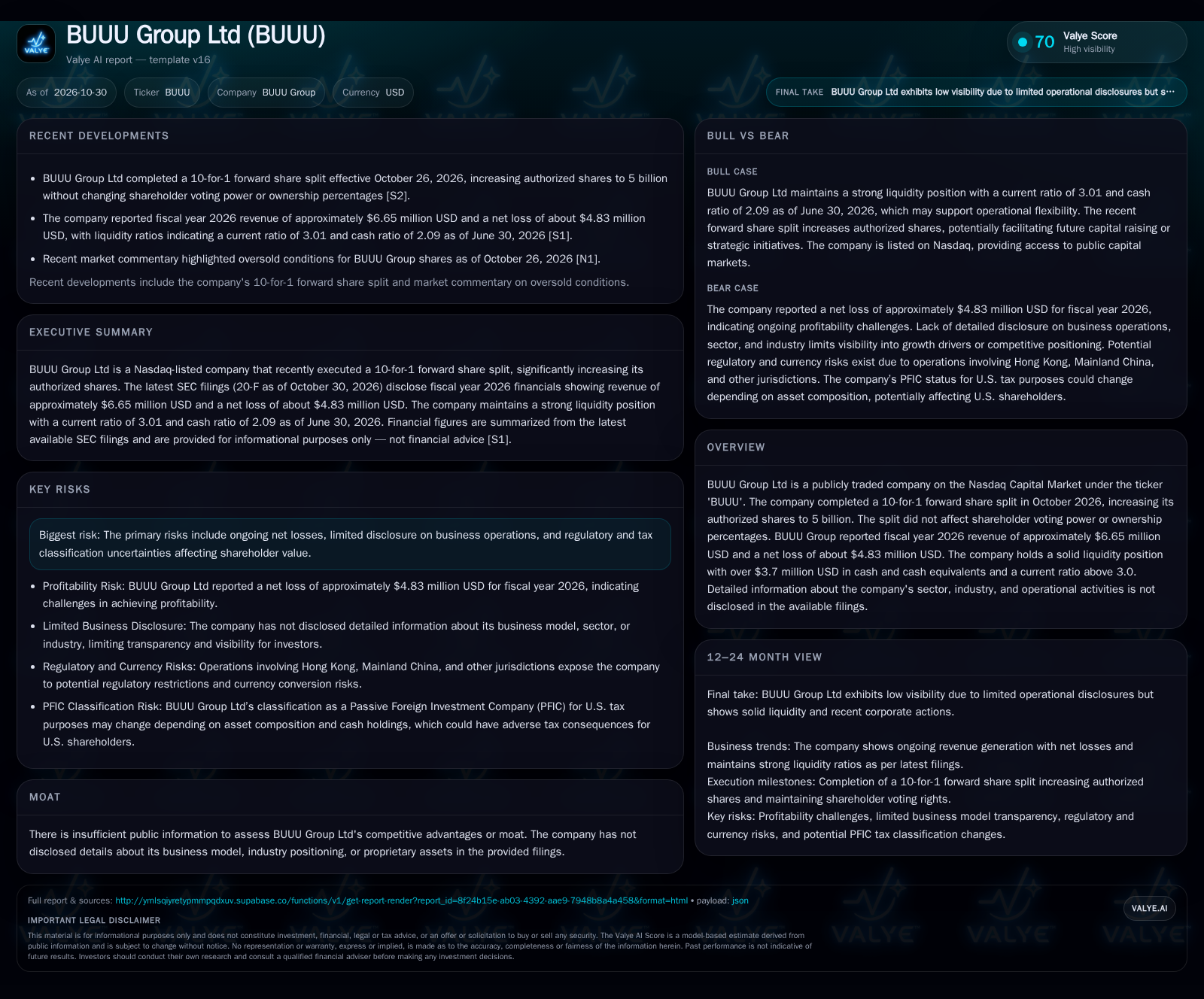
BUUU Group Ltd completed a 10-for-1 forward share split, dramatically increasing authorized shares, while reporting $6.65 million in revenue and a $4.83 million net loss for fiscal 2026.Despite a reported cash position and reported current ratio, the absence of business model and sector disclosures obscures the company’s economic drivers. The share structure may facilitate future financing or strategic actions, but profitability and regulatory risks remain unresolved. Investors face high uncertainty without greater transparency on operating activities, margin structure, or competitive context. [S1] [S2]
BUUU Group Ltd’s 2026 financial statements reveal a company with meaningful liquidity and a dramatically expanded share structure, but little transparency into what drives the business or how future value could be created. The 10-for-1 share split and reported current ratio may enable capital market actions or operational pivots, but the persistent net loss and lack of operational details leave the company’s economic logic and competitive footing largely to speculation. Investors must weigh the potential for future strategic moves against the risks of opacity, ongoing losses, and cross-border regulatory exposure.
Liquidity Cushion and Share Split: Immediate Facts Shaping BUUU Group’s Profile
BUUU Group Ltd reported $6.65 million in revenue and a net loss of $4.83 million for the fiscal year ending June 30, 2026. Cash and cash equivalents stood at $3.76 million, with a current ratio of 3.01 and a cash ratio of 2.09. On October 26, 2026, the company completed a 10-for-1 forward share split, increasing authorized shares to 5 billion (split evenly between Class A and Class B), with no change to voting rights or ownership proportions. No new material agreements outside the ordinary course of business were reported, and there is no disclosure of the company’s sector, industry, or operational focus. Recent market commentary notes oversold conditions for BUUU shares as of October 26, 2026. [S1] [S2] [N1]
Unpacking the Economics: Margin Structure and Capital Needs Remain Unclear
The core challenge in analyzing BUUU Group’s economics is the total absence of business model and sector disclosure. The company’s $6.65 million in revenue and $4.83 million net loss imply negative operating margins, but without segmentation or cost breakdowns, it is impossible to assess gross margin, fixed versus variable cost structure, or capital intensity.
The recent forward share split, which raised authorized shares to 5 billion, may signal intent or readiness to raise additional capital via equity issuance. If so, dilution risk could be material for existing shareholders, especially in the absence of demonstrated profitability or a clear reinvestment thesis. Without detail on working capital requirements, customer concentration, or contract mechanics, investors cannot estimate the company’s intrinsic operating leverage or potential for positive cash flow generation.
Understanding capital intensity and cost structure is critical to forecasting BUUU Group’s path to profitability. If the business model relies heavily on fixed costs, such as infrastructure or technology development, scale effects could improve margins over time, assuming revenue growth. Conversely, a predominantly variable cost base might restrict margin expansion but allow greater operational flexibility. In the absence of disclosed customer concentration, the risk of revenue volatility remains unknown; a high concentration could exacerbate financial instability if key clients reduce engagement. Additionally, clarity on contract terms—such as subscription versus transactional revenue—would help assess revenue predictability and the company's ability to manage cash flow and investment cycles.
Competitive Landscape: Strategic Ambiguity Limits Moat Assessment
With no disclosure of sector, product set, or target market, BUUU Group’s competitive positioning is indeterminate. The company operates under exchange control environments spanning Hong Kong, Mainland China, the British Virgin Islands, the Cayman Islands, and Singapore, exposing it to regulatory and currency conversion risks. These cross-border structures are sometimes associated with technology, fintech, or trading businesses, but without confirmation, any inference about customer switching costs, network effects, or proprietary advantages is speculative.
The absence of disclosed competitors, market share, or unique assets makes it impossible to evaluate the company’s moat, pricing power, or vulnerability to substitutes. If the business operates in a highly commoditized or regulated environment, margin pressure could remain severe. Conversely, a niche or IP-driven model could, in theory, support future profitability, but there is no evidence to support this from filings.
The cross-jurisdictional operational footprint introduces not only regulatory and currency risks but also strategic complexity in supply chain management, compliance costs, and market access. If BUUU Group operates in sectors subject to rapid regulatory shifts or geopolitical tensions, the cost of compliance and risk of operational disruption could materially impact financial performance. Additionally, currency fluctuations could affect reported revenues and expenses, complicating performance assessment. If the company has developed proprietary technology or network effects, these could serve as barriers to entry, but without disclosure, investors cannot gauge the sustainability of any competitive advantage. The lack of clarity on customer demographics or distribution channels further obscures potential switching costs or brand loyalty factors.
What Could Unlock Value: Transparency, Strategic Capital Use, and a Defined Growth Story
The most constructive scenario would see BUUU Group leverage its clean balance sheet and expanded share count to secure growth capital, execute a transformative acquisition, or reveal a scalable business model. If the company were to disclose a differentiated product, a defensible market position, or a high-margin recurring revenue stream, investor confidence and valuation could improve rapidly. Successful navigation of regulatory complexities and demonstration of operational leverage (e.g., narrowing losses as revenue grows) would reinforce the thesis.
Confirmation would come from detailed operational updates, new customer wins, or accretive capital deployment. Evidence against this scenario would include further dilution absent business model clarity, continued net losses with stagnant or shrinking revenue, or adverse regulatory developments in core jurisdictions.
Stagnation in the Absence of Strategic Disclosure
The most plausible outcome, given current disclosures, is a continuation of modest revenue generation paired with ongoing net losses and limited strategic visibility.
This scenario would be confirmed by a lack of material business updates, persistent losses, and continued opacity around operations, customer base, and competitive dynamics. A falsification would require the company to provide detailed, credible guidance on its business model, unit economics, or strategic direction.
Risks of Strategic Drift and Regulatory Friction
The adverse scenario centers on BUUU Group’s inability to halt losses or clarify its business, leading to value erosion through dilution, regulatory setbacks, or forced restructuring. Prolonged cash burn without a path to profitability could necessitate dilutive capital raises, especially given the new share capacity. If regulatory or currency conversion restrictions in Mainland China, Hong Kong, or other jurisdictions intensify, operational flexibility and shareholder value could be further constrained.
This downside would be confirmed by accelerating losses, shrinking cash balances, new equity offerings at depressed prices, or adverse regulatory/tax developments (such as PFIC reclassification). Any sign of management turnover or auditor concerns would further undermine confidence.
Testing the BUUU Group Thesis: Transparency, Capital Actions, and Regulatory Signals
Disclosure of the company’s core business activities, sector, and revenue sources would help clarify the economic engine and address opacity risk.
Quarterly revenue and operating expense trends, if disclosed, would provide insight into margin structure and cost discipline.
Announcements of new customer contracts, partnerships, or acquisitions would indicate active capital deployment and strategy execution.
Any equity or debt financing events following the share split would test the company’s ability to access capital and the risk of shareholder dilution.
Updates on regulatory or currency developments in key jurisdictions (Hong Kong, Mainland China, Singapore) would help gauge cross-border risk.
Evidence of narrowing net losses or positive operating cash flow would support an improving operating leverage thesis.
Disclosure of customer concentration, backlog (if any), or recurring revenue metrics would help assess revenue visibility and business model quality.
Material changes in management, auditor opinions, or governance structures would be important red flags for operational and financial oversight.
Disclaimer: This is research-only, informational analysis and not investment advice. It may include AI-generated interpretation and general industry context. Always verify important details using primary sources.

Comments