
First Western Financial: Boutique Wealth Platform Scales in Affluent Western Markets, but Regional and Credit Risks Loom
First Western Financial’s hybrid banking and wealth model is driving growth in high-net-worth Western U.S. markets, but concentration in residential and commercial real estate lending, plus regional economic sensitivity, shape the risk-reward calculus as it expands its boutique footprint.
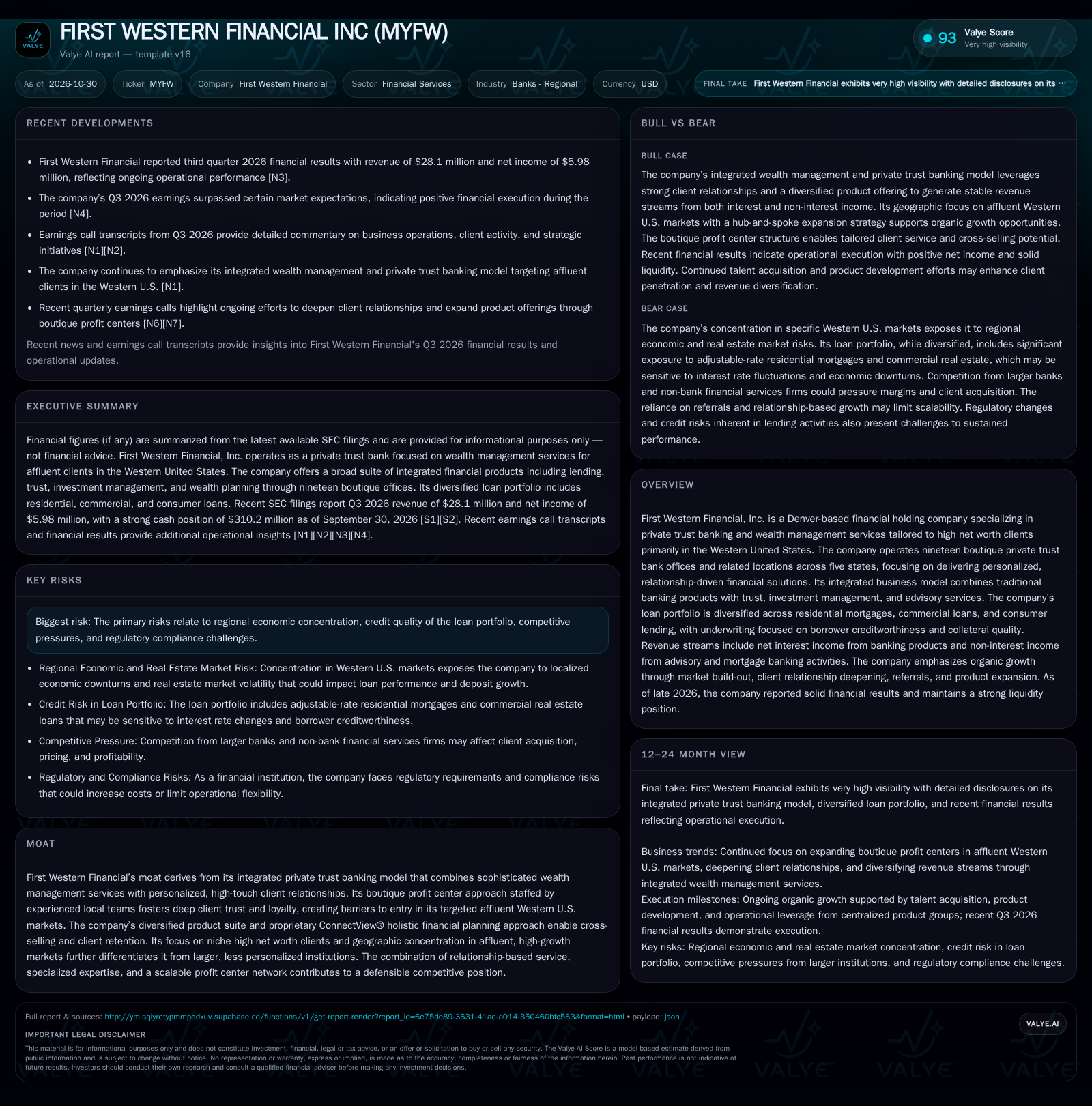
First Western Financial (MYFW) continues to grow its integrated private trust banking and wealth management platform, reporting $28.1 million in Q3 2026 revenue and $5.98 million in net income, with $310.2 million in cash and cash equivalents as of September 30, 2026. Its model targets affluent Western U.S. markets through nineteen boutique offices, blending traditional banking with advisory and investment services. While the company benefits from high-touch client relationships and a diversified loan portfolio, its concentration in residential and commercial real estate lending and exposure to regional economic cycles remain core risks. Future performance will hinge on the ability to deepen client penetration, expand profit centers, and manage credit and market risks amid evolving competitive and regulatory landscapes. [S1] [S2]
First Western Financial, Inc. is attempting to carve out a defensible niche in the Western U.S. through its boutique, relationship-driven approach to private trust banking and wealth management. With $7.28 billion in fiduciary and advisory assets under management and a diversified lending book, the company’s latest results show continued growth in both interest and non-interest income. Yet as it doubles down on affluent regional markets and expands its profit center network, First Western faces a classic trade-off: the potential for outsized client penetration and cross-sell versus the risks of geographic and loan-type concentration. The stakes for investors are whether the model delivers scalable, resilient earnings or remains vulnerable to regional shocks and competitive encroachment.
Recent Results Highlight Revenue Growth, Asset Scale, and Strategic Focus
First Western Financial reported Q3 2026 revenue of $28.1 million and net income of $5.98 million, with cash and cash equivalents of $310.2 million as of September 30, 2026 [S2]. These results reflect continued execution of its integrated private trust banking and wealth management strategy, with nineteen boutique offices targeting affluent clients in Colorado, Arizona, Wyoming, Montana, and California [S1]. As of year-end 2025, the company managed $7.28 billion in fiduciary and advisory AUM, supported by a loan portfolio of $2.65 billion and deposits of $2.75 billion [S1]. Non-interest income (trust, investment, advisory, and mortgage services) comprised 27.4% of total income before non-interest expense in 2025, underscoring the importance of fee-based businesses to the company’s earnings mix [S1].
How First Western Monetizes High-Net-Worth Relationships: Revenue Mix and Margin Levers
First Western’s business model revolves around blending traditional net interest income from lending and deposits with higher-margin, fee-based wealth management and trust services. In 2025, net interest income made up 77.8% of income before non-interest expense, while non-interest income contributed 27.4% [S1]. This mix provides some diversification, but the core engine remains lending—particularly residential mortgages and commercial real estate loans. The company’s boutique approach enables higher pricing power on advisory fees and the potential for cross-selling, but also entails higher fixed costs (experienced staff, local presence) that may constrain operating leverage at smaller scale.
The loan book is diversified by product but remains exposed to residential ($1.03 billion, 39.1% of loans) and commercial real estate ($1.01 billion, 38.3% split between owner- and non-owner-occupied) [S1]. These categories can generate attractive spreads in strong markets but expose the company to asset quality and margin compression in downturns or during periods of rate volatility. Fee income from trust, investment management, and advisory services is less balance-sheet intensive and can deliver higher incremental margins if client penetration increases.
Funding is primarily through client deposits ($2.75 billion as of year-end 2025) [S1], which are typically lower-cost in a relationship-driven model, but competition for affluent deposits can intensify in rising-rate or risk-off environments. Capital intensity is moderate for a regional bank, but continued geographic expansion and talent acquisition could require incremental investment, especially if organic growth slows. Operating leverage may improve as profit centers scale, but the high-touch service model likely sets a floor on fixed costs.
Defensible Niche or Margin Squeeze? Assessing First Western’s Position in the Affluent Banking Landscape
First Western’s moat is predicated on its boutique, high-touch approach, targeting high-net-worth individuals in affluent Western markets through interdisciplinary teams and personalized service [S1]. This creates switching frictions for established clients and enables cross-sell of complex wealth, trust, and lending solutions. Larger national and superregional banks, however, can offer broader digital capabilities, more competitive rates, and greater product breadth. Non-bank wealth managers and fintechs increasingly encroach on advisory and investment management, pressuring fees and commoditizing some services.
The company’s geographic focus on high-growth, affluent areas—especially in Colorado, Arizona, and California—supports organic growth and relationship depth. However, this same concentration amplifies vulnerability to regional economic downturns or real estate corrections. The company’s proprietary ConnectView® approach and profit center structure differentiate it from mass-market competitors, but scaling this model may prove challenging in less relationship-driven or more price-sensitive segments.
Switching costs in private trust banking are real but not insurmountable; affluent clients can be enticed by better digital service, rates, or specialized offerings elsewhere. The key competitive question is whether First Western can continuously deepen wallet share and client tenure faster than competitors can erode its niche advantages.
Path to Durable Growth: If Boutique Expansion and Fee Income Outpace Credit Risks
A favorable outcome could emerge if First Western successfully scales its profit center model, deepens client penetration, and grows fee-based wealth management income faster than credit and funding costs rise. In this scenario, the company leverages its local expertise and referral-driven growth to capture a disproportionate share of affluent clients in expanding Western markets. The result would be higher AUM, increased cross-sell, and improved operating leverage as fixed costs are spread over a larger client base.
Confirmation would come from sustained double-digit growth in AUM, rising non-interest income as a percentage of total revenue, and evidence of stable or improving net interest margins even in volatile rate environments. Expansion into new high-growth markets—with strong initial client acquisition and low attrition—would further validate the scalability of the model. If credit quality remains robust and the company avoids outsized losses in its real estate loan book during regional slowdowns, the thesis of a resilient, differentiated regional wealth platform would be strengthened.
Steady Growth with Episodic Credit and Margin Headwinds Likely Defines the Next Phase
The most plausible path is continued moderate growth in both interest and non-interest income, punctuated by periodic credit or margin shocks tied to regional real estate or economic cycles. The company is likely to benefit from its affluent market focus and personalized service, enabling incremental AUM and deposit growth as existing clients deepen relationships and new profit centers come online. However, the heavy weighting toward residential and commercial real estate lending means that periods of rising rates, property value volatility, or local economic weakness could pressure asset quality and net interest margins.
Fee-based income should gradually rise as a share of total revenue, but given the company’s size and competitive landscape, major step-change improvements may be limited without a significant acquisition or breakthrough in client acquisition. The company’s high-touch model should support above-average client retention, but switching frictions may be tested if competitors ramp up digital, pricing, or product innovation. Confirmation of this scenario would include relatively stable net interest margins, modest AUM growth, and manageable credit losses; meaningful deviation in any direction would signal a shift toward either the upside or downside case.
Regional Shocks, Credit Losses, or Competitive Displacement Could Erode Value
The most significant risks to the First Western model are a sharp regional economic downturn, a material correction in residential or commercial real estate, or an acceleration of competitive pressures from larger or more agile wealth platforms. If property values decline or loan defaults rise, the company’s concentrated loan book could experience elevated credit losses, eroding profitability and potentially constraining growth in new lending. Intense competition for affluent deposits could drive up funding costs, squeezing net interest margins.
A regulatory change targeting wealth management fees, trust structures, or capital requirements could also disrupt the economics of the boutique model. If non-interest income stagnates and net interest income contracts, the company could see a reversal in earnings momentum. Confirmation would come from a spike in non-performing assets, compression in net interest margins, client attrition in core profit centers, or a material slowdown in AUM growth.
Signals That Will Clarify the Resilience and Scalability of First Western’s Boutique Banking Model
Trends in non-interest income as a percentage of total revenue—sustained growth would indicate successful wealth management expansion, while stagnation could signal competitive or operational hurdles.
Quarterly net interest margin movements—compression could flag funding cost pressures or asset yield challenges, especially in rising-rate or risk-off environments.
Changes in non-performing assets and loan loss provisions—rising levels would test the underwriting discipline and regional risk sensitivity of the loan book.
AUM growth rates by profit center and geography—above-market expansion would validate the hub-and-spoke strategy; deceleration or concentration in mature markets would be a caution.
Client attrition rates (if disclosed) or qualitative commentary on relationship retention—high stability would reinforce the switching cost thesis; elevated churn would challenge it.
Deposit mix and growth trends—shifts toward higher-cost or less stable funding would increase balance sheet risk.
Talent acquisition and retention, particularly among senior advisors and profit center presidents—key for maintaining relationship depth and growth momentum.
Any regulatory developments affecting trust, wealth management, or lending practices in core states—could materially alter economics or compliance costs.
Disclaimer: This is research-only, informational analysis and not investment advice. It may include AI-generated interpretation and general industry context. Always verify important details using primary sources.

Comments