
Monarch Casino & Resort: Navigating Record Results and Volatility in a Competitive Gaming Landscape
Monarch Casino & Resort posted record Q3 2026 financials, but recent quarters reveal substantial earnings variability, highlighting both operational strength and the persistent volatility inherent to regional gaming.
Monarch Casino & Resort delivered record net income in Q3 2026, yet its quarterly results continue to fluctuate amid industry volatility and shifting consumer demand.
Monarch Casino & Resort Inc’s Q3 2026 record net income headline belies a deeper narrative of performance variability and industry cyclicality. The question for investors is whether the company’s operational strengths and regulatory positioning are enough to offset the persistent volatility of its core business.
Record Q3 Earnings Highlight Performance Peaks Amid Underlying Volatility
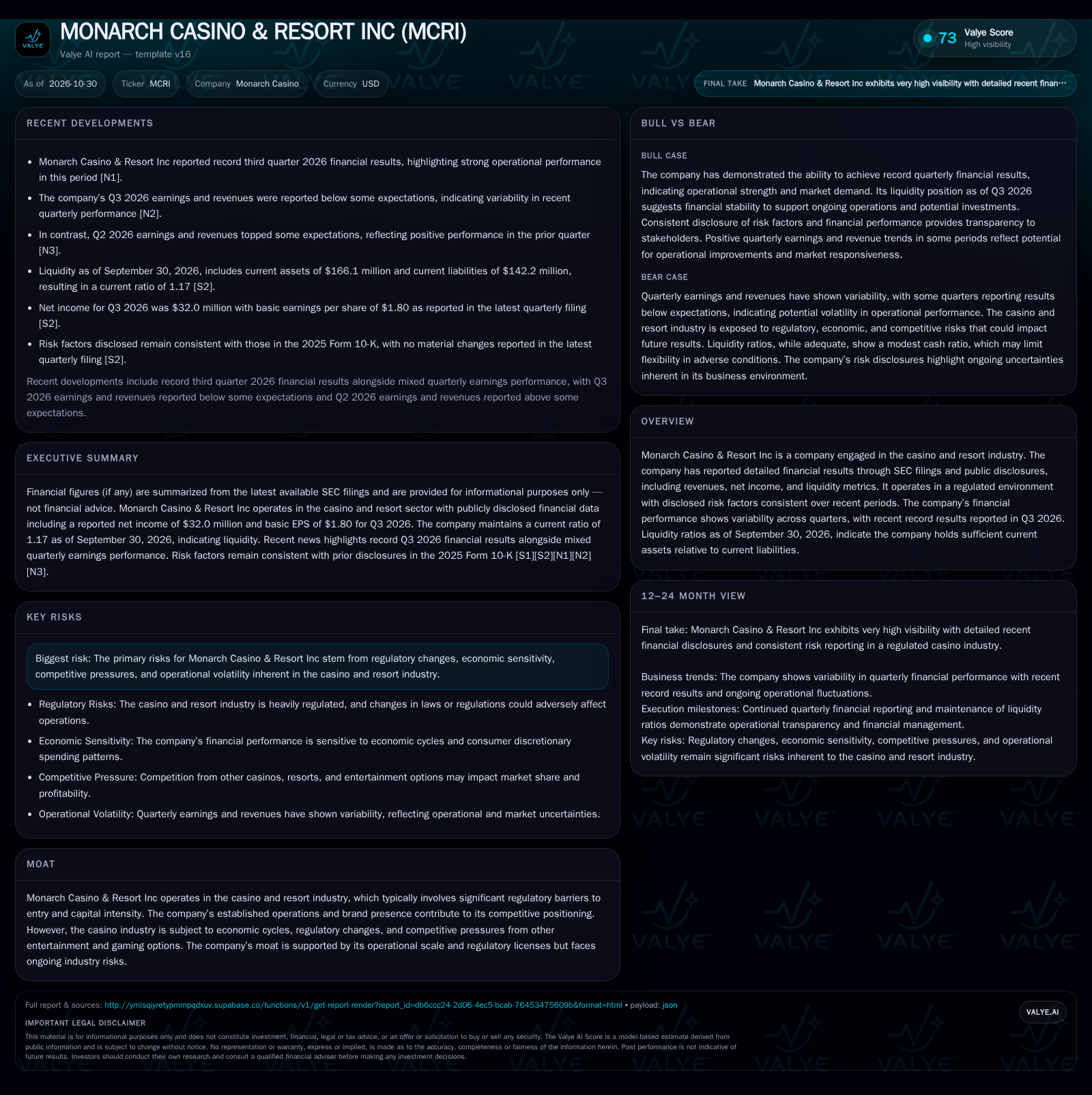
Monarch Casino & Resort reported a record net income of $32.0 million and basic earnings per share of $1.80 in Q3 2026, signaling strong operational performance for the period [S2] [N1]. However, these results came in below some market expectations, underlining the ongoing variability in quarterly outcomes [N2]. In contrast, Q2 2026 saw the company exceed both earnings and revenue expectations, reinforcing the theme of inconsistent quarterly performance [N3]. On the liquidity front, Monarch reported current assets of $166.1 million against current liabilities of $142.2 million as of September 30, 2026, resulting in a current ratio of 1.17 and a cash ratio of 0.17 [S2]. The company’s risk disclosures have remained consistent, with no new material changes flagged since the 2025 Form 10-K [S1] [S2].
How Monarch Generates Value: Casino Economics and Operating Leverage
Casinos and integrated resorts typically rely on a blend of gaming revenues, hotel occupancy, food and beverage sales, and ancillary entertainment offerings. Gross margins are often driven by gaming mix, house edge, and scale efficiencies in non-gaming operations. Monarch’s ability to achieve record net income in Q3 2026 suggests effective yield management and cost control during periods of high demand [S2] [N1]. However, the industry is capital-intensive, with significant fixed costs tied to property maintenance, regulatory compliance, and labor. This structure creates operating leverage: incremental revenue growth can disproportionately lift profits during peak periods, but revenue declines can quickly pressure margins and cash flow. [S2] Pricing power is limited by regional competition and consumer sensitivity to economic cycles, making volume and mix optimization critical for sustained profitability.
The capital intensity of casino operations also implies that Monarch’s return on invested capital (ROIC) is highly sensitive to the effective utilization of its assets. In periods of high demand, the fixed-cost base is spread over greater revenue, enhancing profitability and ROIC. Conversely, underutilization during downturns can rapidly degrade returns, making capacity management and flexible cost structures crucial. Additionally, the interplay between gaming and non-gaming revenues affects overall margin dynamics; non-gaming segments often have different cost structures and demand drivers, so their growth or contraction can either mitigate or amplify earnings volatility. Understanding the correlation between these revenue streams would help assess the stability and scalability of Monarch’s earnings profile.
Regulated Markets, Brand Presence, and Competitive Frictions
Monarch competes in a highly regulated and capital-intensive industry, where entry barriers include licensing requirements, zoning, and substantial upfront investment. Its established operations and brand recognition in core markets provide some insulation from new entrants. However, competition from both local and destination casinos, as well as emerging entertainment alternatives, exerts constant pressure on market share and pricing. Regulatory stability is a double-edged sword: while it limits new competition, it also exposes operators to abrupt shifts in policy or tax regimes. The company’s consistent risk disclosures suggest that it is not currently facing acute regulatory threats, but the broader industry remains vulnerable to changes in gaming legislation or consumer protection rules [S1] [S2]. In a landscape increasingly shaped by digital gaming and shifting leisure preferences, Monarch’s moat is supported by its physical assets and licenses, but not immune to substitution from online casinos or alternative entertainment experiences.
Monarch’s competitive positioning also hinges on its ability to adapt to evolving consumer preferences within a constrained regulatory framework. While physical assets and licenses provide a moat, the rise of digital entertainment and alternative leisure activities necessitates continuous innovation in customer experience and service differentiation. The company’s capacity to leverage data analytics and customer insights to tailor offerings and enhance loyalty programs could be a key determinant of market share retention. Moreover, competitive friction is not static; regional competitors may respond with aggressive promotions or capital investments, which could compress margins or necessitate increased marketing spend. Monitoring competitor capital deployment and promotional intensity would provide early signals of shifting competitive dynamics.
What Could Drive a Sustained Earnings Upswing?
A plausible upside scenario would see Monarch capitalize on favorable economic conditions, robust consumer discretionary spending, and effective marketing or loyalty initiatives to drive higher visitation and gaming volumes. If the company can maintain or expand its market share while controlling labor and promotional costs, the resulting operating leverage could yield outsized gains in net income and cash flow. Upside could also materialize if regulatory frameworks remain stable and the company successfully invests in property enhancements or digital engagement that boost non-gaming revenues. Confirmation of this scenario would come from consecutive quarters of above-expectation earnings, clear growth in visitation or spend per guest, and evidence of margin expansion without a commensurate rise in promotional or labor expenses. On the other hand, a failure to sustain momentum across multiple reporting periods would falsify the thesis of a durable upswing.
Volatility as the Norm: Navigating Cycles in Regional Gaming
The most plausible near-term trajectory for Monarch is a continuation of quarter-to-quarter variability, reflecting both the strengths and the vulnerabilities inherent in its business model. In this scenario, the company delivers solid results during periods of strong consumer demand—such as holiday seasons or major events—but experiences softer quarters when macroeconomic or competitive pressures intensify. Reported liquidity position, but not abundant, requiring careful cash and capital allocation. Regulatory status stays stable, and the company neither gains nor loses significant market share. This outcome would be confirmed by a pattern of mixed quarterly results, with no clear trend in either direction, and stable risk disclosures. A break from this pattern—either sustained outperformance or a string of disappointing results—would invalidate the base case.
How Downturns, Cost Pressures, or Regulatory Shocks Could Erode Value
A negative turn could occur if consumer discretionary spending weakens due to economic downturns, leading to a drop in visitation and gaming revenue. Rising labor or maintenance costs could squeeze margins, especially given the industry’s high fixed-cost base. A regulatory change—such as higher gaming taxes or new restrictions—could further pressure profitability. Alternatively, stabilization or recovery in these metrics would suggest the downside is being managed or avoided.
Testing Monarch’s Thesis: Concrete Evidence to Track in the Next 18 Months
Quarterly net income and basic EPS trends—sustained growth or volatility would clarify earnings trajectory.
If disclosed, visitation volumes and spend-per-guest metrics to gauge demand resilience and marketing effectiveness.
Changes in the current and cash ratios, especially if they signal tightening or loosening liquidity conditions.
Updates on regulatory developments or tax changes affecting the company’s core markets.
Evidence of new capital projects, property upgrades, or expansion initiatives and their funding mechanisms.
Labor and promotional expense trends, as rising costs could erode margins in a flat-revenue environment.
Any new disclosure of digital or online gaming initiatives, which could influence future revenue mix and competitive positioning.
Material changes to risk disclosures in SEC filings, which could signal emerging threats or opportunities.
Disclaimer: This is research-only, informational analysis and not investment advice. It may include AI-generated interpretation and general industry context. Always verify important details using primary sources.

Comments