
Intercont (Cayman) Ltd: Shipping Core, Digital Asset Ambition, and the Real Stakes of Liquidity and Control
Intercont (Cayman) Ltd combines a legacy shipping operation with a push into digital asset infrastructure following the acquisition of Starks Network Ltd.
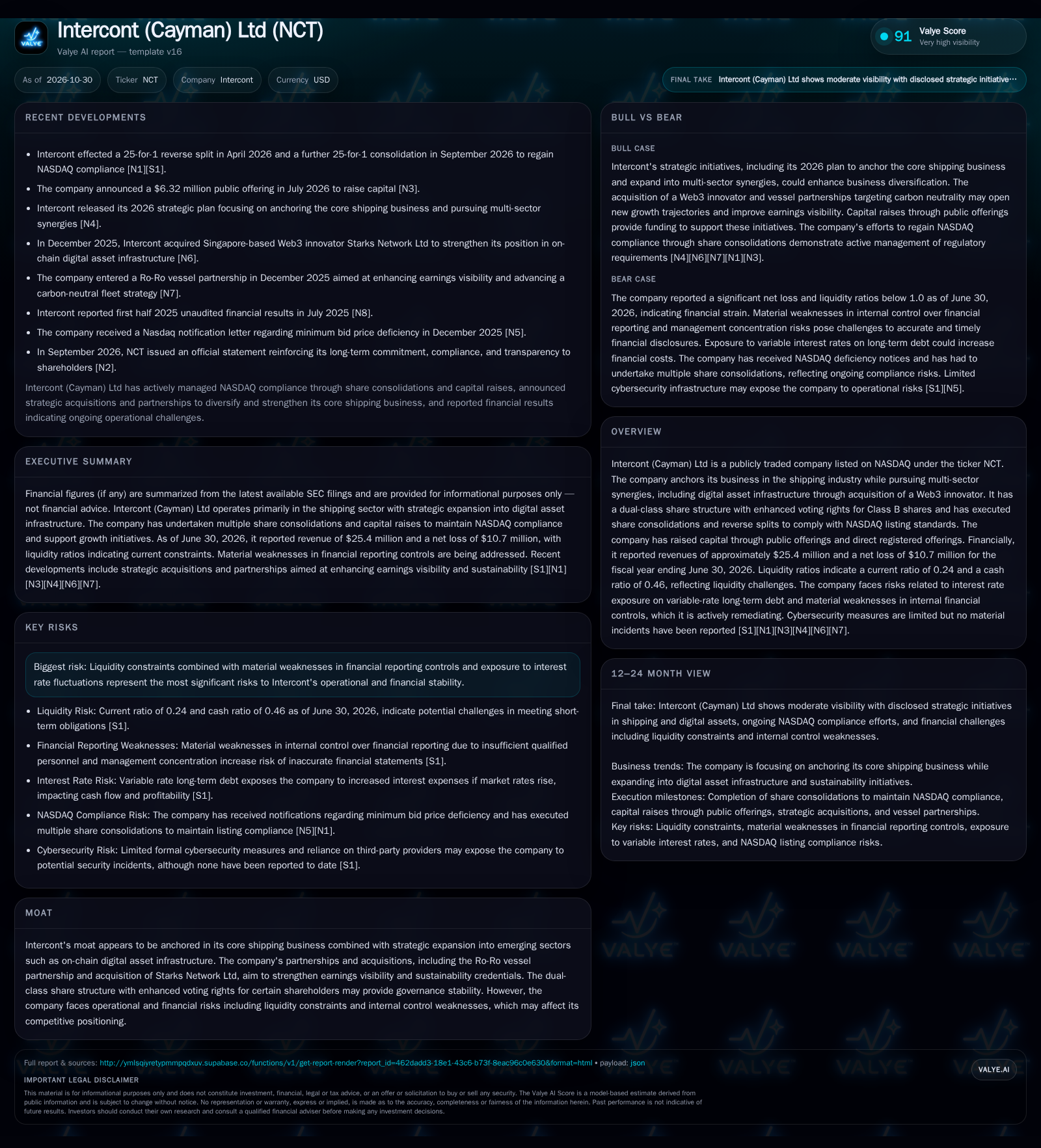
Intercont (Cayman) Ltd combines a legacy shipping operation with a push into digital asset infrastructure following the acquisition of Starks Network Ltd. Despite generating $25.4 million in revenue for the year ended June 30, 2026, the company faces a steep net loss, acute liquidity pressures, and ongoing internal control issues. Multiple share consolidations and capital raises signal active management but also underline operational and financial strain.
Intercont (Cayman) Ltd sits at a strategic crossroads. With roots in the shipping industry, the company is now extending its ambitions into digital asset infrastructure and sustainability-focused logistics. Whether Intercont can turn its diversification strategy into a sustainable business model—or is forced into further dilution or restructuring—will depend on execution, cost control, and the actual monetization of its new digital and green initiatives.
Why Intercont’s Recent Capital Actions and Losses Set the Stage for Urgent Change
Intercont (Cayman) Ltd’s most recent financials underscore a business under pressure. For the year ended June 30, 2026, the company reported $25.4 million in revenue but a net loss of $10.7 million, translating to a basic and diluted EPS of -$43.16 per share [S1]. Liquidity is particularly strained: cash and short-term investments totaled $13.7 million against current liabilities of $29.7 million, resulting in a current ratio of just 0.24 and a cash ratio of 0.46 [S1]. These figures indicate a material risk of near-term funding shortfalls.
To address these pressures and maintain its NASDAQ listing, Intercont has executed two major share consolidations in 2026 and raised $6.32 million via a public offering in July [N1] [N3]. The company has also highlighted ongoing material weaknesses in internal control over financial reporting, citing insufficient qualified accounting personnel and management concentration as key issues [S1].
On the strategic front, Intercont has acquired Starks Network Ltd, signaling intent to move into digital asset infrastructure, and entered a Ro-Ro vessel partnership aimed at enhancing earnings visibility and advancing a carbon-neutral fleet [N6] [N7]. These moves signal ambition—but the question is whether the company’s capital structure, governance, and operating model can support this pivot before liquidity risks force more dramatic action.
How Intercont’s Hybrid Model Could (or Might Not) Deliver Profitable Scale
Intercont’s business model is now a hybrid: it continues to anchor itself in traditional shipping, while layering in digital asset infrastructure following its acquisition of Starks Network Ltd. In shipping, revenue is typically driven by volume (tonnage shipped, distance, and frequency), with profitability hinging on vessel utilization, operational efficiency, and fuel costs. The addition of a Ro-Ro partnership may improve asset utilization and support a transition to lower-emission fleets, potentially qualifying for green premiums or subsidies if successfully executed.
Digital asset infrastructure, if successfully commercialized, could offer higher-margin, more recurring revenue streams—such as transaction fees, staking, or SaaS-style licensing for blockchain infrastructure. However, unless Intercont can demonstrate that its digital initiatives are monetizing at scale, this diversification may simply add complexity without improving cash flow.
Fixed costs in shipping (vessel acquisition/maintenance, regulatory compliance, crew) are high, so operating leverage can work both ways: small increases in revenue can drive disproportionate profit improvements, but volume shortfalls or rate declines can quickly erode margin. The digital segment may be less capital-intensive but will require ongoing investment in technology, talent, and security. Intercont’s current liquidity constraints and variable-rate debt mean that even modest missteps could force further equity dilution or asset sales if cash flows do not improve quickly [S1].
Competitive Dynamics: Can Synergies and Structure Outweigh Sector Headwinds?
In the shipping sector, Intercont faces intense competition from global logistics providers and specialized Ro-Ro operators, many of whom benefit from greater scale, established customer relationships, and more resilient balance sheets. Price competition is fierce, and incumbents with modern, carbon-efficient fleets are better positioned to win business from sustainability-focused shippers.
The acquisition of Starks Network Ltd places Intercont in the highly competitive digital asset infrastructure space, where barriers to entry are lower but the pace of technology change and regulatory scrutiny is high. Established blockchain infrastructure providers and cloud platforms already command meaningful market share and developer mindshare.
Intercont’s dual-class share structure, with Class B shares having up to 100 votes per share, may provide board and management with governance stability to execute its strategy through periods of volatility [S1]. However, this also concentrates control and may reduce responsiveness to minority shareholder concerns, particularly if further capital raises are required. The ultimate competitive advantage will depend on whether Intercont can integrate its shipping and digital asset businesses in a way that creates genuine customer value and margin uplift, rather than simply operating two separate, capital-hungry lines.
A Path to Profitability: What Successful Integration and Niche Leadership Would Look Like
The most favorable scenario for Intercont is one in which it leverages its shipping heritage to offer integrated logistics solutions enhanced by digital asset infrastructure—such as blockchain-based cargo tracking, digital bill of lading, or smart contracts for freight payments. If the Ro-Ro partnership delivers improved vessel utilization and green credentials, Intercont could win business from shippers seeking both reliability and sustainability.
On the digital asset side, if Starks Network Ltd can quickly establish a differentiated platform—say, by securing key partnerships or recurring enterprise customers—margin and cash flow could improve, providing much-needed funding for both segments.
Confirmation of this scenario would come from: (1) sequential revenue growth with improving gross and operating margins; (2) evidence of recurring or contracted digital infrastructure revenue; (3) reduction in net loss and stabilization or improvement in liquidity ratios; and (4) positive feedback from new customer segments or partners citing Intercont’s integrated offering as a reason for switching.
Incremental Progress Amid Persistent Strain: The Most Likely Trajectory
The most plausible outcome is gradual operational improvement but continued financial strain. Intercont may stabilize revenue in its core shipping business and achieve modest digital asset infrastructure gains, but offsetting these will be high fixed costs, ongoing investment needs, and the drag of interest expense on variable-rate debt.
Management may continue to rely on periodic equity raises or asset sales to bridge liquidity gaps, and share consolidation could remain a recurring feature if the stock price stays under pressure. While some synergies or cross-selling between shipping and digital assets may emerge, it is more likely to be incremental than transformative in the near-term.
This scenario would be confirmed by stagnant or slightly improving revenue and margin trends, continued negative net income, and further capital actions to maintain compliance and meet obligations. Falsification would require clear evidence of sustained profitability, robust free cash flow, or a step-change in customer adoption of the digital asset platform.
Liquidity Crunch and Dilution: How Financial Weakness Could Override Strategic Ambition
In the adverse scenario, liquidity constraints become acute before new initiatives deliver meaningful returns. Rising interest rates could increase debt service costs, while working capital needs in shipping and R&D expenses in digital assets outpace available cash and investment inflows.
If internal control weaknesses persist, financial reporting errors or delays could further erode investor confidence and restrict access to capital markets. Repeated share consolidations and equity raises could drive significant dilution, weakening the value proposition for existing shareholders.
Confirmation of this scenario would include: (1) further deterioration in current and cash ratios; (2) missed or delayed financial reporting; (3) additional NASDAQ compliance warnings; (4) forced asset sales, restructuring, or even delisting if liquidity is not restored and strategic pivots fail to produce cash flow.
What Will Determine Whether Intercont’s Diversification Pays Off or Falters?
Sustained improvement in current and cash ratios, indicating progress in managing near-term liquidity risk.
Quarterly trends in gross margin and operating cash flow, which would show whether digital asset expansion is translating into improved economics.
Disclosure of recurring or contracted revenue from digital asset infrastructure, if available, to test the viability of the new business line.
Updates on the remediation of internal control weaknesses, particularly in accounting and financial reporting.
Customer wins or partnership announcements that specifically cite Intercont’s integrated shipping and digital asset suite as a differentiator.
Interest expense as a proportion of revenue, to gauge the impact of variable-rate debt on potential financial flexibility.
Any further NASDAQ notifications regarding listing compliance, which could signal continued operational or market stress.
Evidence of successful vessel utilization improvement or green premium capture in the shipping segment, if disclosed.
Disclaimer: This is research-only, informational analysis and not investment advice. It may include AI-generated interpretation and general industry context. Always verify important details using primary sources.

Comments