
Church & Dwight After Q3 2026: Margin Gains, Liquidity Constraints, and the Stakes of Brand-Led Growth
Church & Dwight delivered Q3 earnings and revenues above expectations, driven by organic growth and operational improvements.
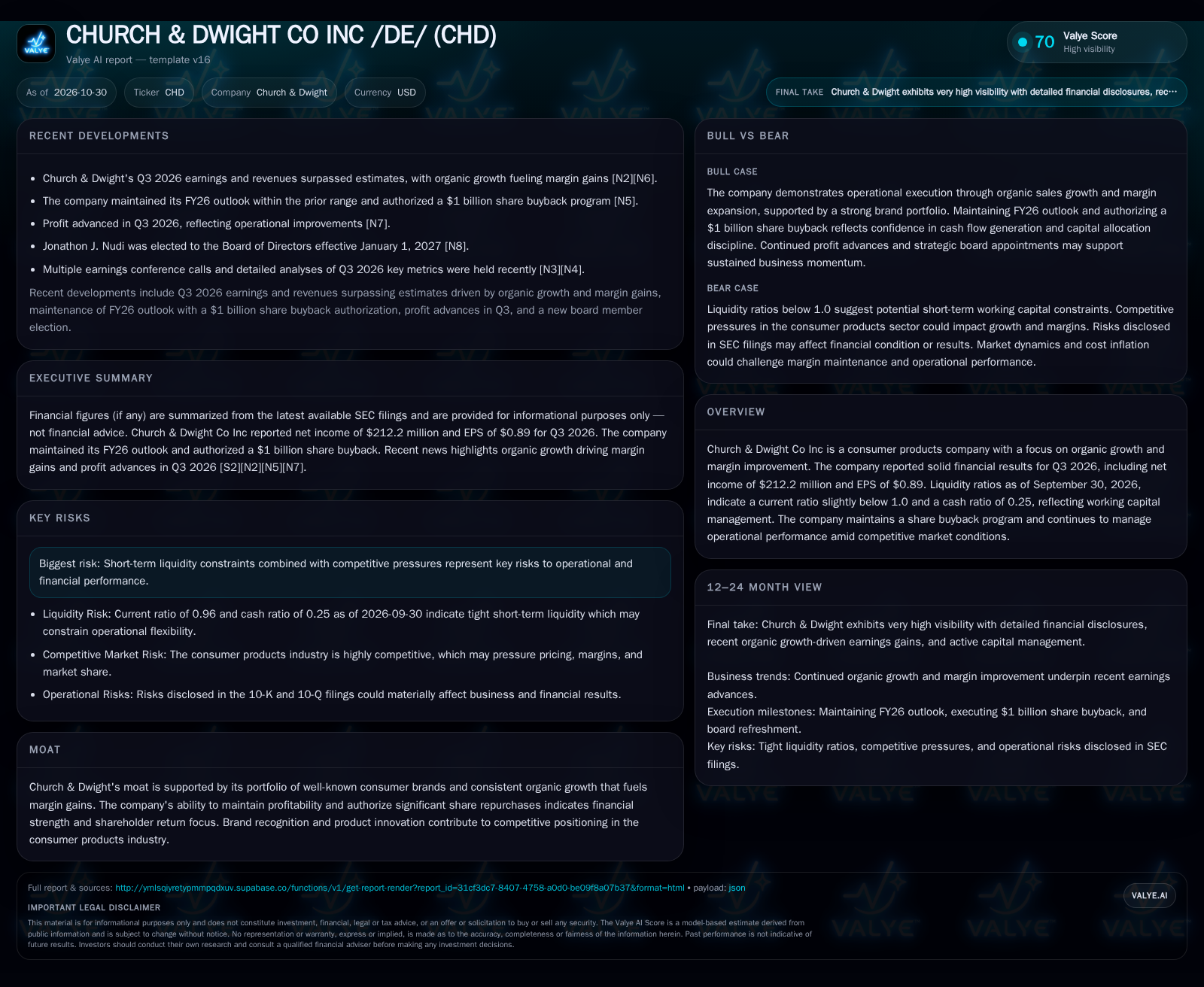
Church & Dwight posted strong Q3 2026 results with $212.2 million in net income and EPS of $0.89, fueled by organic growth and margin gains. The company’s future hinges on sustaining brand-driven growth and navigating industry competition with careful working capital management. [S2] [N2] [N6] [N7]
In Q3 2026, the company outperformed expectations with strong organic growth and profit advances. Yet, below-par liquidity ratios and an evolving board composition suggest that sustaining momentum will require deft management of both the balance sheet and the brand portfolio. Investors and analysts must weigh the durability of Church & Dwight’s margin improvement against the constraints imposed by tight working capital and relentless sector competition. [S2] [N2] [N6] [N7] [N8]
Q3 2026 Snapshot: Margin Expansion Meets Liquidity Tightness
Church & Dwight reported net income of $212.2 million and EPS of $0.89 for Q3 2026, with both earnings and revenues surpassing estimates. Management attributed margin gains to organic growth, reflecting improved operational execution [S2] [N2] [N6] [N7]. The company reported cash and liquidity metrics for the period; these figures do not by themselves establish operating runway, investment capacity, financial flexibility, or financing capacity. [S2] The election of Jonathon J. Nudi to the board, effective January 2027, signals potential strategic refresh as the company faces a competitive consumer products landscape [N8]. These facts frame a business balancing strong profit momentum with the realities of constrained liquidity, setting the stage for upcoming strategic and operational decisions.
How Church & Dwight Converts Brand Strength into Profitability
Church & Dwight’s earnings model is anchored in its portfolio of established consumer brands, which enables it to generate steady revenue streams primarily through high-volume sales in categories such as household and personal care. Organic growth—driven by new product introductions, brand extensions, and marketing investments—can support incremental pricing power and positive mix, which in turn may contribute to margin expansion as observed in Q3 2026 [N2] [N6] [N7].
The company’s cost structure typically features a mix of fixed manufacturing and SG&A expenses, with variable costs tied to input prices and promotional spending. This structure creates the potential for operating leverage when revenue growth outpaces expense increases, as seen in recent margin gains. However, tight liquidity, as reflected in low current and cash ratios, constrains flexibility to invest aggressively in inventory, marketing, or innovation without additional financing or improved cash conversion [S2].
Capital allocation decisions—such as share buybacks or potential bolt-on acquisitions—must be weighed against short-term working capital needs and the ability to weather input cost shocks or demand volatility. The company’s ability to sustain profit growth will depend not only on topline momentum but also on disciplined management of cash flows, inventory, and payables in a competitive, fast-moving sector.
Brand Portfolio as Moat—But Is It Enough in a Crowded Market?
Church & Dwight’s competitive positioning rests on its established portfolio of consumer brands and a track record of organic growth and margin improvement. Brand recognition and product innovation have historically supported shelf presence and consumer loyalty, creating a moderate moat against new entrants and private-label substitutes.
However, the consumer products sector is intensely competitive, with rivals ranging from global conglomerates to agile niche players and retailer-owned brands. Competitive pressure can limit pricing power, compress margins, and require sustained marketing outlays. In this environment, the durability of Church & Dwight’s moat depends on its ability to refresh its product lineup, maintain distribution relationships, and optimize promotional effectiveness.
Switching costs for consumers are typically low, so retention hinges on perceived value, convenience, and brand trust. The company’s ongoing focus on organic growth suggests it is investing in these levers, but the question is whether this will be enough to offset rising input costs and ongoing promotional intensity across the sector.
If Brand Investments Translate to Sustained Margin Expansion
The most favorable outcome for Church & Dwight is that recent organic growth proves durable and self-reinforcing—driven by effective new product launches, successful marketing campaigns, and continued operational discipline. In this scenario, the company leverages its brand portfolio to capture incremental share in core categories, achieves further pricing or mix improvement, and realizes additional operating leverage as fixed costs are spread over a growing revenue base.
Confirmation would come from several signals: continued outperformance versus peer revenue and margin trends, evidence of successful product innovations or category extensions, and sequential improvement in cash conversion cycles despite tight starting liquidity.
Falsification would be indicated by stalling organic growth, margin compression relative to peers, or the need for external financing to support basic operations—suggesting that the current momentum is unsustainable without greater liquidity or deeper brand reinvestment.
Balancing Operational Execution with Ongoing Liquidity Constraints
The most plausible trajectory is that Church & Dwight continues to deliver modest organic growth and incremental margin improvement, but remains constrained by tight liquidity and working capital management requirements. The company is likely to prioritize cash generation and disciplined spending, seeking to avoid overextending itself on inventory or promotional activity.
This scenario would be confirmed by steady, though not accelerating, EPS and margin trends; maintenance of a current ratio near or just below 1.0; and avoidance of material negative surprises from inventory or receivables. Modest share repurchases or selective investment in innovation could continue, but large-scale capital deployment would likely be deferred until liquidity improves.
Falsification would occur if margin gains reverse due to cost inflation or price competition, or if short-term obligations force asset sales, emergency financing, or a pullback in core brand support.
When Liquidity Constraints Amplify Competitive Threats
This could result in lost shelf space, eroding brand relevance, and heightened price sensitivity among consumers—especially if private-label or value brands accelerate share gains.
Such a chain of events would likely manifest through declining sales, margin compression, and negative cash flow, forcing management to cut costs or seek external financing under less favorable terms. Confirmation would come from sequential declines in revenue, gross margin, or cash balances, as well as disclosures of delayed payments, inventory write-downs, or reduced marketing activity.
Testing the Resilience of Church & Dwight’s Brand-Led Growth Model
Organic sales growth rate by product category: A useful metric would be category-level growth, if disclosed, to assess where momentum is concentrated or fading.
Sequential trends in gross and operating margin: Monitoring for sustained improvement or early signs of compression will help test the durability of recent gains.
Cash conversion cycle and working capital metrics: Changes in inventory, receivables, and payables will indicate whether liquidity constraints are easing or intensifying.
Advertising and marketing spend as a share of revenue: Increases or decreases, if disclosed, may signal shifts in brand support and competitive intent.
Share repurchase activity and capital allocation disclosures: Actual buyback execution versus authorization will reveal management’s risk appetite and confidence.
Board and management commentary on competitive dynamics: New director perspectives and strategy updates could foreshadow changes in market approach.
Input cost inflation and supply chain disruptions: Any commentary or disclosure on cost pressures will be important for margin outlook.
Evidence of new product launches or brand extensions: Data or disclosures here would help assess the vitality of Church & Dwight’s innovation pipeline.
Disclaimer: This is research-only, informational analysis and not investment advice. It may include AI-generated interpretation and general industry context. Always verify important details using primary sources.

Comments