
Tompkins Financial: Community Banking Strength, Governance Discipline, and the Stakes of Regional Scale
As regulatory, credit, and cybersecurity risks loom, the company’s ability to maintain customer loyalty and operational discipline will determine whether its steady performance can translate into durable value creation.
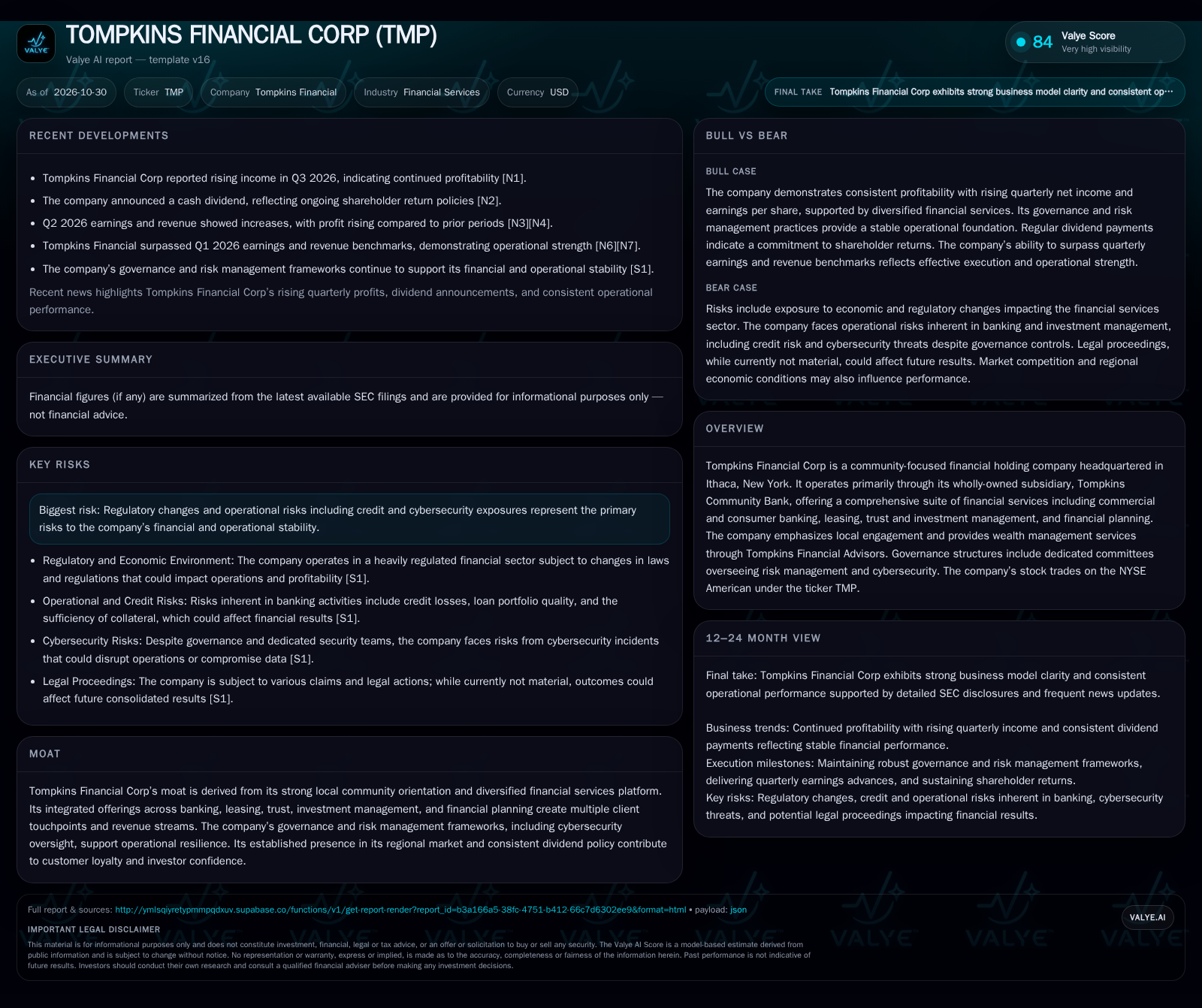
The company’s governance structures and risk management frameworks are notable for a community-focused bank, supporting operational stability. However, its future trajectory will hinge on managing credit quality, regulatory headwinds, and evolving customer needs in a competitive regional landscape. [S2] [N1] [N2] [N3] [N4]
Tompkins Financial Corp stands out in the community banking landscape for its steady profitability, consistent earnings growth, and disciplined governance. With a diversified product suite spanning commercial and consumer banking, leasing, and wealth management, the company has repeatedly surpassed quarterly benchmarks and maintained a reliable dividend. Yet, as regulatory and credit risks evolve and competitors modernize, Tompkins’ ability to sustain its local advantage and risk controls will shape its long-term trajectory.
Recent Earnings Momentum and Dividend Continuity
Tompkins Financial Corp reported net income of $28.65 million for Q3 2026, with basic and diluted earnings per share at $2.01 and $2.00, respectively. These results continue a pattern of rising quarterly profits and consistent earnings outperformance over the past three quarters, as confirmed by multiple independent news sources. The company maintains cash and cash equivalents of $242.15 million as of September 30, 2026. Alongside its earnings, Tompkins has announced ongoing cash dividends, demonstrating a commitment to shareholder returns amid operational strength. [S2] [N1] [N2] [N3] [N4]
How Diversified Local Banking Drives Profitability
Tompkins Financial’s business model revolves around traditional spread-based banking, fee-based services, and wealth management. The company generates interest income primarily from commercial and consumer lending, complemented by noninterest income from trust, investment management, and financial planning services. This diversified mix supports a more stable revenue base than pure lending-centric models, potentially dampening volatility during credit cycles.
Pricing power is generally limited by the highly competitive regional banking market, but Tompkins’ community orientation and integrated service offerings may allow for some premium on relationship-based products and advisory services. Deposits, the primary funding source, are typically low-cost but sensitive to rate competition and macroeconomic conditions. Operating leverage in community banks is often modest due to branch-heavy cost structures, but Tompkins’ focus on risk management and technology oversight could enable incremental efficiency gains, especially if digital adoption accelerates.
Capital needs are governed by regulatory requirements, with balance sheet growth constrained by prudent credit risk management and regulatory capital ratios. The company reported profitability for the period.
A nuanced understanding of Tompkins Financial’s profitability also requires examining the interplay between interest rate cycles and asset-liability management. In a rising rate environment, the bank’s ability to reprice loans faster than deposit costs can enhance net interest margins, but this dynamic depends on the composition and duration of its loan portfolio and deposit base. Conversely, a flattening or declining rate scenario could compress margins unless offset by fee income growth or cost control. The bank’s strategic choices around loan mix—balancing commercial, consumer, and leasing exposures—will influence sensitivity to economic cycles and credit risk, shaping earnings volatility and capital allocation priorities.
Local Scale, Customer Relationships, and the Pressure from Larger Banks
Tompkins Financial’s competitive position is shaped by its strong local brand, long-standing customer relationships, and the breadth of its financial services. Its ability to offer commercial banking, leasing, trust, and wealth management under one regional umbrella creates multiple touchpoints and enhances customer retention. However, the company operates in a crowded landscape, facing competition from larger national banks, fintech entrants, and credit unions—all of which may offer superior digital experiences or pricing.
Switching costs for core banking services remain moderate, but Tompkins’ integrated advisory and wealth management offerings could increase client stickiness among higher-value segments. The company’s governance and risk management frameworks, including specialized cybersecurity oversight, provide an additional layer of resilience and may reassure both customers and regulators. However, absent scale-driven cost advantages or proprietary technology, the company must rely on service quality, local knowledge, and operational discipline to defend its niche.
The competitive landscape also imposes strategic imperatives on Tompkins Financial’s product innovation and technology adoption. While community banks traditionally rely on personal relationships, evolving customer expectations increasingly demand seamless digital experiences, mobile access, and real-time service capabilities. The bank’s capacity to integrate digital tools without diluting the personalized service ethos may determine its success in attracting younger demographics and retaining existing clients. Moreover, partnerships or investments in fintech could provide scalable solutions to enhance operational efficiency and broaden service offerings, but these require careful governance to mitigate technology and compliance risks inherent in third-party relationships.
Unlocking Value through Relationship Deepening and Digital Leverage
If Tompkins Financial successfully deepens existing client relationships—cross-selling advisory, trust, and investment management services—while leveraging technology to enhance efficiency and customer engagement, the company could increase its share of wallet and improve its cost structure.
Confirmation of this trajectory would include sustained above-peer growth in noninterest income (if disclosed), evidence of improved operating efficiency ratios, and continued outperformance versus quarterly earnings benchmarks. Accelerated uptake of digital banking services and expansion in wealth management assets under administration would further validate this pathway.
Expanding on the potential for digital leverage, Tompkins Financial could capitalize on data analytics to deepen customer insights, enabling more targeted cross-selling and risk assessment. By harnessing customer data responsibly, the bank can tailor product recommendations, optimize pricing, and proactively manage credit exposure, thereby enhancing both revenue and risk-adjusted returns. Additionally, embracing automation in back-office processes could reduce operational costs and error rates, freeing resources for strategic initiatives. Success in these areas would likely manifest in improved efficiency ratios, higher customer lifetime value, and a more resilient earnings profile amid competitive pressures.
Sustained Community Banking Performance with Incremental Efficiency Gains
The most plausible scenario is that Tompkins Financial continues to deliver steady, moderate earnings growth driven by its diversified product base and disciplined risk management. Credit quality remains stable, and regulatory compliance is managed without major disruptions.
This scenario would be confirmed by consistent quarterly earnings in line with recent trends, stable net interest margins, manageable credit losses, and ongoing regulatory compliance. Modest growth in noninterest income and gradual improvements in cost management would further support the base case.
Credit Deterioration, Regulatory Shocks, or Cyber Events Erode Resilience
An adverse scenario could materialize if regional economic weakness leads to higher credit losses or if regulatory changes impose new compliance costs, squeezing margins and profitability. Additionally, despite governance controls, a significant cybersecurity incident could disrupt operations or damage customer trust, resulting in financial and reputational harm.
Evidence supporting this scenario would include a spike in loan loss provisions, declining net interest margins, or regulatory disclosures indicating new compliance burdens. A material data breach or operational disruption would further confirm downside risk, as would missed earnings targets or dividend cuts.
What Will Determine Tompkins Financial’s Next Phase of Value Creation?
Quarterly trends in noninterest income from advisory, trust, and wealth management services—if disclosed—would help gauge the success of cross-selling and diversification.
Net interest margin evolution relative to peer banks, indicating the company’s pricing discipline and funding cost management.
Credit quality metrics, including nonperforming loan ratios and loan loss provisions, to detect early signs of regional or sectoral stress.
Operating efficiency ratios (e.g., expense-to-revenue), particularly as digital adoption and cost initiatives progress.
Customer retention and satisfaction measures, such as deposit growth or churn rates, if made available.
Disclosure of material cybersecurity incidents or enhancements to the risk management framework.
Regulatory developments or legal proceedings that could impact capital requirements or operational flexibility.
Disclaimer: This is research-only, informational analysis and not investment advice. It may include AI-generated interpretation and general industry context. Always verify important details using primary sources.

Comments