
Old Republic International: Insurance Scale, Investment Leverage, and the Stakes of Underwriting Discipline in 2026
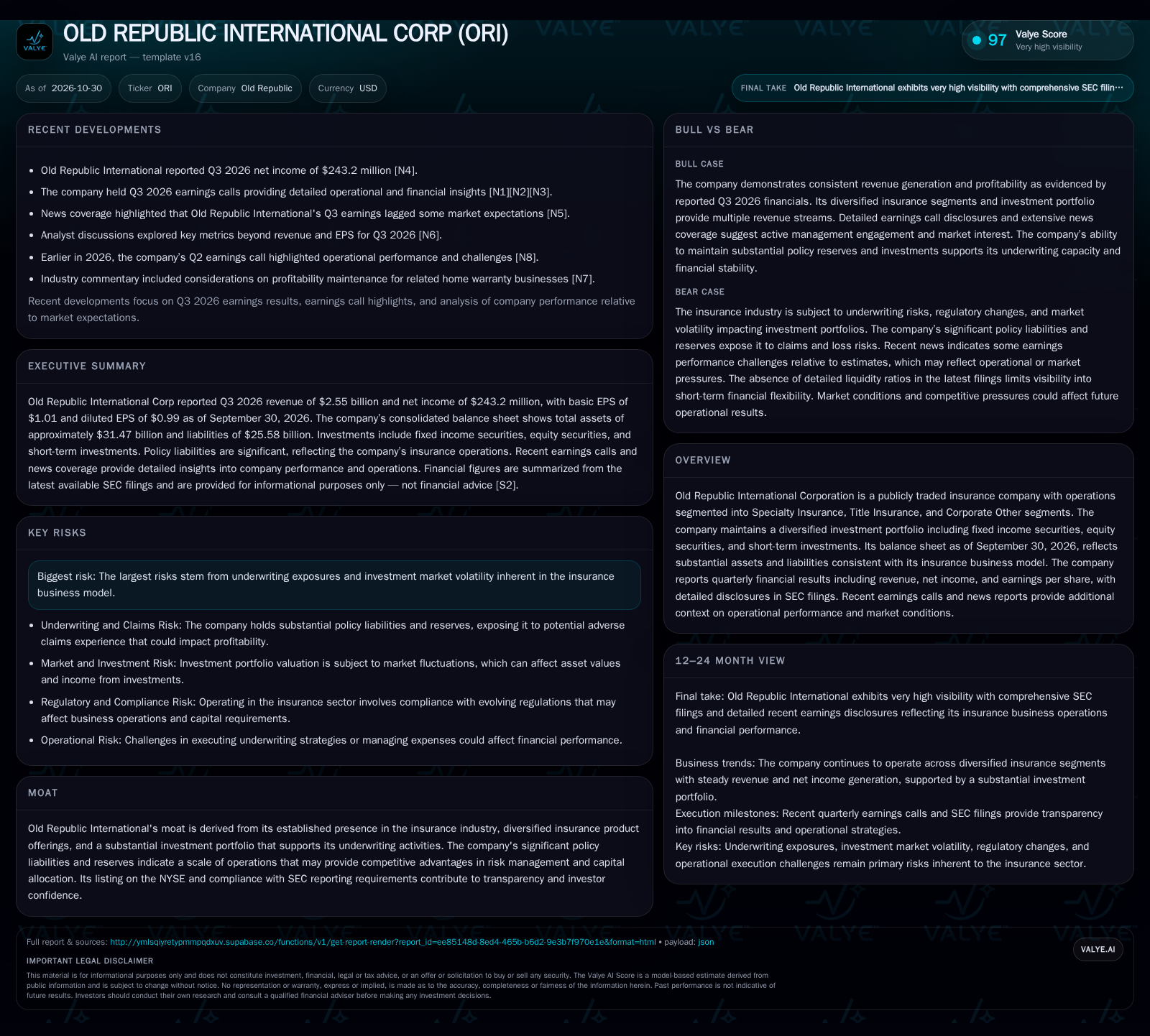
Old Republic’s Q3 2026 results highlight the company’s scale across specialty and title insurance, with net income of $243.2 million on $2.55 billion in revenue. The durability of its business now turns on the interplay between underwriting performance and investment returns against a backdrop of elevated policy liabilities and sector-wide uncertainty.
Old Republic International’s latest quarterly results reinforce its position as a diversified insurer with sizable assets and investment holdings. While profitability remains solid, the tension between underwriting outcomes, investment portfolio performance, and hefty policy reserves will determine its ability to sustain earnings power and fend off sector headwinds.
Old Republic International’s third quarter 2026 snapshot underscores the classic strengths—and vulnerabilities—of a mature multiline insurer. With $2.55 billion in revenue and $243.2 million in net income for Q3, Old Republic’s business is underpinned by substantial policy reserves and a diversified $16.6 billion-plus investment portfolio. Yet, as recent earnings missed some analyst expectations, the company’s ability to translate scale into consistent, high-quality profits will hinge on underwriting discipline, claims management, and the performance of its investment assets in a volatile macro environment. The next phase will test whether Old Republic’s structural advantages can offset sector headwinds and deliver sustainable value for shareholders.
Recent Financial Performance Sets the Stage for Strategic Choices
Old Republic International reported Q3 2026 revenue of $2.5505 billion and net income of $243.2 million, translating to diluted EPS of $0.99 [S2] [N4]. The company’s consolidated balance sheet as of September 30, 2026, shows $31.47 billion in total assets and $25.58 billion in liabilities, with policy liabilities (including loss reserves and unearned premiums) reaching $20.82 billion [S2]. Investments comprise $12.14 billion in fixed income, $2.25 billion in equities, and $2.26 billion in short-term instruments, while cash on hand is $336 million [S2].
Recent earnings calls and news coverage indicate that Q3 results lagged some market expectations, prompting renewed scrutiny of underwriting performance and investment returns [N5]. These facts anchor Old Republic’s current thesis around the sustainability of profitability, the adequacy of reserves, and the potential for investment-driven earnings volatility.
How Insurance Segment Mix and Investment Portfolio Drive Returns
Old Republic’s core economics stem from collecting premiums (insurance revenues), investing those premiums (the ‘float’), and managing claims and expenses to generate an underwriting profit. The company’s business spans Specialty Insurance, Title Insurance, and Corporate Other segments, each with distinct risk profiles and return drivers [S2]. Specialty Insurance typically offers higher-margin, higher-risk products, while Title Insurance is more sensitive to real estate transaction volumes and interest rate cycles.
The investment portfolio—over $16.6 billion across fixed income, equities, and short-term assets—provides a secondary source of earnings. Investment income can cushion underwriting losses but also exposes the company to market volatility. The fixed income allocation suggests a conservative tilt, but equity and short-term securities introduce variability, especially if interest rates or asset prices shift rapidly.
Operating leverage in insurance arises when premium growth outpaces expense growth, but claims volatility and regulatory capital requirements can quickly erode margins. Reserve adequacy is a constant balancing act: over-reserving ties up capital, while under-reserving risks future losses. Capital needs are dictated by regulatory mandates and the need to maintain customer and ratings-agency confidence—especially with policy liabilities at $20.82 billion [S2].
Scale, Diversification, and the Challenge of Differentiation in Insurance
Old Republic’s competitive position is anchored in its scale, segment diversity, and established reputation as a multiline insurer. Its presence in both Specialty and Title Insurance broadens its revenue base, potentially reducing overall volatility compared to mono-line competitors. The substantial investment portfolio enables risk pooling and investment leverage, supporting returns in favorable market cycles.
However, structural advantages are tempered by sector realities. Insurance is intensely competitive, with price-sensitive customers, low switching frictions for certain lines, and periodic bouts of pricing pressure. Regulatory compliance and capital adequacy are table stakes, not differentiators. In Title Insurance, cyclical swings in transaction volumes and interest rates can compress margins across the industry. Specialty lines face ongoing competition from national carriers and niche players alike.
Barriers to entry remain meaningful due to regulatory requirements, capital intensity, and the need for underwriting expertise, but established peers with similar resources limit the scope for sustainable excess returns. The question is whether Old Republic’s operational discipline and segment mix can consistently outperform through the cycle.
When Underwriting Discipline and Investment Tailwinds Align
The favorable scenario for Old Republic hinges on a period of disciplined underwriting, benign claims experience, and stable-to-rising investment yields. If the company can sustain or improve its combined ratio (the sum of loss and expense ratios) across segments, underwriting profit would add to investment income, potentially driving double-digit ROE.
Further, if interest rates remain elevated or rise moderately, fixed income reinvestment could lift investment returns without triggering major mark-to-market losses. Title Insurance volumes could rebound if real estate activity accelerates, while Specialty Insurance pricing remains rational.
Evidence that would confirm this scenario includes reported improvement in combined ratios, rising investment income, modest reserve releases, and sequential growth in segment profitability. Management commentary on disciplined underwriting and favorable claims trends during earnings calls would further support the case.
Navigating Margin Pressures in a Mixed Macro Environment
The most plausible trajectory for Old Republic involves steady revenue growth, modest investment income improvement, and periodic margin pressures from claims volatility or competitive pricing. Title Insurance volumes may remain subdued if housing market recovery is slow, while Specialty Insurance could offset with more stable or growing premiums.
Investment returns are likely to be solid but not exceptional, with fixed income yields gradually rising and equity returns subject to market swings. Underwriting margins may fluctuate but remain within a historical range, as the company manages reserve adequacy and expense discipline.
Confirmation would come from relatively stable combined ratios, consistent (if unspectacular) investment income, and segment results tracking historical norms. Any major reserve adjustments or outsized claims would challenge this scenario.
Adverse Claims or Investment Shocks Undermine Profitability
The adverse scenario unfolds if Old Republic faces a spike in large claims, reserve shortfalls, or a sharp downturn in its investment portfolio. Catastrophic events, litigation, or regulatory changes could drive loss ratios higher, forcing reserve increases and eroding earnings.
A rapid decline in equity markets or a reversal in fixed income valuations would hit investment income and could trigger unrealized losses. If Title Insurance remains weak due to prolonged housing market stagnation, overall revenue and profitability could come under sustained pressure.
This scenario would be confirmed by deteriorating combined ratios, significant reserve charges, and negative investment income trends. Management disclosures of adverse claims developments or major mark-to-market losses would signal deeper operational and financial stress.
Milestones and Metrics That Will Test Old Republic’s Strategic Resilience
Quarterly and annual combined ratios for each major insurance segment, to track underwriting discipline and claims experience.
Investment income trends, including realized and unrealized gains/losses across fixed income and equity portfolios.
Reserve development disclosures—specifically any significant strengthening or releases, which would indicate claims trends and reserve adequacy.
Title Insurance premium volume and margin trends, as a proxy for real estate cycle sensitivity.
Specialty Insurance premium growth relative to industry benchmarks, to assess competitive positioning and market share (if disclosed).
Management commentary on pricing discipline and expense management during earnings calls.
Regulatory or ratings-agency commentary on capital adequacy and policy liability coverage.
Disclaimer: This is research-only, informational analysis and not investment advice. It may include AI-generated interpretation and general industry context. Always verify important details using primary sources.

Comments