
Teradyne in 2026: AI-Driven Test Demand, Cyclicality, and the Stakes of Customer Concentration
Teradyne’s Q3 2026 results highlight the transformative impact of AI demand on semiconductor test equipment, but also underscore persistent risks from industry cyclicality and a highly concentrated customer base. The company’s ability to leverage proprietary technology, navigate competitive threats, and manage supply chain and regulatory complexity will shape its next phase.
Teradyne’s Q3 2026 performance was propelled by sustained AI-driven demand for semiconductor test equipment, resulting in substantial revenue and profit growth. However, the company’s fortunes remain closely tied to industry cycles and a handful of major customers, and it faces mounting competition, supply chain risks, and regulatory hurdles. The next phase hinges on Teradyne’s ability to innovate, diversify, and defend its position amid volatile industry dynamics.
Teradyne’s most recent quarter demonstrates how the semiconductor industry’s AI supercycle is reshaping demand for advanced test equipment, with the company delivering robust year-over-year revenue and profit gains. Yet these results also reveal the company’s enduring exposure to industry cyclicality, customer concentration, and the operational challenges of serving a global, rapidly evolving market. Whether Teradyne can capitalize on AI-driven momentum while mitigating structural risks will be critical to its future competitiveness and resilience.
AI Surge Drives Q3 Growth, But Customer Concentration and Cyclicality Remain
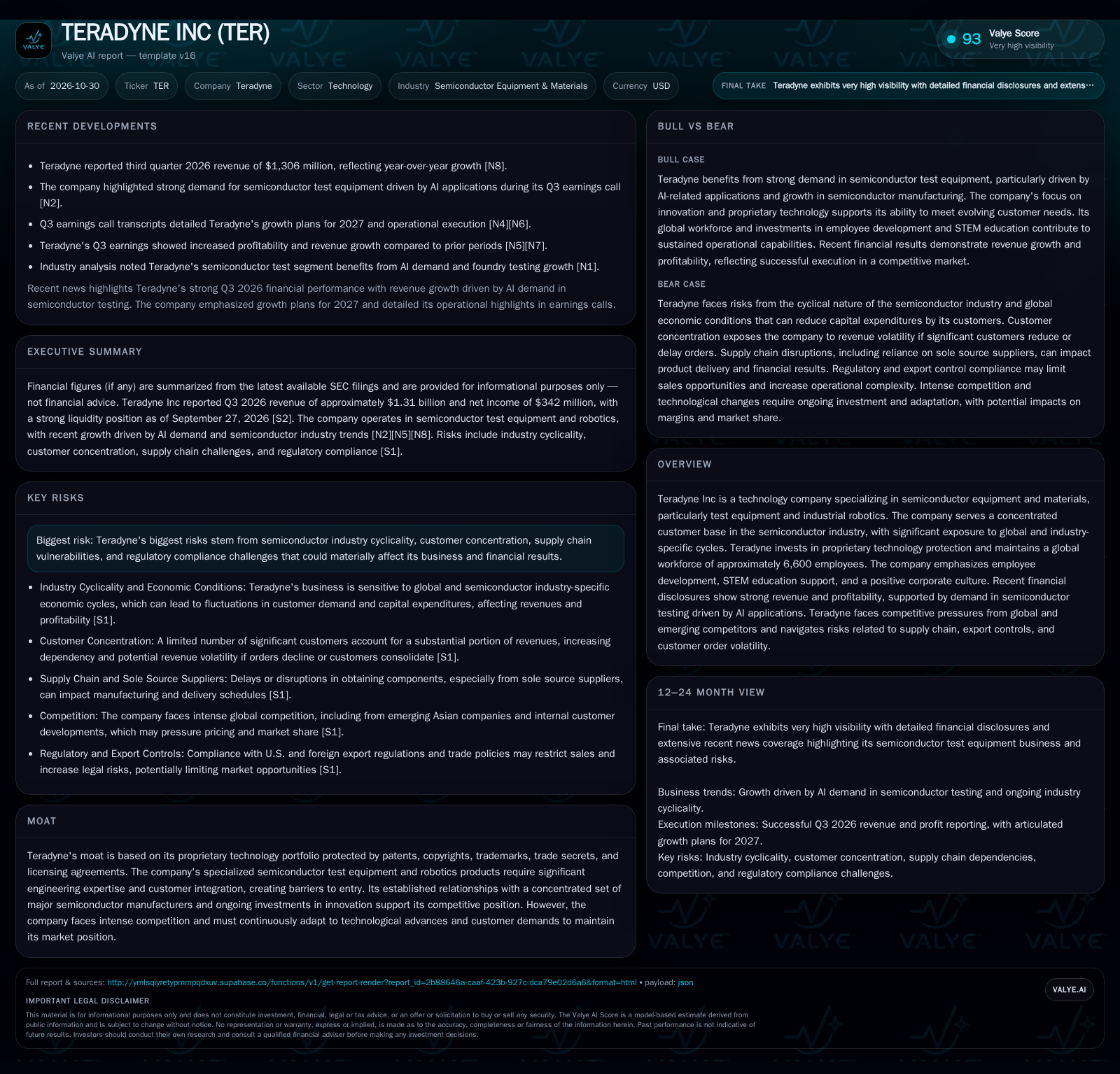
Teradyne reported Q3 2026 revenue of $1.31 billion and net income of $342 million, marking continued year-over-year growth, with basic EPS at $2.19 and diluted EPS at $2.17 [S2] [N5] [N8]. The company’s Semiconductor Test segment revenue increased 77% year over year, propelled by persistent AI-driven demand across compute, memory, and storage markets. Notably, memory test revenue hit a record $301 million, its fourth consecutive quarter above $200 million [S2]. Robotics, while a smaller contributor, achieved profitability on $96 million in quarterly revenue. Despite these gains, Teradyne’s customer base remains concentrated: in 2025, its five largest customers accounted for 44% of total revenues [S1]. This concentration, combined with the cyclical nature of the semiconductor industry, leaves Teradyne exposed to significant revenue volatility based on customer spending and macroeconomic swings.
Revenue Mix, Operating Leverage, and the Economics of Test Equipment
Teradyne’s business model is anchored in selling sophisticated automated test equipment, which is capital-intensive for customers but mission-critical to semiconductor manufacturing and quality assurance. The company’s revenue is heavily weighted toward large, lumpy system sales—particularly in its Semiconductor Test segment—while recurring revenue from servicing, upgrades, or software may be less significant compared to the upfront equipment sales, unless explicitly structured as such. This model can generate strong gross margins when demand is high, due to high engineering value-add and limited direct substitutes. However, fixed costs in R&D and manufacturing infrastructure create operating leverage, amplifying both upside in demand surges and downside during industry contractions.
The company’s Q3 2026 results suggest that operating leverage worked in its favor, with robust incremental profitability as volumes rose [S2]. However, this leverage also means that a downturn in semiconductor capital expenditures could quickly compress margins. Capital needs are largely driven by ongoing R&D investment to maintain technological leadership and by working capital requirements tied to inventory and supply chain management. Robotics, while profitable in the quarter, remains a smaller revenue stream and may have different margin characteristics and capital intensity compared to the core test business.
Defending the Moat: Proprietary Technology vs. Global Rivals and Customer Insourcing
Teradyne’s competitive position relies on its portfolio of proprietary technologies, protected by patents, trade secrets, and a history of engineering expertise. The complexity of semiconductor test requirements and the need for close integration with customers’ manufacturing processes create meaningful switching frictions and barriers to entry for new competitors. However, the intensity of global competition is increasing, especially from emerging Asian equipment suppliers and the trend of large semiconductor customers developing their own in-house solutions [S1].
While Teradyne’s established relationships with leading chipmakers and its ongoing investments in innovation support its market share, these strengths are counterbalanced by the risk of technological leapfrogging and pricing pressure. The pace of semiconductor innovation—especially in AI, advanced memory, and high-speed interconnects—means that any lapse in R&D or customer responsiveness could erode Teradyne’s advantage. Furthermore, customer consolidation in the semiconductor industry could further compress Teradyne’s bargaining power and margin structure.
AI Testing Boom Sustains Multi-Year Growth and Margin Expansion
A favorable scenario for Teradyne is that the current wave of AI-driven semiconductor investment persists well into 2027 and beyond, with chipmakers and systems companies continuing to expand capacity and requiring ever-more sophisticated test solutions. In this case, Teradyne could see sustained high demand in both its Semiconductor Test and Product Test segments, supporting operating leverage and possibly enabling Robotics to scale into a more material profit contributor. If Teradyne can maintain its pace of innovation and secure multiyear contracts or deeper integration with top customers, recurring revenue or higher-margin service streams could emerge.
Evidence confirming this scenario would include continued sequential revenue and margin expansion, new product launches tied to AI and advanced memory, and disclosures of multi-year customer commitments or design wins. Conversely, a sharp deceleration in AI infrastructure buildouts, or signs that key customers are shifting spend to competitors or insourcing, would falsify this upside case.
Cyclical Normalization Amid Persistent Volatility and Competitive Pressures
The most plausible trajectory is that AI-related demand remains elevated but begins to moderate as chipmakers digest recent capacity additions, resulting in more normalized—though still above historical—levels of test equipment sales. Revenue growth may flatten or become more volatile, with quarter-to-quarter swings tied to customer capex cycles. Teradyne’s operating margins could remain healthy but less robust than during peak demand, especially if competitive pricing pressures intensify or R&D spending rises to keep pace with technological change.
In this scenario, customer concentration remains a double-edged sword: while Teradyne may retain its position with key accounts, any disruption or loss of a major customer would have outsized impact. Confirmation could come from guidance pointing to mid-single-digit revenue growth, stable gross margins, and continued, but not accelerating, R&D investment. Falsification would occur if order cancellations, backlog volatility, or competitive share losses accelerate more than expected.
Semiconductor Downturn, Customer Losses, and Margin Compression
A negative scenario would see a sharp contraction in semiconductor capital spending, driven by macroeconomic weakness, inventory corrections, or a slowdown in AI-related projects. In this case, Teradyne could experience a rapid drop in equipment orders, with fixed R&D and manufacturing costs leading to margin compression and potential operating losses in lower-volume quarters. Customer concentration amplifies this risk: if a top customer consolidates, insources, or delays investment, revenue could decline disproportionately.
Evidence supporting this downside would include a sequential decline in orders, guidance cuts, or disclosures of significant customer cancellations or delays. Additional stress could come from supply chain disruptions, regulatory restrictions limiting sales to key international markets, or the emergence of low-cost competitors eroding price and share.
Milestones and Data Points That Will Shape Teradyne’s AI-Driven Test Thesis
Quarterly order intake and backlog trends for Semiconductor Test and Product Test: a useful metric would be order visibility beyond the next two quarters.
Customer concentration metrics: changes in the percentage of revenue from the top five customers would help test dependency risk.
Product-level growth rates, especially for AI and memory test equipment: disclosures of new design wins or major product launches would be informative.
Robotics segment profitability and revenue mix: sustained profitability or rapid growth would indicate scaling success.
Gross margin trends: movement in gross margin could signal pricing power, competitive pressure, or cost discipline.
R&D spending as a percentage of revenue: a shift here could indicate either strategic investment or cost containment.
Supply chain and regulatory disclosures: any material commentary on sole source dependencies, trade restrictions, or export control impacts would be critical.
Evidence of customer insourcing or competitive displacement: public wins/losses or commentary from major chipmakers would help clarify share dynamics.
Disclaimer: This is research-only, informational analysis and not investment advice. It may include AI-generated interpretation and general industry context. Always verify important details using primary sources.

Comments