
Exelon’s Regulated Utility Model: Navigating Capital Demands and Regulatory Certainty in 2026
Exelon’s recent earnings beat and upgraded FY26 outlook highlight its resilience within a tightly regulated utility landscape. With nearly $10 billion in capital expenditures planned for infrastructure upgrades this year, the company’s performance will hinge on its ability to balance regulatory cost recovery, funding requirements, and operational execution amid evolving credit and commodity risk.
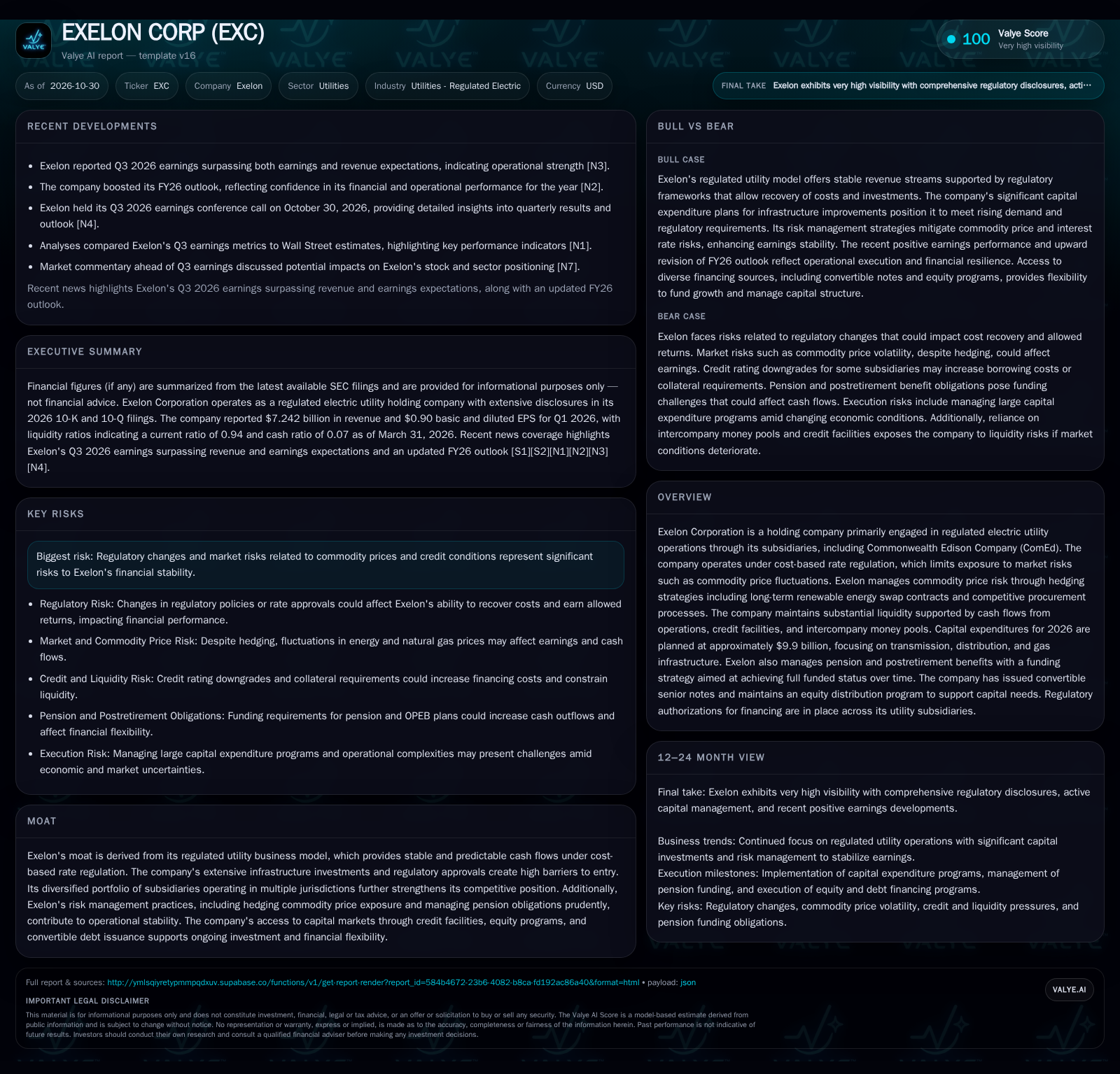
Exelon’s Q3 2026 earnings exceeded expectations, prompting an upward revision of its full-year outlook as the company advances a $9.9 billion capital expenditure program. Its cost-based, regulated model provides revenue stability but leaves Exelon exposed to regulatory decisions, credit rating shifts, and the need to manage pension and postretirement obligations. The company’s future hinges on its ability to secure allowed returns, maintain access to low-cost capital, and execute on infrastructure investments without eroding potential financial flexibility.
Exelon’s latest quarterly results and upgraded FY26 outlook underscore the company’s ability to deliver stable performance in a capital-intensive, regulated environment. As Exelon embarks on nearly $10 billion in infrastructure investments this year, its fortunes are closely tied to regulatory frameworks that determine cost recovery and allowed returns, as well as its access to affordable capital. With credit ratings under pressure for some subsidiaries and persistent pension funding requirements, Exelon’s execution on both operational and financial fronts will be critical to sustaining its current trajectory.
Earnings Momentum and Capital Deployment Take Center Stage
Exelon reported Q3 2026 earnings and revenue that surpassed analyst expectations, prompting management to raise its full-year outlook [N3] [N2]. This performance comes as the company advances a $9.9 billion capital expenditure program for 2026, targeting upgrades across its transmission, distribution, and gas segments [S2]. As of March 31, 2026, Exelon held $713 million in cash and cash equivalents against $9.588 billion in current liabilities, producing a current ratio of 0.94 and a cash ratio of 0.07 [S2]. Meanwhile, the company faces $325 million in scheduled pension contributions for the year [S2]. These facts underscore a pivotal moment: Exelon’s ability to execute on its infrastructure ambitions and manage funding requirements will shape both its near-term potential financial flexibility and long-term value.
How Exelon’s Regulated Model Shapes Cash Flows and Capital Needs
Exelon’s revenue is largely determined by cost-based rate regulation, which allows utilities to recover prudently incurred operating and capital costs plus a regulated return on equity. This model provides stability but constrains pricing autonomy, tying profitability to regulatory decisions and the timing of allowed rate increases. The company’s $9.9 billion capital expenditure plan for 2026 is focused on grid modernization, reliability, and gas infrastructure, which require ongoing regulatory approval for cost recovery [S2].
Operating leverage is moderate: while much of Exelon’s cost base is fixed (infrastructure, labor, pensions), allowed returns are set to cover these costs plus an equity premium. Capital intensity is high, and the company’s funding mix includes equity (via an ATM program for up to $2.5 billion), debt (including recent $1 billion convertible notes), and operating cash flows [S2]. Pension and postretirement obligations add a recurring cash drain, and interest rate risk is partially mitigated by a preference for fixed-rate borrowings. The economic challenge is to align capital deployment with regulatory recovery, avoid excessive rate base lag, and manage funding costs amid evolving credit conditions.
A critical dimension of Exelon’s regulated model is the timing mismatch between capital expenditures and regulatory recovery, often referred to as rate base lag. Since cost recovery depends on regulatory approvals and rate case cycles, there can be delays between when capital is deployed and when revenues reflect those investments. This lag introduces working capital requirements and can pressure liquidity, especially during periods of accelerated capital spending. Effective management of this timing gap, potentially through regulatory mechanisms such as construction work in progress (CWIP) recovery or accelerated depreciation, can materially influence cash flow stability and reduce the need for external financing.
Another nuanced aspect is the interplay between allowed returns and the company’s capital structure. Regulators typically set allowed returns based on a deemed capital mix and cost of capital assumptions, which may differ from the utility’s actual financing mix. If Exelon’s actual cost of debt or equity diverges from regulatory assumptions, it can create earnings volatility. Moreover, regulatory frameworks may limit the company’s ability to fully capitalize certain costs or recover expenses promptly, requiring careful financial planning to avoid margin compression. Thus, the alignment between regulatory cost recovery mechanisms and Exelon’s capital markets strategy is essential for sustaining financial health.
Barriers, Peers, and the Limits of Differentiation in Regulated Utilities
Exelon’s competitive position is defined less by direct rivalry and more by regulatory environment and geographic footprint. High barriers to entry stem from capital requirements, regulatory approvals, and entrenched infrastructure. Incumbency in multiple jurisdictions and a diversified portfolio of utility subsidiaries provide some risk diversification. However, unlike in unregulated power markets, competitive differentiation is muted: pricing, margins, and investment returns are set by regulators, not market forces.
Peer companies—such as other large U.S. regulated electric and gas utilities—face similar capital needs, regulatory risks, and pension funding challenges. The main vectors for relative outperformance are operational efficiency, execution on capital plans, and the ability to secure favorable regulatory outcomes (e.g., higher allowed returns or accelerated cost recovery). Technology substitution risk (e.g., distributed generation, storage, energy efficiency) is present but limited by regulatory frameworks that often allow utilities to earn on new investments in grid modernization and resilience.
What Could Drive Outperformance: Regulatory Tailwinds and Capital Efficiency
A favorable scenario for Exelon would involve successful execution of its $9.9 billion capital plan, with regulators allowing timely and full recovery of costs at attractive rates of return. If Exelon can demonstrate operational excellence—delivering projects on time and under budget—it may earn incentive returns, boosting earnings above baseline regulatory allowances.
Evidence supporting this scenario would include further upward revisions to guidance, regulatory approvals for higher ROEs or accelerated cost recovery, and continued earnings beats. In addition, visible progress on infrastructure upgrades and pension funding could reinforce the narrative of execution strength.
In addition to regulatory approvals, technological advancements and innovation in grid management could enhance Exelon’s operational efficiency and reduce capital intensity over time. If the company successfully integrates digitalization, automation, and predictive maintenance into its infrastructure upgrades, it could lower operating costs and improve asset utilization. This operational leverage would complement regulatory incentives, potentially leading to improved returns on invested capital. However, such benefits are conditional on regulatory acceptance of new technologies and associated costs, as well as Exelon’s ability to execute complex modernization projects without significant delays or cost overruns.
Furthermore, evolving regulatory policies that encourage decarbonization and resilience investments may create opportunities for Exelon to expand its rate base with projects that qualify for enhanced returns or performance-based incentives. If regulators prioritize grid modernization aligned with environmental goals, Exelon could leverage its capital program to capture incremental earnings beyond traditional cost-of-service frameworks. This scenario depends on favorable policy environments and the company’s ability to demonstrate the value proposition of such investments to regulators and stakeholders, potentially positioning Exelon ahead of peers in securing supportive regulatory treatment.
Navigating the Status Quo: Steady Returns Amid Regulatory and Funding Constraints
The most plausible path is that Exelon continues to deliver steady, regulated returns in line with recent history. The company executes on its capital program with modest overruns, secures routine cost recovery from regulators, and manages funding needs via a blend of operating cash, ATM equity issuance, and new debt. Pension contributions remain a recurring but manageable cash demand, and credit ratings for most subsidiaries remain stable, though not improving.
The base case assumes no major regulatory shocks, commodity price spikes, or execution failures in capital deployment.
When Regulatory, Credit, or Execution Risks Materialize
A negative scenario could unfold if Exelon faces adverse regulatory decisions—such as denied or delayed cost recovery, lower allowed returns, or unfavorable rate base adjustments. This could create a lag between investment and earnings, compressing margins and pressuring cash flows. Concurrently, further credit rating downgrades for subsidiaries could raise borrowing costs or trigger collateral requirements, narrowing potential financial flexibility. If pension and postretirement funding needs spike (due to market performance or actuarial changes), cash outflows could exceed projections, forcing greater reliance on external financing.
Signs this scenario is materializing would include downward earnings revisions, regulatory setbacks or litigation, widening debt spreads, increased ATM equity issuance (potentially dilutive), or reductions in dividend guidance.
Milestones That Will Clarify Exelon’s Earnings Power and Capital Discipline
Progress and cost discipline on the $9.9 billion capital expenditure program: Delays, overruns, or regulatory disallowances would impact returns.
Regulatory outcomes on rate cases and allowed ROEs across major subsidiaries: Approvals or challenges will directly affect earnings trajectories.
Frequency and scale of ATM equity issuances: Higher-than-expected dilution could signal funding strain.
Changes in credit ratings for Exelon’s subsidiaries: Further downgrades would increase borrowing costs and limit potential financial flexibility.
Actual pension and postretirement funding outflows versus projections: Increases could pressure free cash flow.
Any sign of regulatory or legal challenges to cost recovery for major infrastructure projects.
If disclosed, metrics on customer rate increases and affordability: Regulatory pushback could constrain future allowed returns.
Disclaimer: This is research-only, informational analysis and not investment advice. It may include AI-generated interpretation and general industry context. Always verify important details using primary sources.

Comments