
Manhattan Associates: Advancing Cloud and AI to Strengthen Supply Chain Platform Leadership
Manhattan Associates is capitalizing on the accelerating shift to cloud-native supply chain and omnichannel commerce solutions, embedding AI to drive operational value. Its versionless platform, quarterly innovation cadence, and SaaS economics underpin recurring revenues, but integration complexity, competition, and capital allocation choices shape both upside and risk.
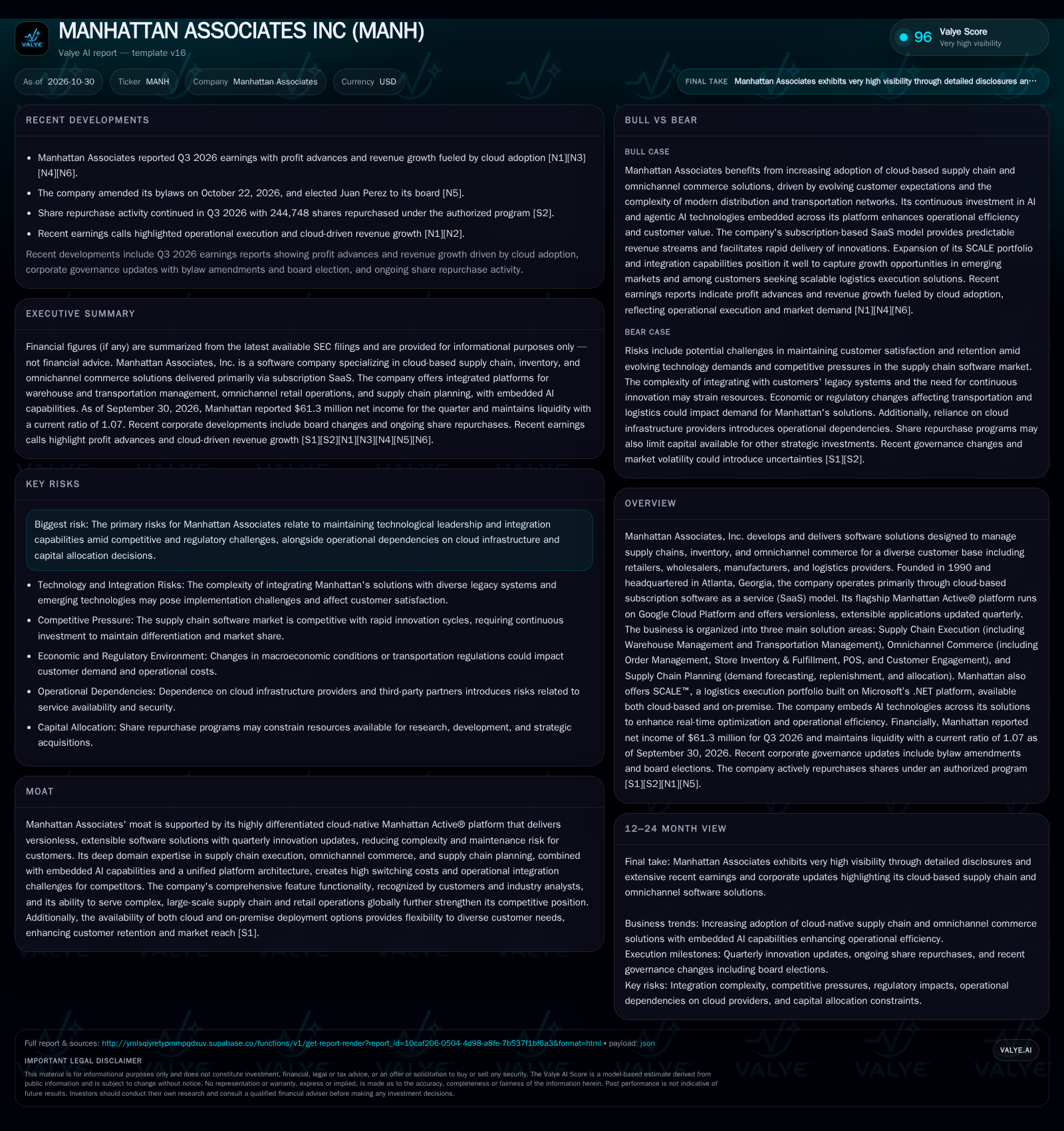
Manhattan Associates’ Q3 2026 results highlight profit and revenue growth driven by cloud adoption and platform innovation. The shift to SaaS, embedded AI, and extensibility position it well for long-term relevance, but the company must navigate integration challenges, intense competition, and resource allocation trade-offs as it seeks to consolidate its leadership in supply chain software. [S1] [S2] [N1] [N3] [N4] [N6]
Manhattan Associates has built a differentiated position in supply chain and omnichannel commerce software by migrating mission-critical operations to a versionless, cloud-native SaaS model and embedding AI to drive efficiency gains. Q3 2026 results show continued profit and revenue growth, outpacing expectations and highlighting customers’ willingness to modernize their supply chain technology stacks. Yet, as the platform deepens its reach and complexity, the company faces a dual challenge: maintaining high customer satisfaction amid difficult integrations and fending off aggressive competition in a rapidly evolving software landscape. The company’s financial profile and capital deployment choices will influence its ability to sustain innovation and defend its leadership in the years ahead. [S1] [S2] [N1] [N3] [N4] [N5] [N6]
Profit Growth, Cloud Progress, and Board Updates Reflect Strategic Direction
Manhattan Associates reported net income of $61.3 million for Q3 2026, with both basic and diluted EPS exceeding $1.00, and quarterly profit and revenue surpassing analyst expectations. This performance is attributed to continued adoption of its cloud-based SaaS offerings, particularly the Manhattan Active® suite, which is designed for continuous upgrades and extensibility. The company reported cash and liquidity metrics for the period; these figures do not by themselves establish operating runway, investment capacity, financial flexibility, or financing capacity. Share repurchases remained active in Q3, with 244,748 shares bought back and $175 million remaining under the authorized program. Governance updates included an amended set of bylaws and the election of Juan Perez to the board, signaling an ongoing refresh of oversight and strategic direction. [S2] [N1] [N3] [N4] [N5] [N6]
SaaS Revenue Streams and Platform Flexibility Underpin Business Model
Manhattan Associates’ core business model is built around subscription-based SaaS delivery, providing customers with supply chain execution, omnichannel commerce, and planning solutions. This transition from perpetual license and maintenance to SaaS has shifted revenue mix toward more predictable, recurring streams, reducing volatility and improving forward visibility. The Manhattan Active® platform, delivered on Google Cloud, allows for versionless deployment—every customer operates on the latest codebase, enabling rapid, quarterly innovation updates and lowering the operational burden for both the company and its clients. Higher gross margins are typical for SaaS compared to legacy on-premise software, and the platform’s extensibility (via the ProActive developer toolkit) encourages customer stickiness and custom solution development, which can expand account value over time.
Embedded AI and agentic automation may further strengthen software economics by driving efficiency for customers and potentially enabling premium pricing or upsell opportunities. However, the company must continue investing heavily in R&D to sustain this innovation cycle. The capital-light nature of SaaS limits the need for large physical assets, but significant ongoing product development and cloud infrastructure costs are necessary to maintain competitiveness. Operating leverage can emerge as the installed SaaS base grows, especially if R&D and customer success costs scale more slowly than recurring revenues.
Evaluating Platform Strengths Amid Competition and Switching Barriers
Manhattan Associates’ competitive position rests on several pillars: a versionless, fully cloud-native architecture; deep domain expertise in supply chain execution and omnichannel commerce; and a platform that unifies execution, planning, and commerce on a single codebase. The quarterly update cadence and embedded AI capabilities make the platform attractive for large, complex organizations that need agility and continuous improvement. High switching costs arise from the platform’s integration deep within customer operations—migrating warehouse, order management, and planning systems is typically costly and operationally risky.
However, the supply chain software market is intensely competitive, with global enterprise software vendors and specialized SaaS challengers all vying for share. Customers may evaluate alternatives based on price, integration ease, and feature fit, and the risk of commoditization increases as core functionalities become standardized across platforms. Integration complexity—especially with legacy environments—can create friction in new deployments and expansion. Manhattan’s ability to maintain its differentiation will depend on sustaining its innovation lead, superior integration support, and leveraging its ecosystem to create lasting customer value.
Market Share Gains Fueled by Cloud Uptake and AI Enhancements
If enterprise and mid-market customers continue accelerating their migration to cloud-native supply chain solutions, Manhattan Associates could see above-trend growth in SaaS subscriptions and cross-sell of its unified platform. Successful deployment of embedded AI—enabling measurable improvements in warehouse throughput, labor productivity, and omnichannel fulfillment—would provide tangible ROI, improving both customer retention and competitive win rates. The quarterly innovation cadence may keep the platform ahead of rivals, while extensibility features could reduce churn and expand wallet share as customers build proprietary extensions atop Manhattan’s core.
Evidence supporting this scenario would include sustained double-digit growth in cloud subscription revenues, rising average contract values, customer wins against major competitors, and public case studies quantifying operational gains from AI modules. Increased R&D leverage—where revenue grows faster than development spend—would also support the thesis of scalable operating economics. Conversely, if cloud adoption slows or AI capabilities are matched by competitors, the upside scenario would be challenged.
Continued Platform Development Faces Integration and Competitive Challenges
The most plausible trajectory is that Manhattan Associates continues to expand its SaaS customer base and enhance its platform, but faces persistent integration challenges and competitive pricing pressure. As the majority of large customers have complex legacy environments, implementation cycles may lengthen and require significant services support, reducing near-term margin expansion. Competitive intensity—particularly from large enterprise resource planning (ERP) vendors and nimble SaaS entrants—could limit pricing power, especially for standardized modules.
Confirmation of this scenario would show steady, but not accelerating, cloud revenue growth, stable customer retention rates, and continued high R&D and customer success spending as a percentage of revenue. If integration projects routinely encounter delays or overruns, or if churn rises in legacy segments, this would reinforce the stickiness of current constraints. On the other hand, a step-change in customer go-lives or a surge in net new logos would suggest a pivot toward the upside case.
Margin Pressures and Customer Losses Risked by Integration Delays and Platform Similarities
Adverse outcomes could materialize if integration complexity becomes a bottleneck, leading to delayed or failed implementations that erode customer satisfaction and increase churn. If competitors narrow the feature gap—especially in AI-driven optimization and cloud delivery—the perceived differentiation of Manhattan’s platform could diminish, resulting in greater pricing pressure and lost deals. Economic or regulatory shocks affecting retail, manufacturing, or logistics could also dampen demand for new software investments, pressuring top-line growth.
Downside evidence would include a rising number of project delays, elevated churn or contract downsizing, margin compression from increased support and implementation costs, and stagnant or declining cloud revenue. If customer wins shift toward lower-value modules or if Manhattan is forced to discount aggressively to retain business, the company’s operating leverage and long-term value proposition would come under stress.
Factors Influencing Manhattan Associates’ Platform Leadership and Profit Trends
Cloud subscription revenue growth rate: Acceleration or deceleration would test the thesis of platform adoption and SaaS leverage.
Gross margin trends: Sustained or expanding margins would indicate effective SaaS scaling and operational leverage. Compression could signal pricing or support cost pressures.
Customer retention and churn rates: High retention and low churn would confirm platform stickiness and integration value.
Implementation cycle times and project success rates: Shorter cycles and high success rates would support the differentiation narrative; frequent overruns would challenge it.
AI module adoption and quantified customer ROI: Evidence of widespread AI-driven gains would reinforce the value proposition and moat.
Competitive win/loss rates against major ERP and SaaS supply chain vendors: Shifts here would indicate changes in market positioning.
R&D and customer success spend as a percentage of revenue: Declining ratios with sustained growth would validate scalable economics; persistently high levels might point to competitive or integration friction.
Material changes in share repurchase activity or capital allocation to R&D/M&A: Reallocation could signal shifting priorities or emerging risks. [S2]
Disclaimer: This is research-only, informational analysis and not investment advice. It may include AI-generated interpretation and general industry context. Always verify important details using primary sources.

Comments