
LyondellBasell After Refining: Asset Sales, Polymer Weakness, and the Stakes of Portfolio Restructuring
LyondellBasell’s exit from refining, substantial non-cash impairments, and ongoing asset divestitures frame a pivotal transition for the chemical giant. As weak polymer prices drag near-term results and portfolio optimization accelerates, the company’s ability to realign toward higher-margin segments and withstand cyclical volatility will define its next chapter.
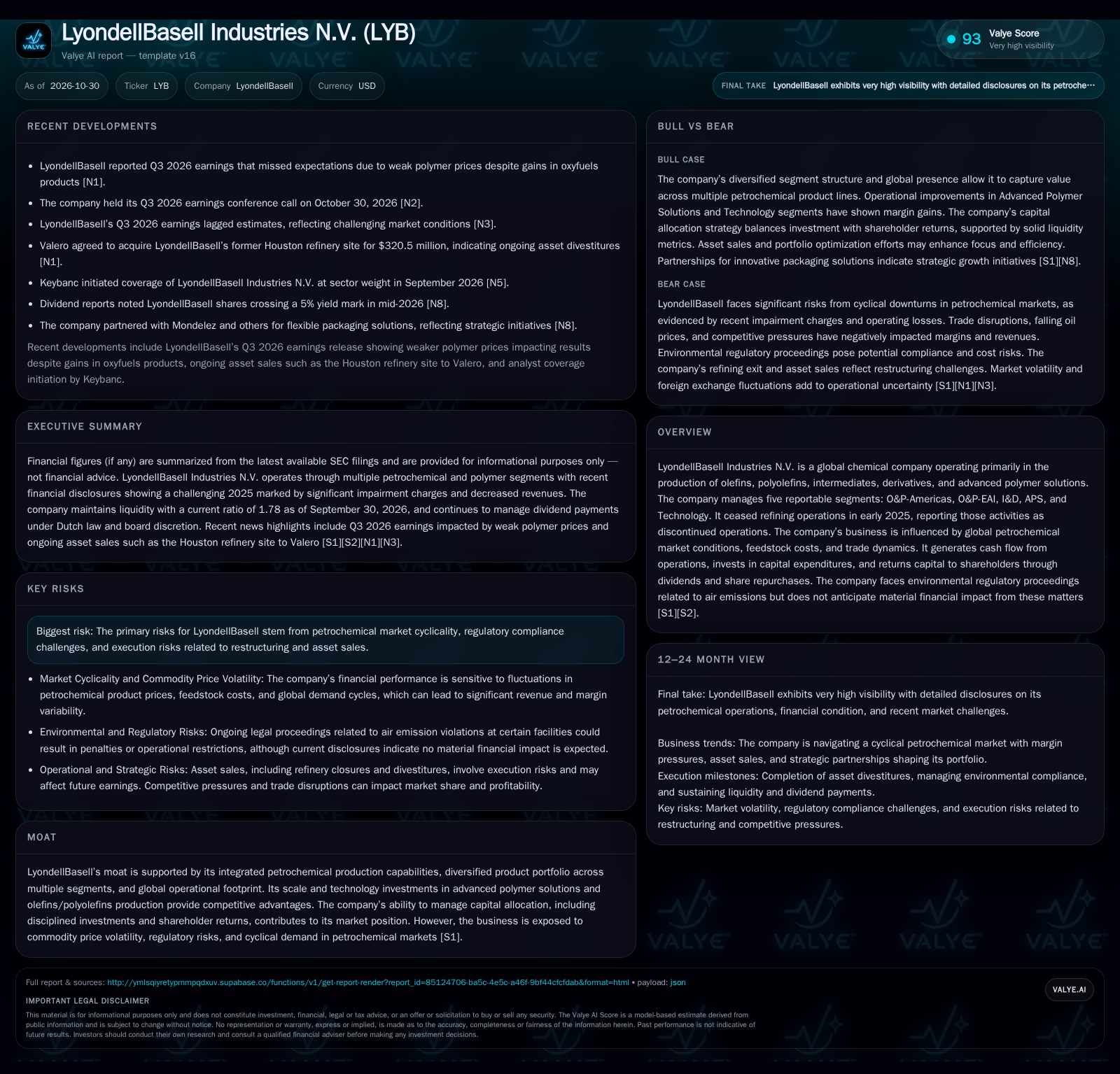
LyondellBasell’s 2025-2026 period is marked by a refining exit, major asset impairments, and weak polymer pricing that pressured earnings. Despite $2.3 billion in 2025 operating cash flow and a $3.2 billion cash balance as of Q3 2026, the company faces headwinds from cyclical downturns and competitive pressures. The focus now shifts to asset sales, capital allocation, and strategic repositioning toward more resilient polymer and derivative markets. Ongoing environmental legal proceedings and volatile feedstock pricing remain risks to watch. [S1] [S2] [N1] [N3]
LyondellBasell Industries N.V. stands at a strategic crossroads after exiting refining, absorbing major impairments, and contending with a challenging polymer pricing environment. The company’s $320 million refinery sale and over $1.2 billion in impairment charges underscore the urgency of portfolio realignment amid cyclical and structural headwinds. With cash flow generation still robust, the focus is now on optimizing its core petrochemical and polymer businesses, managing environmental risks, and repositioning for greater resilience and value creation in a volatile market landscape. [S1] [S2] [N1]
Recent Impairments, Refining Exit, and Asset Sales Reshape LyondellBasell’s Trajectory
LyondellBasell’s last 18 months have been shaped by the cessation of its refining operations in early 2025, culminating in reporting the segment as discontinued and selling its Houston refinery site to Valero for $320.5 million. This strategic move follows a year of significant financial turbulence: 2025 revenues fell 10%, operating income dropped by 122%, and the company posted a $738 million net loss, largely due to over $1.2 billion in non-cash impairment charges tied to European petrochemical and automotive market downturns. Q3 2026 earnings continued to lag expectations, with weak polymer prices offsetting gains in oxyfuels, further highlighting the challenges facing the core business. Meanwhile, LyondellBasell reported a $3.2 billion cash balance and a current ratio of 1.78 as of September 2026, reflecting a still-reported liquidity position despite market adversity. [S1] [S2] [N1] [N3]
How Volume, Pricing, and Capital Allocation Shape Underlying Profitability
LyondellBasell’s economics are fundamentally driven by the spread between petrochemical product prices (notably olefins and polyolefins) and feedstock input costs, both of which are highly sensitive to global supply/demand cycles and energy price volatility. Pricing power is typically limited in commodity resin markets, leading to margin compression during downturns such as the one experienced in 2025-2026. Volume declines—exacerbated by trade disruptions and weak end-market demand in Europe—have further pressured results.
Fixed costs are significant due to the capital-intensive nature of chemical production. Operating leverage can amplify both upside and downside, as seen in the outsized decline in operating income relative to revenue drop in 2025. The company reported cash and liquidity metrics for the period; these figures do not by themselves establish operating runway, investment capacity, financial flexibility, or financing capacity. Strategic capital allocation remains pivotal: LyondellBasell invested $1.9 billion in capex, returned $2 billion to shareholders, and is actively redeploying proceeds from asset sales. The ongoing shift toward Advanced Polymer Solutions and Technology segments could enhance margins if successful, but requires continued investment and innovation to differentiate from basic commodity peers. [S1] [S2]
In addition to pricing and volume dynamics, the timing and scale of capital expenditures critically influence LyondellBasell's profitability trajectory. Capital intensity in petrochemical production necessitates a delicate balance between maintaining asset reliability and pursuing capacity expansions or upgrades. If the company prioritizes maintenance capex to sustain existing operations over growth investments, it may preserve short-term cash flow but risk longer-term competitiveness. Conversely, aggressive investment in advanced polymer technologies could strain liquidity but potentially yield higher returns if market adoption accelerates. Moreover, capital allocation decisions must consider the evolving regulatory environment, especially regarding emissions and sustainability standards, which may require incremental spending to ensure compliance and avoid operational disruptions.
Competitive Pressures Intensify as Commodity Cyclicality and Innovation Collide
LyondellBasell operates in an intensely competitive global petrochemical market, facing rivals across North America, Europe, and Asia. Key competitive factors include feedstock integration, scale, process technology, and the ability to innovate in specialty and advanced polymer applications. The company’s integrated production assets and global footprint provide some cost advantages, but these are often offset by commodity price swings and local overcapacity.
European operations have been especially vulnerable to high energy costs and declining automotive demand, contributing to the recent impairment charges. While LyondellBasell’s partnerships in flexible packaging and recycling signal a pivot toward higher-value segments, competitors are also investing in circular plastics and sustainability-driven innovation. The company’s ability to capture value in these new markets will depend on execution and the pace of regulatory and customer adoption. Meanwhile, substitutes such as biodegradable materials and shifting consumer preferences could erode demand for traditional polymers over time.
Feedstock integration remains a critical competitive lever, as access to low-cost and stable feedstock supplies can materially affect margins in commodity petrochemicals. LyondellBasell's degree of vertical integration and geographic diversification can mitigate some feedstock price volatility, but this advantage is conditional on maintaining operational flexibility and cost discipline. Competitors with more integrated upstream assets or proximity to advantaged feedstocks may sustain pricing power during downturns, challenging LyondellBasell's relative positioning. Additionally, the pace of innovation in specialty polymers and circular economy initiatives will likely differentiate winners from laggards, as customers increasingly demand sustainable and high-performance materials. The company's ability to scale these innovations efficiently and protect intellectual property will be vital to defending market share against both traditional rivals and emerging bio-based or biodegradable alternatives.
If Portfolio Optimization and Specialty Growth Outpace Commodity Headwinds
A favorable scenario for LyondellBasell would see successful portfolio optimization—accelerated by asset sales like the Houston refinery—freeing capital and management bandwidth to target higher-margin, less cyclical segments such as Advanced Polymer Solutions and Technology. If global polymer demand stabilizes and pricing improves in 2027, the company could leverage its scale and operational improvements to expand margins.
Confirmation of the upside would require evidence of sustained volume recovery in core segments, continued margin improvement in APS and Technology, and visible traction from partnerships in flexible packaging or circular solutions. An upward trend in operating income, even as commodity pricing remains volatile, would support the thesis that LyondellBasell’s transformation is yielding results. Material new contract wins in specialty applications or regulatory-driven demand for recycled polymers would further validate the scenario.
Structural Cyclicality Persists Amid Incremental Portfolio Shifts
The most plausible near-term path is continued earnings volatility, with core profitability closely tied to global petrochemical cycles and feedstock price dynamics. Asset sales and the refining exit may improve capital efficiency, but the lion’s share of earnings will likely remain exposed to commodity swings in olefins and polyolefins. European operations may remain a drag unless regional demand meaningfully recovers.
Incremental gains in Advanced Polymer Solutions and value-added products could offset some margin pressure, but are unlikely to fully insulate results from broad market downturns in the next 12-24 months. Conversely, further large impairments or a sustained decline in cash generation would falsify the base scenario.
Further Margin Compression if Polymer Prices Stay Depressed and Asset Sales Stall
In a less favorable scenario, polymer pricing remains weak through 2027 as global overcapacity and economic uncertainty persist. If LyondellBasell faces continued volume declines in key segments and is unable to close planned asset sales at attractive valuations, cash flow could deteriorate. Environmental liabilities or regulatory actions, while not currently expected to be material, could escalate and add to cost pressures.
Prolonged weakness in European operations, delays in strategic partnerships, or a failure to gain traction in specialty segments would further reinforce the bear case.
If macroeconomic uncertainties prolong demand softness, LyondellBasell may face pressure not only from depressed polymer prices but also from tightening credit conditions or rising interest rates, which could constrain refinancing options and elevate borrowing costs. In such a scenario, the company's potential financial flexibility to weather cyclical troughs would be tested, especially if asset sales fail to generate expected proceeds or are delayed. Additionally, regulatory developments—such as stricter environmental mandates or tariffs—could increase operating expenses or limit market access, compounding margin pressures. The risk of technological obsolescence also looms if the company cannot accelerate innovation in advanced polymers or circular solutions, potentially ceding ground to more agile competitors and further eroding profitability.
What Will Reveal LyondellBasell’s Real Progress in Portfolio Transition?
Segment-level volume and margin trends in Advanced Polymer Solutions and Technology—if disclosed—would help test whether the business mix is shifting toward higher-value products.
Operating cash flow generation relative to capital expenditures, particularly as asset sales proceed and market conditions evolve.
The pace, terms, and proceeds of ongoing and future asset divestitures, and whether these translate into improved capital returns or strategic reinvestment.
Updates on environmental legal proceedings, including any new regulatory orders or settlements that could affect operational flexibility or cost structure.
Evidence of meaningful commercial progress in flexible packaging and circular polymer partnerships, such as new contracts or production scale-up announcements.
Any disclosed changes in European operational footprint, including plant closures, capacity reductions, or further impairment charges.
Disclaimer: This is research-only, informational analysis and not investment advice. It may include AI-generated interpretation and general industry context. Always verify important details using primary sources.

Comments