
C.H. Robinson’s AI Leverage, Acquisition Ambitions, and the Stakes of Margin Expansion in Global Logistics
C.H. Robinson is combining proprietary Lean AI, a global logistics network, and a pending acquisition of RXO to drive operating margin gains and scale. The company’s short-term contract structure, exposure to industry pricing dynamics, and execution risk on M&A will determine whether recent efficiency and technology wins can translate into sustained economic advantage.
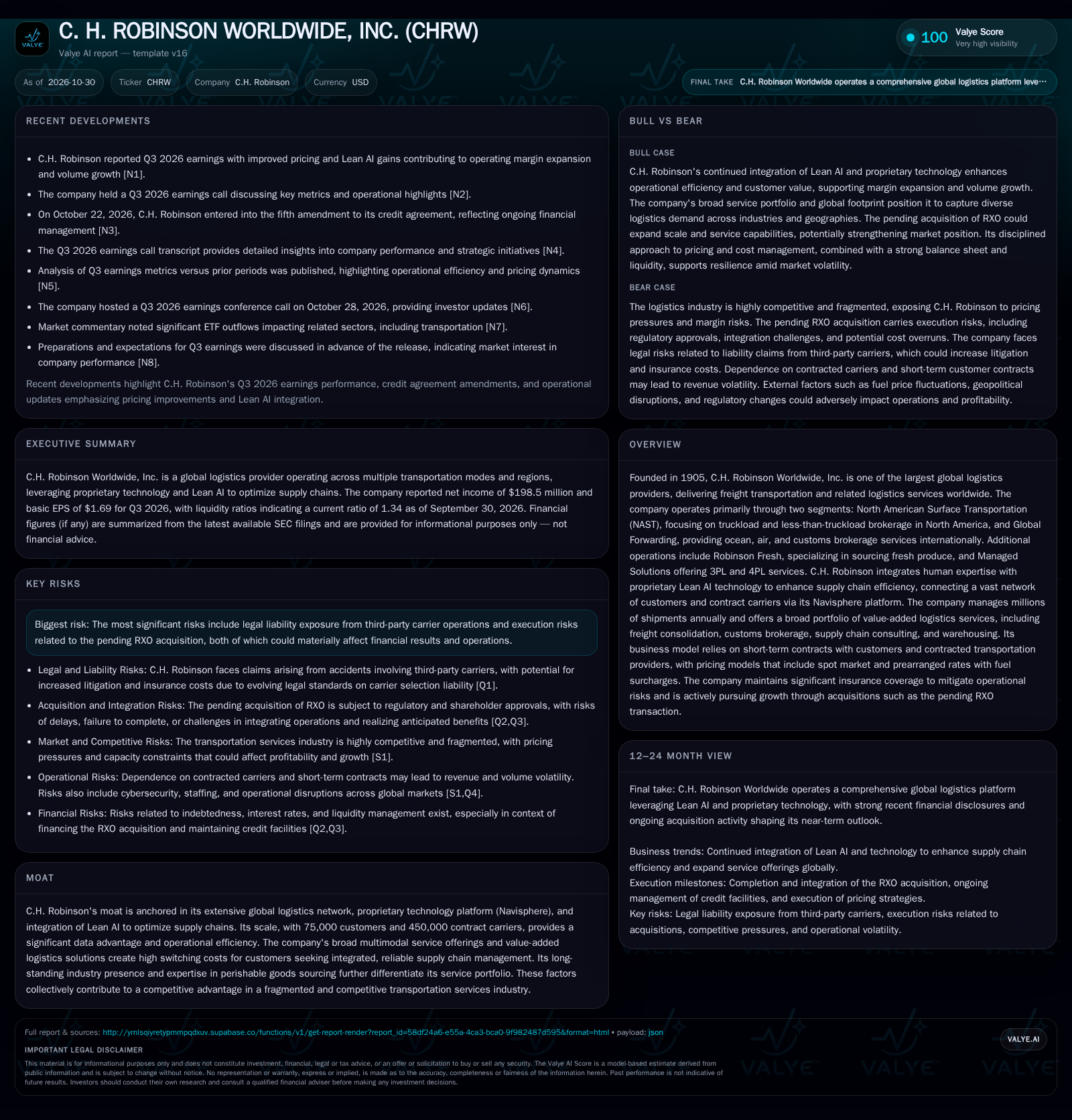
C.H. Robinson reported $16.2 billion in 2025 revenue and Q3 2026 net income of $198.5 million, with operating margin expansion attributed partly to Lean AI gains. The company’s business model is built on short-term contracts, multimodal logistics, and a proprietary technology platform connecting 75,000 customers to 450,000 contract carriers. A definitive agreement to acquire RXO, Inc. could reshape its scale and service breadth, but integration and execution risks remain. The logistics sector’s fragmentation and price competition are persistent headwinds, while the company’s global reach and technological investments are central to its competitive stance. Key future markers include RXO deal completion, sustained margin improvement, customer retention, and the realization of AI-driven efficiencies.
C.H. Robinson Worldwide stands at a strategic crossroads: recent financial reports show margin expansion and improved operating leverage, aided by proprietary Lean AI technology and a vast logistics network. Yet the company’s reliance on short-term contracts, exposure to volatile pricing, and upcoming acquisition of RXO mean that the path to durable economic advantage is not assured. As the global logistics sector faces ongoing fragmentation and cost pressures, C.H. Robinson’s ability to execute on technology integration and scale—while managing risk and customer retention—will define its next chapter.
Recent Margin Gains, AI Integration, and the RXO Acquisition: What’s Changing Now
C.H. Robinson reported $16.2 billion in consolidated revenue for 2025, managing approximately 37 million shipments and $23 billion in freight, which underscores its role as a global logistics powerhouse [S1]. In Q3 2026, net income reached $198.5 million, with basic EPS of $1.69 and operating margin improvement attributed to pricing optimization and Lean AI-driven efficiency gains [S2] [N1]. The company announced a definitive agreement to acquire RXO, Inc. in October 2026, a move that—if completed—will materially expand its scale and service capabilities, but is subject to regulatory and shareholder approvals. The company reported a current ratio of 1.34 for the period. [S2] [N3] These developments collectively signal an inflection point: C.H. Robinson is using technology and potential M&A to drive margin and scale, but faces integration and execution risks.
How C.H. Robinson Makes Money: Transactional Margins, Technology Leverage, and Scale
C.H. Robinson’s economics are primarily transactional: the company brokers transportation across truckload, LTL, ocean, air, and rail, earning a spread between customer pricing and carrier payments. The vast majority of its adjusted gross profit (about 95%) comes from transportation services, with Robinson Fresh contributing approximately 5% through perishable goods sourcing and marketing [S1]. Pricing models include both spot market and prearranged rates, often with fuel surcharges. Most contracts are short-term and lack volume commitments, which means revenue is sensitive to market pricing and shipment volumes [S1].
Operating leverage is achieved via scale—connecting 75,000 customers with 450,000 contract carriers through the proprietary Navisphere platform. Lean AI integration is designed to improve shipment routing, carrier matching, and pricing decisions, potentially reducing manual labor and boosting margins [N1]. However, fixed costs related to technology development, personnel, and insurance are significant, and the company’s capital needs may rise if the RXO acquisition closes. The short-term, variable nature of most contracts creates flexibility but also increases earnings volatility, especially in cyclical or disrupted freight markets. If the RXO deal is completed, integration costs and potential synergies will be central to future margin structure.
Scale, Platform Technology, and the Realities of a Fragmented Market
C.H. Robinson’s competitive position rests on its global scale, breadth of multimodal offerings, and proprietary technology. The Navisphere platform provides a data and connectivity advantage, allowing for real-time shipment management and enhanced carrier optimization. This network effect—linking a vast number of customers and carriers—can create switching frictions for large shippers seeking integrated solutions, especially when paired with Lean AI-driven supply chain analytics.
However, the logistics industry remains highly fragmented and price-competitive, with numerous regional brokers, digital freight startups, and asset-based carriers vying for share. While C.H. Robinson’s scale and platform could confer cost or service advantages, the prevalence of short-term contracts limits revenue visibility and makes customer retention a constant challenge. Technology investments are necessary to stay ahead of digital-first competitors, but also create ongoing capital and execution demands. The pending RXO acquisition could enhance service breadth and scale, but successful integration will be needed to realize any durable advantage.
If AI-Driven Efficiency and RXO Integration Deliver, Margin Expansion Could Accelerate
The most favorable scenario for C.H. Robinson hinges on two reinforcing mechanisms: first, that its Lean AI and proprietary platform yield sustained improvements in carrier utilization, route planning, and pricing optimization; and second, that the RXO acquisition is completed and integrated smoothly, delivering both cost and revenue synergies. In this case, the company could see further operating margin expansion, higher customer retention due to differentiated service, and increased share of wallet among large shippers.
Confirmation of this scenario would come from continued margin improvement outpacing peers, explicit reporting of AI-driven cost savings or productivity gains, and evidence that the RXO integration is on track—such as combined volume growth, cross-selling wins, and limited customer churn post-acquisition. Successful realization of these factors could position C.H. Robinson as the clear technology leader among global logistics providers.
Technology Gains Offset Pricing Volatility, But Growth Remains Tied to Market Cycles
The most plausible trajectory is that C.H. Robinson continues to realize incremental efficiency gains from Lean AI and technology integration, but remains exposed to the inherent volatility of the logistics market. Short-term contracts and lack of volume commitments mean that pricing power is limited, especially during industry downturns or periods of excess capacity. The RXO acquisition, if completed, provides scale and diversification but also brings integration complexity and risk of temporary margin dilution.
In this scenario, modest margin expansion is achieved as technology offsets some pricing headwinds, but growth in revenue and profit closely tracks broader freight market cycles. Evidence confirming this outcome would include steady—but not dramatic—improvement in operating margin, stable customer and carrier retention rates, and RXO integration milestones being met without major disruption. Falsification would occur if technology investments fail to deliver expected savings, or if the RXO integration leads to significant cost overruns or customer attrition.
Integration Missteps or Market Disruption Could Reverse Efficiency Gains
A negative outcome could materialize if the RXO acquisition faces regulatory delays, integration challenges, or fails to deliver anticipated synergies. This could result in higher costs, operational distractions, and customer churn. Additionally, if Lean AI and technology investments do not translate into tangible cost savings or improved service, C.H. Robinson could lose ground to more nimble digital competitors, especially in a soft freight market.
Further downside risk stems from the company’s exposure to legal liability from third-party carrier accidents, which could drive up insurance and litigation costs. Prolonged pricing pressure or a major loss of key customers—given the short-term nature of contracts—would further erode margins. Confirmation of this scenario would include declining operating margins, stalled or negative shipment volume growth, missed integration milestones for RXO, and rising legal or insurance expenses.
Markers That Will Shape C.H. Robinson’s Competitive and Economic Trajectory
Progress and closure of the RXO acquisition, including timing of regulatory and shareholder approvals, and initial integration milestones.
Quarterly trends in operating margin and explicit attribution of margin gains to Lean AI or technology-driven efficiency, if disclosed.
Net shipment volume growth and changes in customer retention rates, especially post-acquisition.
Updates on the proportion of revenue from contract versus spot pricing, and any shift toward longer-duration or volume-committed contracts.
Capital expenditure trends and R&D outlays related to technology and AI platform enhancements, if disclosed.
Legal or insurance cost developments tied to third-party carrier liability claims.
Market share movement relative to digital freight brokers and large asset-based competitors, where available.
Disclaimer: This is research-only, informational analysis and not investment advice. It may include AI-generated interpretation and general industry context. Always verify important details using primary sources.

Comments