
Mohawk Industries in 2026: Restructuring, Innovation, and Strategic Capital Allocation in a Shifting Global Flooring Market
Mohawk Industries' recent restructuring, strong Q3 2026 results, and a $500 million buyback signal a company seeking to bolster efficiency and shareholder value amid cyclical pressures and evolving flooring demand. The challenge: can operational excellence and product innovation offset sector headwinds and margin pressure?
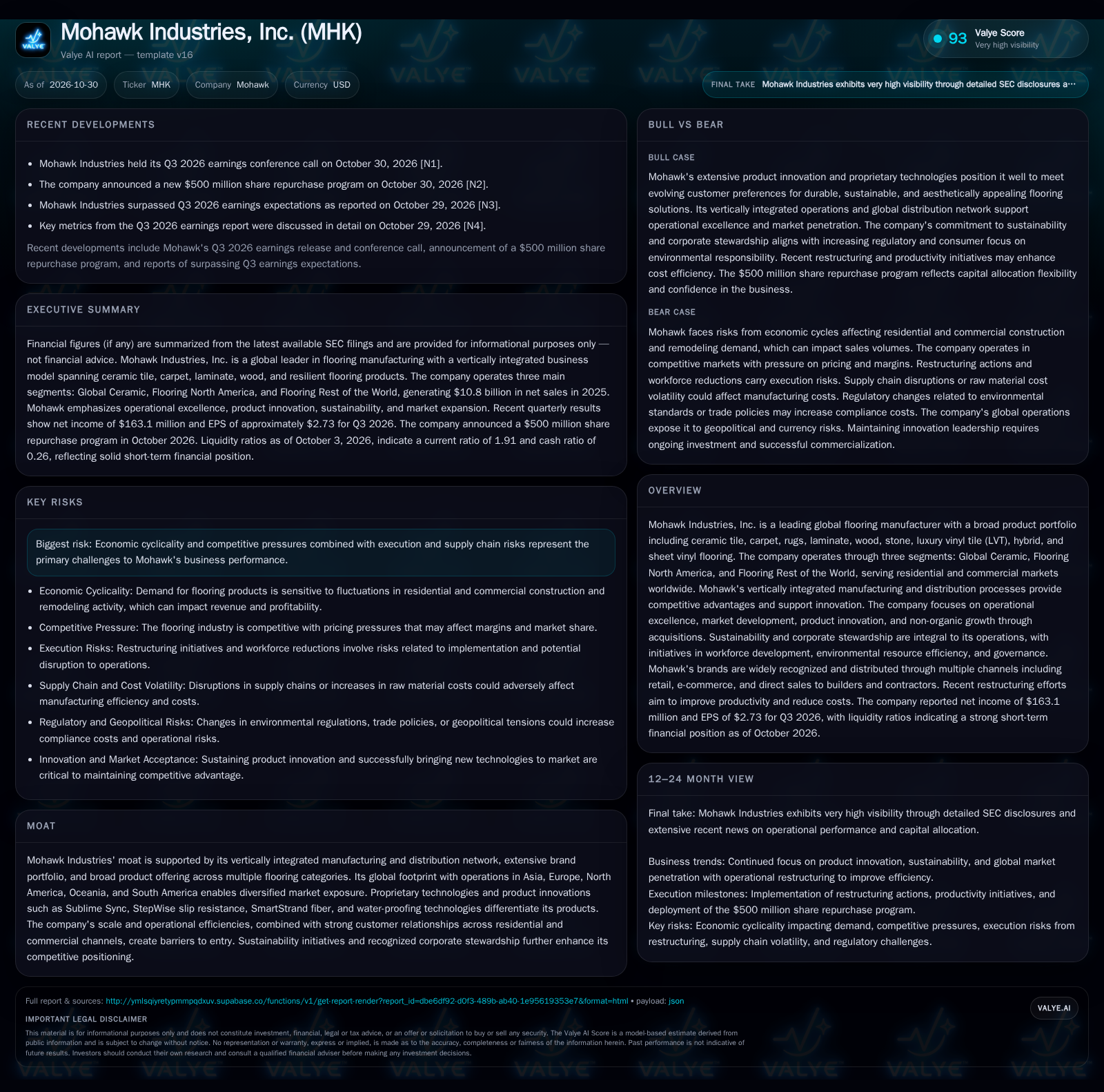
Mohawk Industries reported $163.1 million in Q3 2026 net income, announced a $500 million share repurchase, and continues to pursue cost reductions and product innovation through vertical integration. The company’s ability to navigate cyclical construction demand and competitive pricing pressures will determine whether recent operational and capital allocation moves translate into sustained value creation. [S2] [N2]
Mohawk Industries, one of the world’s largest flooring manufacturers, is at a strategic crossroads in late 2026. The company’s Q3 earnings beat, a substantial new share repurchase program, and ongoing restructuring suggest an assertive approach to boosting productivity and shareholder returns. Yet, Mohawk remains exposed to the inherent cyclicality of construction markets and persistent margin pressures from global competition. The critical question is whether its structural advantages—vertical integration, innovation, and broad market reach—can deliver resilience and margin improvement as the industry adapts to shifting demand, sustainability trends, and input cost volatility.
Restructuring, Earnings Beat, and a Major Buyback Define Mohawk’s Current Moment
Three facts stand out in Mohawk’s late-2026 operating context. First, the company reported Q3 2026 net income of $163.1 million with diluted EPS of $2.72, surpassing analyst estimates and signaling a rebound in operational performance. Second, Mohawk announced a new $500 million share repurchase program, indicating management’s willingness to deploy capital toward shareholder returns after a period of cost rationalization. Third, restructuring actions—specifically facility rationalizations and workforce reductions—are underway to reduce costs and improve productivity. These developments matter because they collectively highlight a pivot toward operational efficiency and capital discipline at a time when the flooring sector remains highly sensitive to macroeconomic swings and evolving consumer preferences. [S2] [N2] [N3] [S1]
How Mohawk’s Vertically Integrated Model Shapes Its Cost Structure and Profit Potential
Mohawk’s vertically integrated manufacturing and distribution processes are designed to capture value across the flooring supply chain—from raw material procurement and product innovation through to distribution across varied retail and commercial channels. This integration may enable greater control over input costs, quality, and inventory, which is particularly valuable in a sector prone to raw material price swings and supply chain disruptions. The company’s broad portfolio—spanning ceramic tile, carpet, rugs, LVT, wood, and hybrid products—enables it to serve both residential and commercial end markets, smoothing revenue volatility across cycles.
Revenue mix is diversified geographically (54% U.S., 46% international in 2025) and by product line, but pricing power is often constrained by intense competition and price-sensitive end markets. Proprietary technologies (e.g., SmartStrand, Uniclic, WetProtect) may support modest premium pricing or share gains in select segments, but the flooring industry overall is characterized by price competition and low switching costs for many customers. Fixed costs are significant due to manufacturing footprint, so operating leverage can amplify both upside in strong demand environments and downside during slowdowns. Recent restructuring is aimed at compressing the fixed-cost base, which could improve margins if volume stabilizes or grows.
The company reported cash and liquidity metrics for the period; these figures do not by themselves establish operating runway, investment capacity, financial flexibility, or financing capacity. [S2] [S1]
Innovation and Scale Versus Margin Compression: Mohawk’s Defensible Advantages and Industry Frictions
Mohawk’s moat is anchored in its scale, vertical integration, and product innovation. The company’s proprietary technologies (e.g., StepWise, HydroSeal, Continuum, and PVC-free PureTech) provide differentiation, particularly as sustainability and performance become more important to buyers. Its extensive brand portfolio and global manufacturing footprint facilitate broad market access and responsiveness to regional design trends.
However, the flooring industry remains structurally competitive. Large international peers and regional manufacturers compete aggressively on price, while product commoditization in categories like laminate, basic LVT, and entry-level carpet limits pricing power. The rise of e-commerce and direct-to-consumer channels further erodes traditional channel advantages, making brand and product innovation even more critical.
Switching costs for end customers—except in high-specification commercial or specialty applications—are generally low. This dynamic places pressure on Mohawk to continually invest in R&D and marketing to maintain share. Regulatory and sustainability requirements are increasing, but Mohawk’s visible commitment to stewardship may provide a modest reputational edge in procurement-driven segments.
If Restructuring and Innovation Translate into Margin Expansion
A favorable scenario for Mohawk would see its restructuring actions successfully lowering the fixed-cost base, with productivity gains and more efficient operations leading to higher margins even if topline growth remains modest. If proprietary technologies and sustainability features allow Mohawk to win share in premium segments or command higher average selling prices, incremental margin expansion could follow.
This scenario would be confirmed by sequential improvement in operating margins, evidence of market share gains in target categories (such as LVT, hybrid, or sustainable flooring), and continued outperformance versus analyst EPS estimates. Sustained or increased buyback activity, funded by free cash flow rather than balance-sheet drawdown, would further support the thesis.
Mixed Recovery as Market Cycles and Margin Pressures Persist
The most plausible scenario is that Mohawk continues to deliver operational improvements and modest EPS growth, but faces ongoing headwinds from cyclical demand in construction and remodeling markets, and persistent margin pressure from competitors and input costs. Revenue growth may remain tepid, with periodic boosts from innovation or channel wins offset by price competition and shifts in end-market mix.
Confirmation would come from stable or slightly improving gross and operating margins, maintenance of market share in core segments, and successful execution of restructuring actions without major operational disruptions. Falsification would be signaled by margin compression outpacing cost savings, or if restructuring leads to supply chain or quality issues that erode customer trust or share.
When Cyclical Weakness and Execution Missteps Erode Value
A negative scenario would see a sharper-than-expected downturn in residential or commercial construction, resulting in material volume declines that overwhelm cost savings from restructuring efforts. If input costs spike or supply chains are disrupted, and Mohawk is unable to pass these through via price, margins could contract substantially.
Execution risk is significant: poorly managed facility closures or workforce reductions could cause operational disruptions, inefficiencies, or loss of organizational know-how. If innovation investments fail to yield commercial traction, Mohawk could lose share to nimbler or more cost-competitive rivals. This scenario would be confirmed by falling sales, deteriorating margins, negative operating leverage, and evidence of customer attrition or adverse quality events.
What Will Determine Mohawk’s Value Creation as the Industry Evolves?
Trends in operating margin and gross margin, especially sequential changes post-restructuring, would help clarify whether cost actions are translating into sustainable profitability gains.
Market share data by product category (e.g., LVT, hybrid, ceramic) and geography, if disclosed, would reveal the effectiveness of innovation and channel strategies.
Progress on the $500 million share repurchase program—including pace, funding source, and impact on share count—would indicate management’s capital allocation discipline and confidence.
Volume trends in key end markets (residential vs. commercial) and geographies, especially in the context of broader construction cycles, would test revenue resilience.
R&D and innovation pipeline disclosures, including new product launches and adoption rates, would help assess the sustainability of Mohawk’s competitive advantages.
Any disclosed changes in input cost structure or supply chain reliability could signal future margin risks or opportunities.
Customer retention or satisfaction metrics, if disclosed, would provide insight into the impact of restructuring and operational changes on market perception.
Disclaimer: This is research-only, informational analysis and not investment advice. It may include AI-generated interpretation and general industry context. Always verify important details using primary sources.

Comments