
Carter’s Inc: Enhancing Retail Strategy, Expanding Brands, and Leading in Children’s Apparel Economics
Carter’s, the dominant U.S. children’s apparel company, is leveraging its brand portfolio and multichannel reach while navigating store closures and evolving consumer preferences. The company’s current financial strength and omni-channel investment set the stage for both margin improvement and competitive risk, especially as wholesale dependencies and supply chain volatility shape the next phase of growth.
However, execution risk around store rationalization, dependence on wholesale partners, and external shocks to supply and demand remain central watchpoints. The company’s ability to transfer sales to higher-margin channels and maintain brand relevance will determine its margin trajectory and competitive durability. [S1] [S2] [N1]
Carter’s Inc stands at a mature but pivotal stage in North American children’s apparel. With a portfolio led by its flagship Carter’s and OshKosh B’gosh brands, the company dominates the U.S. baby and young children’s apparel market and maintains a vast wholesale and retail network. The question is whether Carter’s can successfully migrate sales from closed stores to higher-margin channels, maintain its brand relevance with new generations of parents, and navigate global supply and demand volatility. The outcome will determine if Carter’s can defend its margin structure and leadership as the market evolves.
Store Closures, New Brand Introductions, and Earnings Surprises: Current Developments
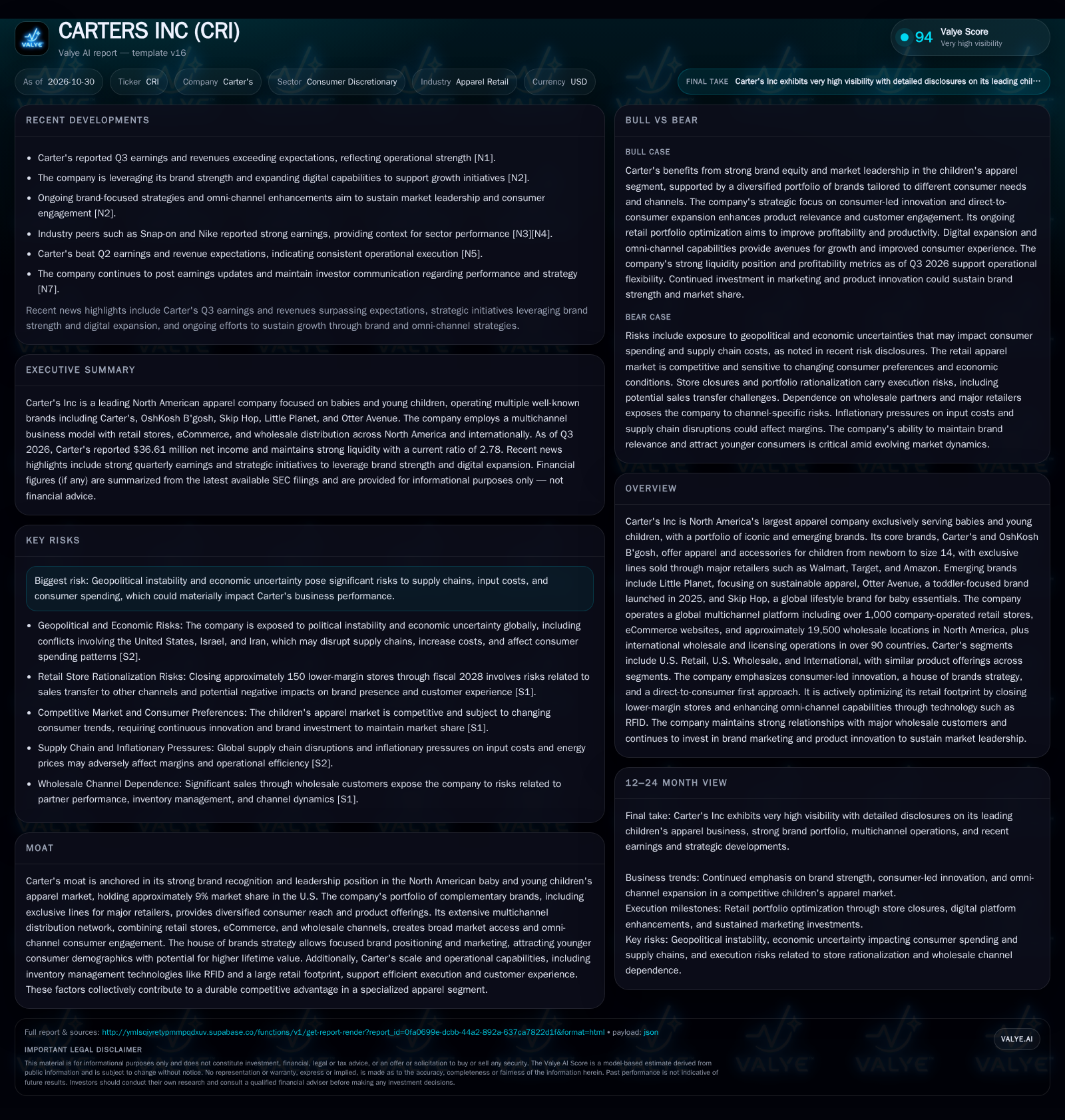
Carter’s reported Q3 2026 net income of $36.61 million and a current ratio of 2.78, with cash and equivalents of $450.96 million and short-term investments of $75 million, reflecting a reported liquidity position. The company’s earnings and revenues have both exceeded analyst expectations in recent quarters, signaling operational resilience and successful execution of its brand and omni-channel strategies. [S2] [N1]
Operationally, Carter’s is pursuing a significant retail portfolio optimization—planning to close about 150 lower-margin U.S. stores by 2028 to focus on higher-productivity locations and digital expansion. Meanwhile, the July 2025 launch of Otter Avenue, a toddler-focused brand, is the latest move to diversify its portfolio and reach new consumer segments. These developments matter because they reveal Carter’s willingness to reshape its channel mix, test new brands, and potentially unlock margin improvement through store rationalization and digital leverage. [S1]
Revenue Drivers: Channel Mix, Brand Licensing, and Operating Leverage Explained
Carter’s generates revenue through three primary segments: U.S. Retail, U.S. Wholesale, and International. Each segment offers similar children’s apparel products, but the economics of each channel differ. In the U.S., company-operated stores (804 locations as of early 2026) and eCommerce drive direct-to-consumer sales, which typically offer higher gross margins but require significant fixed cost investment in stores, digital infrastructure, and marketing. Wholesale (19,500 North American locations) provides scale and reach via major retailers, but at lower unit margins and with potential for greater price sensitivity.
Exclusive brand arrangements—such as Child of Mine at Walmart, Just One You at Target, and Simple Joys at Amazon—extend Carter’s reach into mass retail, likely using a mix of licensing, private-label, or differentiated wholesale agreements. These arrangements may trade off some margin for volume and shelf space, but they help Carter’s defend market share and maintain relevance with value-oriented consumers.
Carter’s ongoing store closures aim to shift sales to more productive stores and digital channels, reducing fixed costs and improving overall profitability. The use of RFID technology in stores improves inventory accuracy and omni-channel fulfillment, potentially reducing markdowns and stock-outs. Operating leverage is created as Carter’s grows digital and higher-margin channels while scaling back less efficient physical locations. However, the capital required for technology upgrades, store remodeling, and brand launches remains significant—meaning the pace and effectiveness of sales migration is critical to near-term margin dynamics.
Maintaining Market Position: Leveraging Brand Equity and Channel Diversity Against Competitors
Carter’s holds an estimated 9% U.S. market share in baby and young children’s apparel, with OshKosh at about 1%—a scale advantage that underpins its negotiating power with suppliers and retailers. The company’s multichannel model, with both direct and wholesale distribution, allows it to reach a wide spectrum of consumers, from value shoppers at Walmart to premium buyers through specialty lines and digital platforms.
However, the competitive landscape is dynamic. Large mass retailers, private-label programs, digital-native brands, and fast-fashion entrants all compete aggressively on price, assortment, and convenience. Substitution risk is high if Carter’s fails to innovate or loses cultural relevance, especially among younger parents seeking sustainability, inclusivity, or digital-first experiences. Exclusive lines at major retailers help Carter’s lock in shelf space, but can also increase reliance on wholesale partners whose own strategies may shift.
Carter’s brand equity, built on decades of trust and quality, remains a key moat. But the speed at which consumer preferences change in children’s apparel—driven by trends, social media, and macroeconomic pressures—means that continuous product innovation and marketing investment are required to defend share. The emergence of new brands like Otter Avenue reflects Carter’s recognition of the need to target distinct consumer segments and stay ahead of the curve.
Unlocking Margin Growth via Channel Realignment and Brand Innovation
If Carter’s is able to effectively transfer sales from closed stores to higher-margin digital and omni-channel platforms, while maintaining or expanding its market share, the result could be meaningful margin expansion. This outcome would be supported by improved inventory efficiency from RFID, increased direct-to-consumer mix, and successful integration of new brands like Otter Avenue and Little Planet.
Confirmation of this scenario would include sustained or improving gross margin and EBIT margin post-store closures, accelerating eCommerce growth, and evidence that new and exclusive brands are gaining traction with target demographics. Additionally, stable or rising revenue per store and positive same-store sales growth in the remaining fleet would suggest that store optimization is not cannibalizing total sales but instead improving overall productivity.
Falsification would occur if sales lost from closed stores are not recaptured digitally or through other channels, leading to revenue contraction or stagnant margins. Weak adoption of new brands or loss of shelf space at major wholesale partners would also undermine this scenario.
Sustaining Growth and Margins During Channel Evolution
The most plausible path is that Carter’s achieves moderate sales migration from closed stores to digital and remaining retail locations, preserving its leading market share but with limited margin improvement. Wholesale remains a large contributor, but pricing pressure and partner dynamics cap upside. New brands contribute incremental growth, though their full potential takes time to realize.
Evidence for this scenario would include stable overall revenue with gradual mix shift toward digital, slight improvement in operating margins as store closures reduce fixed costs, and continued strong cash generation. Market share remains roughly steady as Carter’s leverages its brand and omni-channel presence to offset competitive encroachment.
This scenario would be challenged if digital sales plateau or if the wholesale environment deteriorates more rapidly than expected, making it difficult for Carter’s to offset lost store sales and maintain profitability.
Risks from Store Closures and Market Volatility Impacting Sales and Margins
A less favorable outcome would see Carter’s struggle to transfer sales from closed stores, resulting in a meaningful drop in revenue and operating deleverage. If major wholesale partners reduce orders, shift to private label, or experience their own traffic declines, Carter’s could face further channel pressure. Supply chain disruptions or inflation could erode margins, especially if the company is unable to pass on higher costs.
Confirmation of this scenario would include declining total sales, shrinking market share, and margin pressure despite cost-cutting efforts. Early warning signs would be a sharp drop in digital conversion rates, weak new brand performance, or inventory build-up indicating demand shortfalls.
The scenario would be partially falsified if Carter’s demonstrates resilience in digital and wholesale channels, with stable or improving margins even as the store base contracts.
Evaluating the Effectiveness of Carter’s Store and Channel Approaches and Potential Risks
Track net sales and gross margin trends by channel, especially in periods of accelerated store closures, to assess whether sales are being successfully recaptured digitally or through remaining stores.
Monitor eCommerce and omni-channel sales growth rates, including digital penetration as a percentage of total revenue.
Watch revenue per store and same-store sales growth in the remaining retail fleet as a test of store productivity improvements.
Evaluate the pace of new brand adoption (e.g., Otter Avenue, Little Planet) and their contribution to overall growth.
Follow wholesale partner concentration, order volume trends, and shelf space allocation with major retailers like Walmart, Target, and Amazon.
Assess inventory turnover and markdown rates, as these will signal the effectiveness of RFID and inventory management initiatives.
Monitor input cost inflation, supply chain disruptions, and Carter’s ability to adjust pricing or absorb costs.
Look for shifts in consumer sentiment, especially among younger parents, regarding brand relevance, sustainability, and digital experience.
Disclaimer: This is research-only, informational analysis and not investment advice. It may include AI-generated interpretation and general industry context. Always verify important details using primary sources.

Comments