
Schneider National in 2026: Navigating Regulatory Pressures, Technology Shifts, and the Stakes of Operational Scale
The next phase will test Schneider’s ability to translate scale, IT investments, and early ZEV positioning into sustained margin leadership amid sector headwinds.
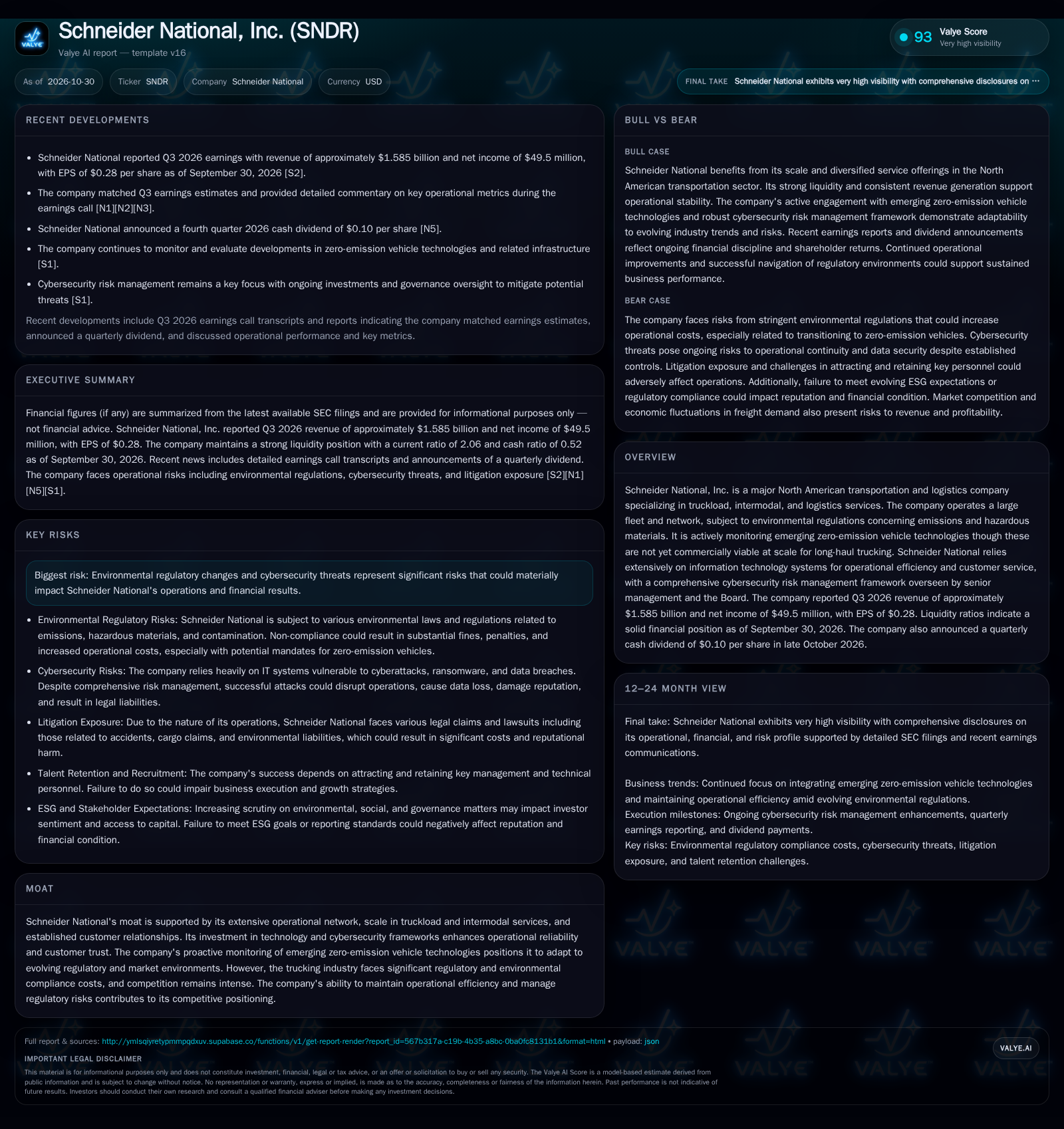
Schneider National reported Q3 2026 revenue of $1.585 billion and net income of $49.5 million, with a reported liquidity position and a $0.10 dividend declared. The company’s operational model faces intensifying environmental regulation, growing cybersecurity complexity, and ongoing technology shifts, particularly around zero-emission vehicles, which remain commercially unviable at scale for long-haul. Schneider’s scale and IT investments could help defend margins, but execution on regulatory adaptation and technology integration will define its competitive trajectory over the next several cycles. [S2] [N5]
Schneider National’s latest quarter confirms its status as a North American leader in truckload, intermodal, and logistics, with stable revenue, disciplined net income, and a reported liquidity position. Yet the real test for Schneider is not in the rearview mirror. The company is on the cusp of an industry-wide transformation driven by tightening environmental regulations, mounting pressure to adopt zero-emission vehicles (ZEVs), and heightened cybersecurity threats. While Schneider’s scale, technology investments, and operational discipline provide ballast, its ability to adapt to regulatory, technological, and competitive shifts will determine whether it can maintain margin leadership and shareholder returns as the transportation landscape evolves. [S2] [N5] [S1]
Recent Performance Anchors a Stable, Liquid Platform
Schneider National reported Q3 2026 revenue of approximately $1.585 billion and net income of $49.5 million, translating to $0.28 per share. The company reported cash and liquidity metrics for the period; these figures do not by themselves establish operating runway, investment capacity, financial flexibility, or financing capacity. The cited source reports dividend-related activity; that disclosure alone does not establish dividend-policy continuity, management confidence, or a material constraint on capital flexibility. These figures reflect operational stability and prudent capital management, even as the company faces sector-wide headwinds. [S2] [N5]
How Scale, Asset Mix, and Technology Shape Earnings Power
Schneider’s business model is built around three primary segments: truckload, intermodal, and logistics. Revenue is a function of freight volumes, pricing (often contract-based, but with spot exposure), and service mix. Fixed costs—fleet ownership, maintenance, terminals, and IT infrastructure—are high, especially for asset-heavy truckload and intermodal operations, creating significant operating leverage. Variable costs, primarily labor, fuel, and purchased transportation, are sensitive to market cycles.
The company’s scale offers procurement advantages (fuel, equipment, insurance) and network density, which can improve load optimization and reduce empty miles. Technology investment—particularly in IT for fleet management, customer portals, and cybersecurity—can enhance operational efficiency and customer stickiness. However, the capital intensity of maintaining and upgrading assets is substantial, and the looming need to invest in zero-emission vehicles could further pressure capital allocation if regulatory mandates accelerate before ZEVs become economically viable.
Margins are vulnerable to swings in freight demand, labor costs, and regulatory compliance expenses. The intermodal and logistics segments may offer higher returns on capital due to lighter asset requirements and potential for value-added services, but the core truckload segment remains exposed to cyclical and regulatory shocks.
The interplay between Schneider’s asset mix and technology investments also creates nuanced capital allocation challenges. For instance, while asset-heavy segments like truckload demand continuous fleet renewal and maintenance, the timing and scale of investment in emerging technologies—such as zero-emission vehicles—require careful calibration to avoid stranded assets or underutilized capacity. If regulatory mandates accelerate unpredictably, Schneider might face a dilemma between accelerating capex to comply and preserving potential financial flexibility. Conversely, a more gradual regulatory environment could allow phased adoption, optimizing return on invested capital. This conditional dynamic underscores the importance of scenario-based capital planning and the agility to pivot investment priorities in response to evolving external pressures.
Defending Share in a Fragmented, Regulation-Driven Market
Schneider’s competitive position stems from its large fleet, broad North American network, and established customer relationships. These enable economies of scale, better route optimization, and deeper integration with shippers’ supply chains. However, the trucking and logistics industry remains fragmented, with both large national peers and numerous regional/specialty operators.
Regulatory and technological change are intensifying the competitive landscape. The push for zero-emission vehicles could favor larger players able to absorb upfront investment and navigate uncertain technology adoption curves, but also risks eroding returns if compliance costs outpace pricing power. Digital freight platforms and asset-light logistics providers are also eroding barriers to entry in brokerage and value-added logistics, pressuring margins.
While Schneider’s investments in IT and cybersecurity may provide incremental advantage in reliability and customer trust, these are increasingly table stakes as shippers demand visibility, data integration, and security from all logistics partners. The company’s ability to adapt its fleet, maintain service levels, and manage cost inflation will be central to sustaining its position.
Schneider’s competitive resilience also depends on its ability to leverage data analytics and digital integration beyond basic operational efficiency. As shippers increasingly demand end-to-end supply chain visibility and predictive insights, Schneider’s IT infrastructure must evolve from transactional platforms to strategic enablers of supply chain optimization. This shift requires not only technology upgrades but also organizational capabilities in data science and customer collaboration. If Schneider can successfully embed these capabilities, it may create higher switching costs and deepen customer relationships. However, failure to keep pace with digital innovation risks commoditization of services and margin erosion, especially as asset-light competitors exploit technology to undercut traditional operators.
If Regulatory Adaptation and Tech Leadership Unlock Margin Expansion
The most favorable scenario for Schneider National is one in which it leverages its scale and technology investments to adapt ahead of regulatory deadlines and competitors. If the company can secure early access to commercially viable zero-emission trucks—perhaps through OEM partnerships or pilot programs—and efficiently integrate them into its long-haul operations, it could contain compliance costs, win contracts from shippers with aggressive ESG targets, and preserve or even expand margins.
Further, if Schneider’s IT and cybersecurity investments translate into demonstrably superior network uptime, customer experience, and data protection, the company could differentiate itself in shipper RFPs, especially with large enterprise customers. Successful execution would be confirmed by: (1) sustained or rising margins despite sector cost pressures, (2) an increasing share of revenue from ESG-sensitive shippers, (3) public disclosure of large ZEV fleet deployments or new regulatory-compliant contracts, and (4) continued low incident rates for cybersecurity breaches.
Steady Execution Amid Incremental Regulatory and Cost Pressures
The most plausible outcome is that Schneider maintains stable performance, with revenue and profitability tracking freight market cycles and incremental compliance costs gradually rising. ZEV technology adoption remains slow and limited to pilot projects or select lanes, with internal combustion engine (ICE) trucks still dominating long-haul. Compliance costs—both environmental and cybersecurity—inch higher but are largely offset by cost controls, modest pricing adjustments, and ongoing efficiency gains from IT investment.
Operating margins may compress modestly as regulatory costs outpace pricing, but the company’s scale and liquidity allow it to weather the transition without major strategic shifts.
Margin Compression If Regulatory and Technology Costs Outrun Adaptation
The adverse scenario is one in which environmental regulations accelerate faster than ZEV technology becomes cost-effective, forcing Schneider to incur substantial compliance expenditures—fleet retrofits, higher fuel costs, or penalties—without the ability to recoup these through pricing. If labor markets tighten, or if cybersecurity incidents cause significant operational disruption or reputational harm, the combined effect could be a sharp margin squeeze or even earnings volatility.
Downside evidence would include: (1) rising operating costs without offsetting pricing, (2) regulatory fines or large compliance capital expenditures disclosed in filings, (3) negative earnings surprises or guidance reductions, (4) increased legal or litigation expenses, and (5) any major cybersecurity breach impacting operations or customer trust.
Milestones That Will Define Schneider’s Competitive and Regulatory Trajectory
Trends in operating margin and segment profitability, especially in truckload and intermodal, as a barometer of cost inflation versus pricing power.
Level and composition of capital expenditures—specifically, any increase in fleet spending tied to zero-emission vehicle adoption or regulatory compliance.
Disclosure of large-scale ZEV fleet deployments, pilot projects, or regulatory-compliant contract wins, which would signal progress on environmental adaptation.
Frequency and severity of cybersecurity incidents, if disclosed, and commentary on IT/cybersecurity investment versus threat environment.
Shifts in revenue or customer mix toward ESG-sensitive shippers, or new customer wins predicated on environmental performance.
Legal and regulatory expense trends, including any new fines, penalties, or litigation settlements.
Employee retention and turnover rates, if disclosed, as a proxy for operational stability and talent risk.
Disclaimer: This is research-only, informational analysis and not investment advice. It may include AI-generated interpretation and general industry context. Always verify important details using primary sources.

Comments