
FMC Corp in 2026: Profitability Pressures, Pricing Moves, and Strategic Priorities in Crop Protection
FMC Corp’s widened Q3 losses and recent channel pricing moves highlight deepening profitability pressures even as revenue outperforms estimates. The company’s active credit management and innovation-driven business model set the stage for a high-stakes contest between margin recovery and persistent market headwinds.
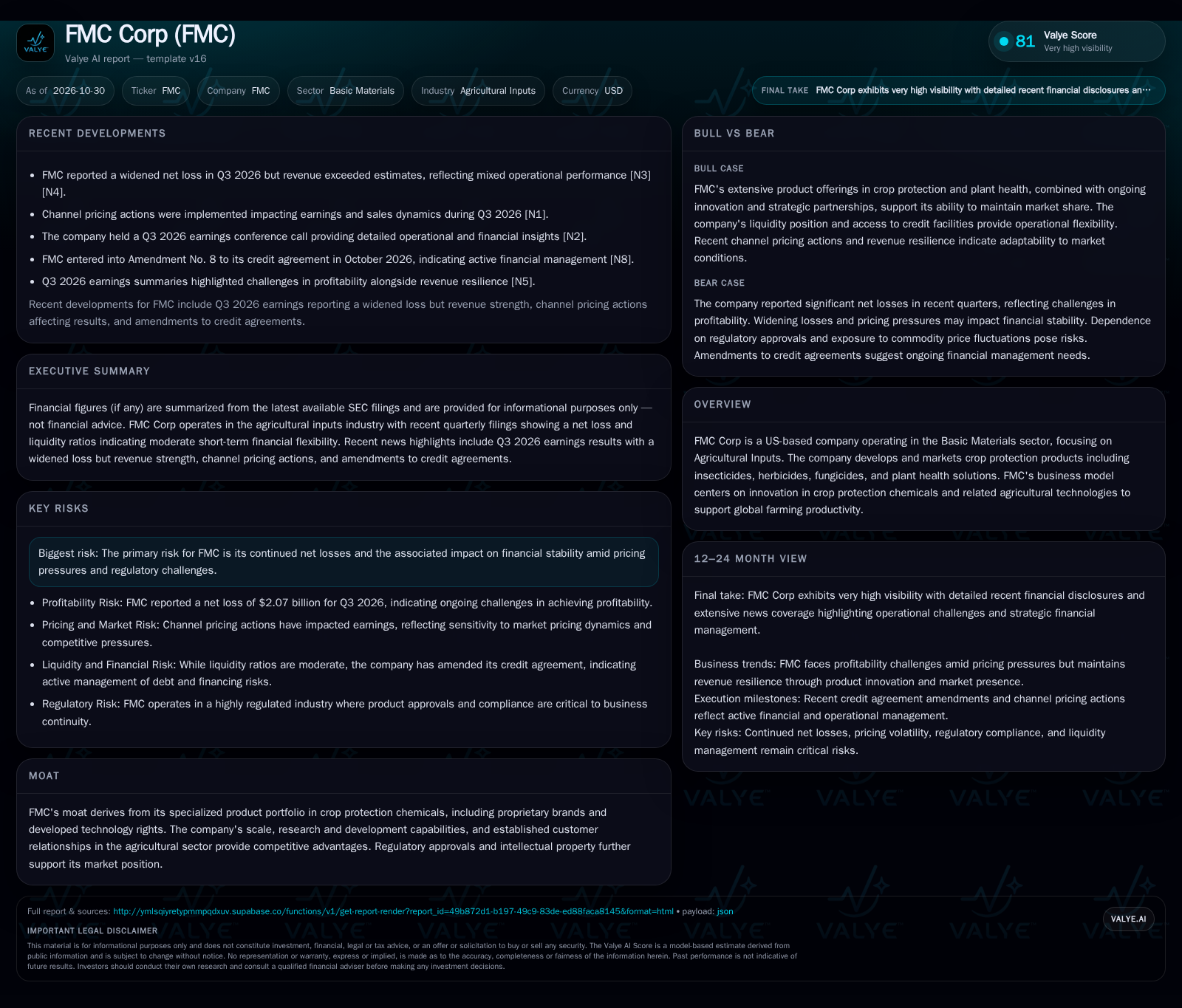
FMC Corp reported a Q3 2026 net loss exceeding $2 billion, with losses widening even as revenue topped forecasts. Channel pricing changes have pressured earnings, and the company amended its credit agreement in October 2026. The business model’s reliance on innovation and established customer relationships will be tested as the company navigates heightened competitive and financial pressures. [S2] [N1] [N3] [N8]
FMC Corp, a key player in the global agricultural inputs market, is confronting a pivotal moment as it reports a sharply widened net loss for Q3 2026—over $2 billion—even as revenue beats expectations. The company’s recent channel pricing actions signal both adaptability and margin compression, while a fresh credit agreement amendment points to proactive but necessary financial management. At stake is FMC’s ability to leverage its innovation engine and established crop protection portfolio to regain profitability in an environment marked by volatile pricing, regulatory complexity, and intensifying competition. The next phase for FMC hinges on whether operational resilience and R&D strength can offset mounting financial and industry pressures. [S2] [N1] [N3] [N8]
FMC’s 2026 Financial Landscape Marked by Loss Expansion and Pricing Initiatives
FMC Corp reported a net loss of $2.0669 billion for Q3 2026, translating to an EPS of -$15.54—substantially worse than prior periods and reflecting intensifying profitability challenges [S2]. Despite this, revenue for the quarter exceeded market estimates, suggesting that underlying demand or execution on channel pricing initiatives provided some top-line support [N3] [N4]. [S2] Notably, FMC implemented channel pricing actions during the quarter, which impacted both earnings and sales performance, and entered Amendment No. 8 to its credit agreement in October 2026—pointing to active financial management amid a turbulent operating environment [N1] [N8].
Crop Protection Economics and Their Impact on FMC’s Profitability
FMC’s business model revolves around the development, production, and sale of crop protection chemicals—including insecticides, herbicides, and fungicides—where pricing power, volume growth, and product mix are critical determinants of profitability. The company’s cost structure is typically characterized by high R&D and regulatory compliance expenses, with variable costs tied to raw materials and distribution. Fixed costs in manufacturing and regulatory overhead create operating leverage, amplifying both upside and downside in earnings. When end-market demand or competitive pricing pressure forces price concessions—as evidenced by recent channel pricing actions—margins can compress rapidly, especially if input costs remain elevated.
In the current context, FMC’s revenue resilience amid widened losses suggests that either price or volume held up, but at the expense of gross margin. The need to amend credit agreements further hints at increased capital requirements, potentially for working capital or refinancing, rather than discretionary growth investment [N8]. In this sector, persistent net losses can erode the capacity to invest in new product development, which is essential for long-term differentiation and regulatory compliance. The interplay between pricing actions, cost discipline, and innovation investment will likely dictate the sustainability of FMC’s economics going forward.
Navigating Competition in the Agricultural Chemicals Sector
FMC operates in a fiercely competitive global market for agricultural inputs, where large multinational peers, generic manufacturers, and biotech entrants vie for share. The company’s historical competitive edge has been rooted in its proprietary product portfolio, established customer relationships, and the high regulatory barriers to entry in crop protection chemicals. Intellectual property and regulatory approvals serve as partial moats, but these can be eroded by patent expirations, generic competition, or tightening regulatory scrutiny.
Recent channel pricing actions suggest that competitive pricing pressure is intensifying—either from lower-cost rivals or from customer pushback in a weak agricultural economy [N1]. At the same time, innovation remains a double-edged sword: it can drive differentiation and pricing power, but requires sustained investment and successful commercialization. The risk is that financial constraints—such as those implied by ongoing net losses and active credit management—could limit FMC’s ability to maintain its innovation lead or defend its market share in the face of aggressive competitors.
Potential for Margin Improvement Fueled by Innovation and Growth
The most favorable scenario for FMC involves a successful restoration of margins through effective channel pricing management, stabilization of input costs, and renewed demand for higher-value crop protection products. If the company is able to leverage its R&D pipeline to launch differentiated products that command premium pricing or address unmet agronomic needs, it could recapture lost profitability and potentially expand share against less innovative competitors.
Evidence that would confirm this scenario includes a sequential improvement in gross and operating margins, a return to positive net income, and publicized product launches or regulatory approvals that drive incremental revenue. Additional confirmation would come from reduced reliance on credit amendments and stabilization or growth in R&D spending—signaling both operational and financial health. Conversely, continued margin compression, further credit facility amendments, or delays in product launches would undermine the upside thesis.
Projected Trends Indicate Continued Margin Challenges with Tactical Responses
The most plausible near-term outcome for FMC is a period of continued operational strain, with ongoing net losses and margin pressure offset by incremental pricing actions and cost management. The company’s revenue may remain resilient due to its entrenched customer base and product breadth, but profitability will likely be constrained by competitive pricing, input cost volatility, and the need to sustain R&D investment under financial duress.
Confirmation of this scenario would appear as stable or slightly improving revenue but persistent negative net income, further operational cost controls, and cautious financial management such as additional credit amendments or working capital optimization. Falsification would require a clear inflection in profitability, such as a return to positive EPS or a marked improvement in cash generation attributable to margin recovery rather than one-off asset sales or financial engineering.
Rising Losses Could Trigger Strategic or Structural Adjustments
A sustained or worsening loss trajectory could force FMC into more drastic actions—such as asset sales, restructuring, or even exploring strategic alternatives—if operating cash flow remains deeply negative and liquidity tightens. In this scenario, the company’s ability to invest in innovation would be sharply curtailed, eroding its competitive position and potentially triggering customer or regulatory setbacks.
Delays in product launches, regulatory setbacks, or market share losses to generics would further reinforce the bear case. Conversely, stabilization of losses or successful cost containment would suggest the downside is being managed, if not averted.
Profitability Drivers and Developments Influencing FMC’s Outlook
Quarterly gross and operating margin trends: Sustained improvement would indicate margin recovery, while further compression would signal persistent pricing and cost pressures.
Net income and EPS progression: A return to profitability, or a narrowing of losses, would mark a positive inflection. Widening losses would reinforce the bear thesis.
R&D spending as a percentage of sales: Stability or growth would suggest ongoing commitment to innovation; reductions could imply financial stress or a shrinking product pipeline.
Frequency and terms of future credit agreement amendments: Additional amendments or covenant relief would highlight ongoing financial constraints.
Volume and price realization by product category, if disclosed: This would clarify whether revenue resilience is driven by volume growth, pricing power, or mix shifts.
Major product launches and regulatory approvals: Successful new products could materially boost margins and competitiveness.
Customer retention rates or churn, if disclosed: High retention would support revenue stability; rising churn could indicate competitive or pricing vulnerabilities.
External regulatory or legal developments: New regulations or litigation could materially affect cost structure, product viability, or market access.
Disclaimer: This is research-only, informational analysis and not investment advice. It may include AI-generated interpretation and general industry context. Always verify important details using primary sources.

Comments