
Ameriprise Financial in 2026: Capital Allocation, Earnings Quality, and the Stakes of Multi-Segment Scale
Ameriprise Financial's Q3 2026 results highlight continued revenue and AUM growth, a new $5.5 billion share repurchase authorization, and mixed earnings performance. The company’s diversified model across wealth management, asset management, and retirement solutions faces margin pressures and competition, raising questions about future operating leverage and value capture.
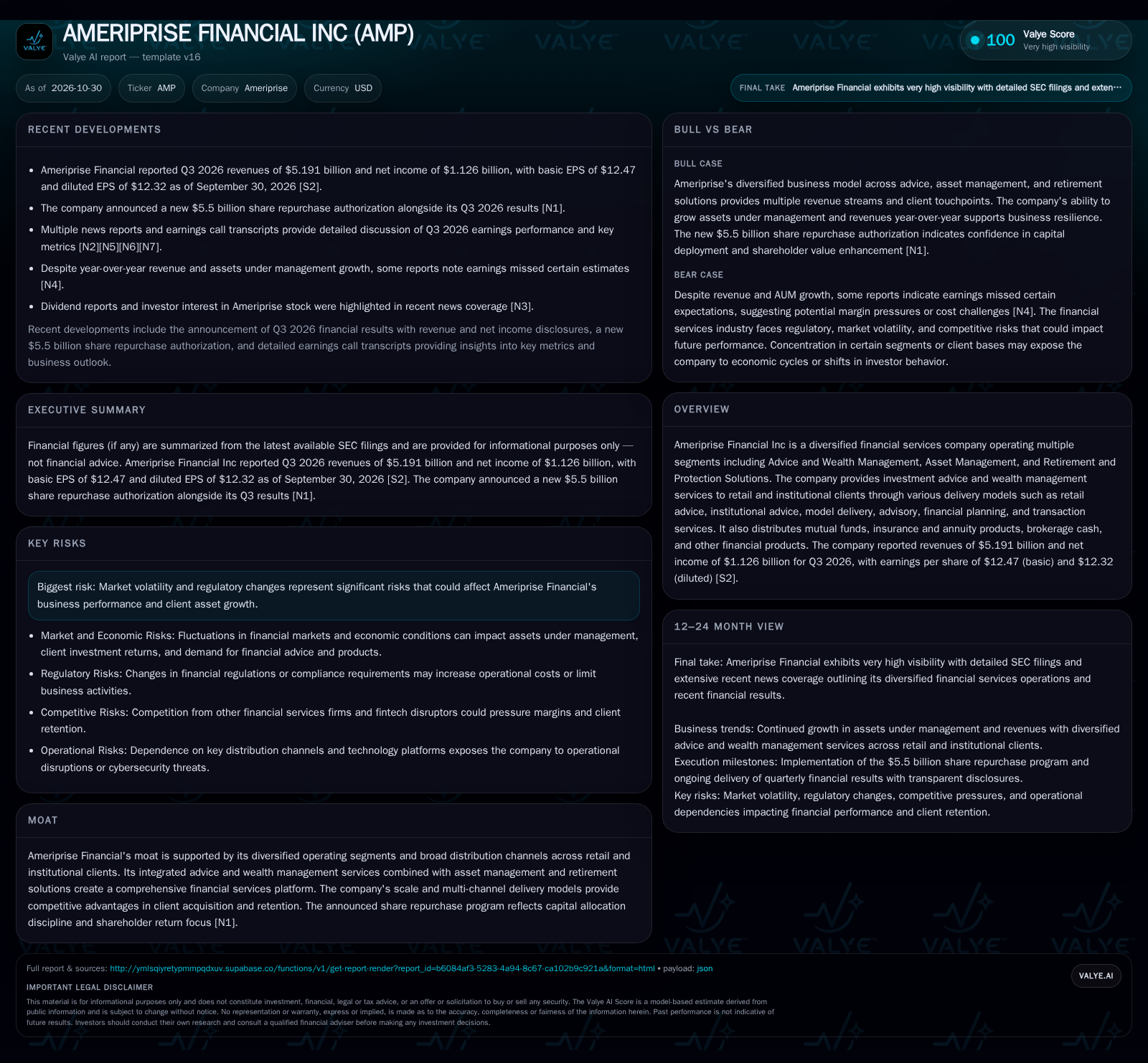
Ameriprise Financial reported Q3 2026 revenues of $5.19 billion and net income of $1.13 billion, with new $5.5 billion in share repurchases authorized. While revenue and AUM advanced year-over-year, some earnings metrics missed expectations, spotlighting margin and cost dynamics. The multi-segment business model supports recurring revenue streams, but competition and regulatory factors could challenge future profitability and growth [S2] [N1] [N4].
Ameriprise Financial’s latest quarter reveals both the strengths and challenges of a diversified financial services platform. With $5.19 billion in revenue and $1.13 billion in net income for Q3 2026, the company continues to grow its top line and assets under management, underpinned by a broad range of wealth management and retirement solutions. However, some earnings shortfalls and a substantial new share repurchase plan put the spotlight on operating leverage, margin sustainability, and the effectiveness of Ameriprise’s capital deployment in a competitive and evolving industry landscape.
Recent Results and Capital Actions Shape the Current Landscape
Ameriprise Financial reported Q3 2026 revenues of $5.191 billion and net income of $1.126 billion, with diluted EPS of $12.32 [S2]. These results reflect continued year-over-year growth in both revenue and assets under management, important for a business reliant on scale and recurring client relationships. However, some reports indicate that earnings fell short of certain analyst estimates, suggesting latent pressures on profitability or costs [N4].
A notable development is the announcement of a new $5.5 billion share repurchase authorization, which could represent a significant portion of Ameriprise’s market capitalization and signals a commitment to returning capital to shareholders [N1]. This buyback program comes alongside standard dividend activity reported in recent news [N3], reinforcing Ameriprise’s shareholder return posture. The intersection of growth, margin performance, and capital allocation is now central to the company’s near-term narrative.
How Ameriprise Converts Scale into Earnings: Revenue Streams, Costs, and Leverage
Ameriprise’s economics are driven by diversified revenue streams across advice and wealth management, asset management, and retirement/protection solutions [S1] [S2]. Wealth management and advice typically generate recurring fees tied to AUM, while asset management adds both management and performance fees. Retirement and protection solutions contribute insurance-related revenue, often with embedded spread or underwriting risk.
The company’s top-line growth is sensitive to net new client asset flows, market performance, and the ability to cross-sell products across segments. Fee-based models provide operating leverage when AUM rises, but can expose earnings to market downturns. On the cost side, compensation and distribution expenses are major fixed and variable components. Technology and regulatory compliance costs are trending upward across the sector, potentially squeezing margins if revenue growth does not outpace expense inflation.
The newly announced $5.5 billion share repurchase authorization, if executed, could boost EPS mechanically, particularly if funded by excess capital rather than new leverage [N1]. However, the underlying return on that capital depends on Ameriprise’s ability to sustain or grow earnings power relative to its cost of equity. Capital needs are generally manageable for a mature, asset-light advice and asset management model, but insurance and annuity products can introduce longer-term balance sheet risks if not carefully hedged and priced.
Integrated Advice Meets Intensifying Competition and Regulatory Complexity
Ameriprise’s competitive position is rooted in its integrated suite of advice, asset management, and retirement solutions, delivered through both retail and institutional channels [S1] [S2]. This breadth enables cross-selling and client retention, supporting a recurring revenue base. The scale of operations creates some cost efficiencies and brand advantage in advisor recruitment.
However, the wealth management and asset management industries remain fiercely competitive, with traditional peers, wirehouses, regional broker-dealers, and independent RIAs all vying for client assets. Additionally, digital-first platforms and fintech disruptors continue to erode barriers to entry, pressuring fees and shifting client expectations toward lower-cost, technology-enabled solutions.
Regulatory risk is also material. Changes in fiduciary standards, disclosure requirements, or product approval processes can affect margins and require technology investment. While Ameriprise’s multi-segment model offers resilience, it also means the company must keep pace with best-in-class service and compliance across multiple fronts. Switching costs for clients are moderate in advice-driven models, but can be higher for those with complex, multi-product relationships—yet technology-enabled competitors are working to reduce these frictions.
What Could Unlock Further Earnings Power: Operating Leverage and Successful Capital Deployment
Ameriprise could outperform if it leverages scale to drive margin expansion, either through sustained net inflows, favorable market performance, or improved expense discipline. If the company can increase AUM at a faster rate than compensation and compliance costs rise, the operating leverage inherent in the fee-based model could deliver accelerating EPS growth.
The new $5.5 billion buyback program could further amplify per-share results if executed at attractive valuations and not offset by deteriorating fundamentals [N1]. A scenario in which Ameriprise’s asset management and advice franchises gain share from competitors—perhaps due to advisor recruitment or technology investments—would support both top-line and bottom-line growth.
Confirmation of this scenario would require: (1) clear evidence of above-peer net new asset flows, (2) margin expansion on a sequential or year-over-year basis, and (3) sustained or rising return on equity even as capital is returned to shareholders. Disproportionate growth in recurring fee revenue relative to costs, and improving client retention rates if disclosed, would also support the upside case.
Stable Growth with Margin Pressures: Most Likely Near-Term Outcome
The most plausible trajectory is for Ameriprise to continue growing revenues and AUM in line with broader market trends, with modest operating leverage but persistent cost pressures. Earnings may track slightly ahead of or in line with sector averages, depending on market conditions and the company’s ability to manage advisor productivity and technology spend.
Margin improvement could be muted by rising compliance and technology costs, as well as ongoing fee compression from competition. The impact of the share repurchase program is likely to be incremental, supporting EPS but not transforming the underlying economics unless paired with organic growth. Dividend continuity and periodic buybacks may continue to attract income-oriented investors, but not fundamentally change the growth profile.
Evidence for this scenario would include steady but unspectacular AUM and revenue growth, stable or slightly pressured operating margins, and EPS growth that is partially buyback-driven. Any acceleration or deceleration in these metrics, if disclosed, would help confirm or challenge this base case.
Margin Compression and Market Headwinds: How the Thesis Could Break
A negative turn could emerge if Ameriprise faces sustained margin compression due to rising costs (e.g., advisor compensation, technology, compliance) that outpace revenue growth, or if market volatility leads to AUM declines and lower fee income. Competitive encroachment by fintech platforms or aggressive pricing by larger incumbents could further erode profitability.
Regulatory shocks—such as new fiduciary standards or adverse tax/regulatory changes—could force business model adjustments, costly technology upgrades, or even product discontinuations. In this scenario, operating leverage works in reverse: falling AUM or revenues would lead to outsized declines in earnings, particularly if fixed costs cannot be quickly scaled down.
Confirmation would come from declining operating margins, negative net new asset flows, or evidence that earnings per share are flat or falling despite buybacks. Additional warning signs would include increased client attrition rates if disclosed, or a need to slow or suspend capital return programs to preserve capital.
Milestones and Data Points That Will Clarify Ameriprise’s Value-Capture Trajectory
Quarterly trends in net new asset flows across advice, asset management, and retirement segments—if disclosed—would help track organic growth momentum.
Operating margin progression relative to both historical levels and direct peers will signal whether Ameriprise is achieving cost discipline or facing margin squeeze.
Advisor headcount and productivity metrics, if reported, would provide insight into the effectiveness of recruitment, retention, and sales enablement investments.
Technology and compliance expense growth as a percentage of revenue will reveal whether operational investments are scaling efficiently.
Execution pace and average price of share repurchases under the new $5.5 billion authorization will show capital allocation discipline and market timing.
Client retention and attrition rates, especially for multi-product relationships, would help test the stickiness of Ameriprise’s integrated model if such data are disclosed.
Updates on regulatory investigations or compliance costs could foreshadow future margin or capital impacts.
Comparative fee rates and changes in product pricing, if available, would indicate competitive intensity and Ameriprise’s ability to maintain pricing power.
Disclaimer: This is research-only, informational analysis and not investment advice. It may include AI-generated interpretation and general industry context. Always verify important details using primary sources.

Comments