
Scores Holding: Trademark Licensing Economics and the Stakes of Licensee Instability
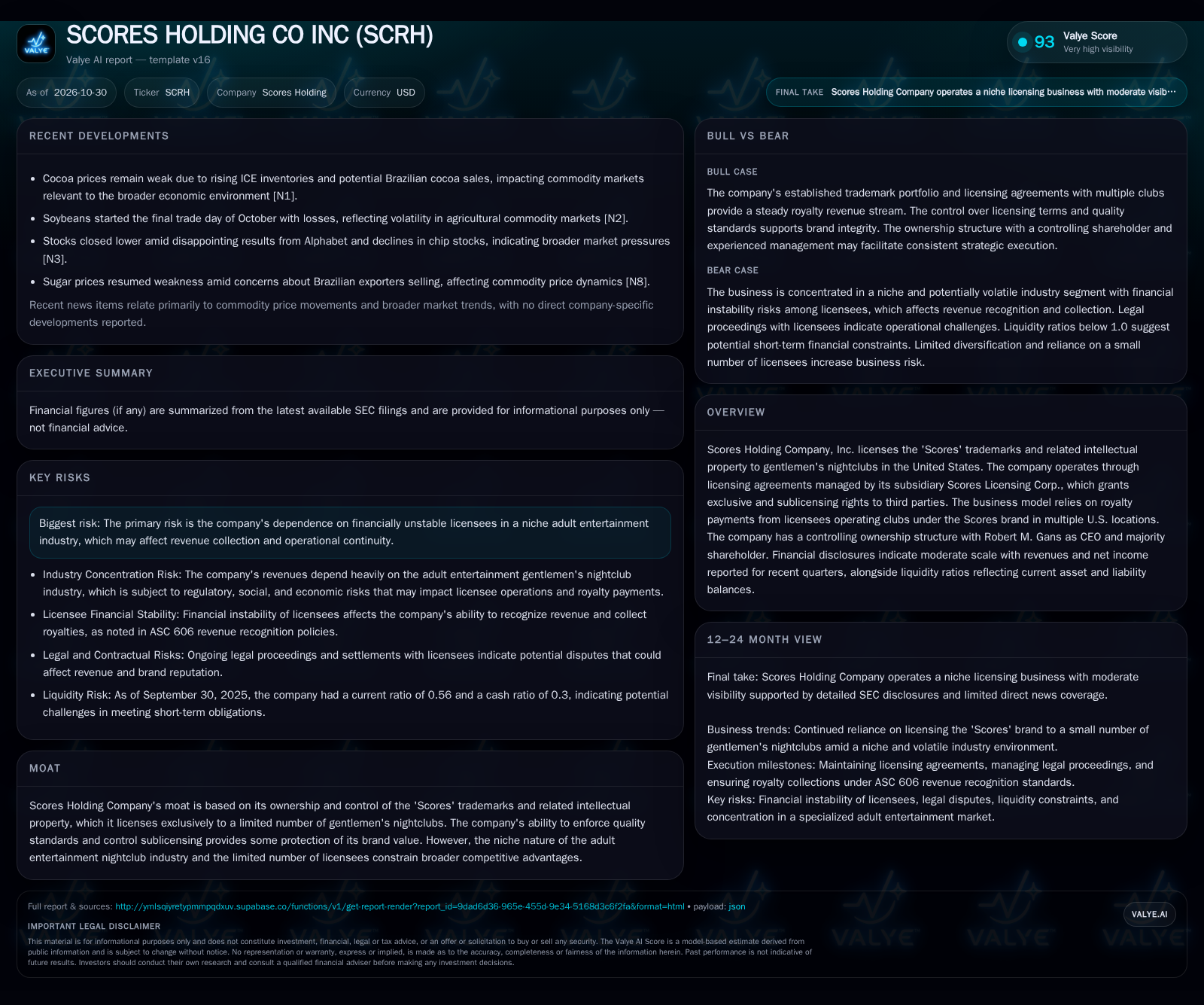
Scores Holding relies on a concentrated portfolio of trademark licensing agreements with U.S. gentlemen’s clubs, yielding steady royalties but exposing the business to licensee volatility, legal disputes, and liquidity pressures.
Scores Holding licenses its 'Scores' brand to five U.S. gentlemen’s clubs, generating royalties under short-term, renewable contracts. While recent revenues and net income indicate ongoing demand, the company’s financial position is complicated by low liquidity ratios, legal proceedings with licensees, and dependence on a niche, unstable segment. The core question is whether Scores can sustain and grow its royalty stream amid licensee risks and industry headwinds. [S2]
Scores Holding’s business model is a pure-play on brand licensing in the high-risk adult entertainment sector. By controlling the 'Scores' trademark and collecting royalties from a handful of U.S. gentlemen’s clubs, the company generates moderate-scale revenue with minimal direct operating exposure. However, this structure also means Scores’ fortunes are tightly linked to licensee stability and the broader health of a niche, volatile industry. The durability of Scores’ royalty stream—and its ability to enforce and expand licensing agreements—will determine the company’s trajectory in the coming quarters. [S2]
Recent Financials and Licensee Dynamics Shape the Present Landscape
As of January 2026, Scores Holding licenses its brand to five gentlemen’s clubs in the U.S., with agreements typically structured as one-year terms, automatically renewing but subject to termination by either party. For the quarter ending September 30, 2025, the company reported $52.8 million in revenue and $19.8 million in net income—a sign that royalty streams remain active. However, the company’s liquidity position is pressured: current assets stand at $160.1 million against $288.2 million in current liabilities, for a current ratio of just 0.56 and a cash ratio of 0.3. Legal proceedings with some licensees remain ongoing, reflecting operational friction and the contentious nature of the licensing environment. Revenue recognition is cautious, following ASC 606, and only recognizing income when collection is probable—underscoring the risk of licensee defaults or delays. [S2]
How Scores Translates Brand Equity into Cash Flow
Scores Holding monetizes its intellectual property through licensing agreements, collecting royalties either as a percentage of club net revenue or as fixed fees. This asset-light model minimizes direct operating costs, but it also means Scores’ revenue base is inherently variable and dependent on the financial health of its licensees. Licensing contracts are short term, typically one year with automatic renewal, creating limited long-term revenue visibility and little contractual lock-in. The model offers high gross margins—royalty income is not labor- or asset-intensive—but features low control over licensee operations and no direct influence over end-market demand.
Operating leverage is high in this structure: incremental royalties drop almost entirely to the bottom line, but the company is exposed to abrupt revenue drops if clubs close, lose customers, or default. The company reported cash and liquidity metrics for the period; these figures do not by themselves establish operating runway, investment capacity, financial flexibility, or financing capacity.
Brand Power Versus Niche Constraints in Adult Entertainment Licensing
Scores’ primary competitive lever is its ownership of a recognized trademark in the gentlemen’s club segment. This brand equity allows it to extract royalties from operators seeking to benefit from the Scores name, signaling a level of quality or exclusivity. However, the addressable market is inherently limited: the adult entertainment nightclub industry is niche, fragmented, and subject to regulatory, reputational, and social volatility. Scores’ moat is narrow—while it can enforce quality standards and control sublicensing, it cannot easily expand its licensee base without either diluting brand value or moving into less reputable or riskier markets.
Competition comes from other branded chains, independent clubs, and substitute forms of adult entertainment, including digital platforms that can erode club foot traffic. Barriers to entry for new licensors are moderate: building a recognized brand is difficult, but the business is exposed to legal and compliance risks that can deter new entrants. The company’s reliance on a handful of licensees amplifies concentration risk; a single club’s closure or legal dispute can materially impact revenue. Scores’ ability to sustain its royalty stream depends on the continued relevance of its brand and its ability to attract and retain solvent, well-managed licensees.
Expanded Licensing and Improved Collection Fuel Sustainable Growth
In a favorable scenario, Scores leverages its brand equity to sign additional licensees in stable markets, diversifying beyond the current five clubs and reducing revenue concentration risk. Improved legal enforcement and tighter credit standards could enhance royalty collection, making revenue recognition less conservative and boosting reported results. If industry conditions stabilize or grow—perhaps through regulatory easing or demographic shifts—Scores could see increased demand for its brand, allowing for higher royalty rates or upfront fees from new entrants.
Evidence for this scenario would include announcements of new licensing agreements, a rising number of affiliated clubs, a declining frequency of legal disputes, and improved liquidity ratios as collections accelerate and cash flow becomes more predictable. A shift toward multi-year contract terms or higher renewal rates would also signal greater revenue visibility and reduced churn.
Royalty Streams Persist Amid Licensee Churn and Operational Friction
The most plausible trajectory sees Scores continuing to license its brand to a limited number of clubs, with short-term contracts and moderate revenue volatility. Legal disputes and collection challenges persist, but the company manages to maintain its existing royalty stream and modest profitability. Some clubs may exit or default, but are replaced by new licensees at similar terms, keeping the revenue base roughly stable. Liquidity ratios remain pressured due to the timing of royalty receipts and ongoing legal costs.
This scenario would be confirmed by a stable or slightly fluctuating number of licensed clubs, periodic legal settlements, and quarterly revenues within a narrow range. Absence of significant expansion or contraction in club count, and continued adherence to ASC 606 revenue recognition, would further support the persistence of the current model.
Licensee Defaults and Legal Setbacks Undermine the Royalty Model
In an adverse outcome, financial instability among licensees accelerates, leading to club closures, defaults on royalty payments, and a shrinking pool of viable clubs willing or able to pay for the Scores brand. Ongoing or escalating legal proceedings could result in unfavorable settlements or the loss of key licensing agreements.
Evidence for this scenario would include a declining number of licensed clubs, sharp drops in quarterly revenue, increased legal reserves or settlement costs, and persistent negative working capital. Repeated delays in revenue recognition, or disclosures of uncollectible royalties, would further confirm a deteriorating outlook.
What Will Validate or Challenge the Scores Licensing Thesis?
Changes in the number of licensed clubs, including new agreements or club closures, would directly impact royalty revenue and concentration risk.
Disclosure of royalty rates, average royalty per club, or contract structure (if disclosed) would clarify revenue sensitivity to club performance and pricing power.
Legal proceeding updates—frequency, scale, and outcomes of disputes with licensees—will indicate operational friction and potential impacts on cash flow.
Quarterly trends in revenue recognition, uncollected royalties, or write-offs under ASC 606 would reveal the effectiveness of collection policies and the true quality of the revenue stream.
Announcements of multi-year contracts or improvements in renewal rates (if disclosed) would suggest greater revenue visibility and reduced churn.
Material regulatory changes in the adult entertainment industry at the state or federal level could alter the addressable market and risk profile for licensed clubs.
Any move into adjacent markets, new licensing verticals, or brand extensions would test Scores’ ability to diversify and reduce dependence on the current niche.
Disclaimer: This is research-only, informational analysis and not investment advice. It may include AI-generated interpretation and general industry context. Always verify important details using primary sources.

Comments