
Civeo Corp: Resource Sector Lodging, Contract Dynamics, and the Impact of Commodities on Remote Hospitality Economics
Civeo Corp’s remote workforce hospitality business is anchored in Australia and Canada, with recent earnings volatility reflecting the cyclical nature of its resource-sector customer base. As contract renewals, acquisition integration, and commodity prices shape demand, the company’s ability to manage occupancy, pricing, and operational scale will determine its resilience and upside.
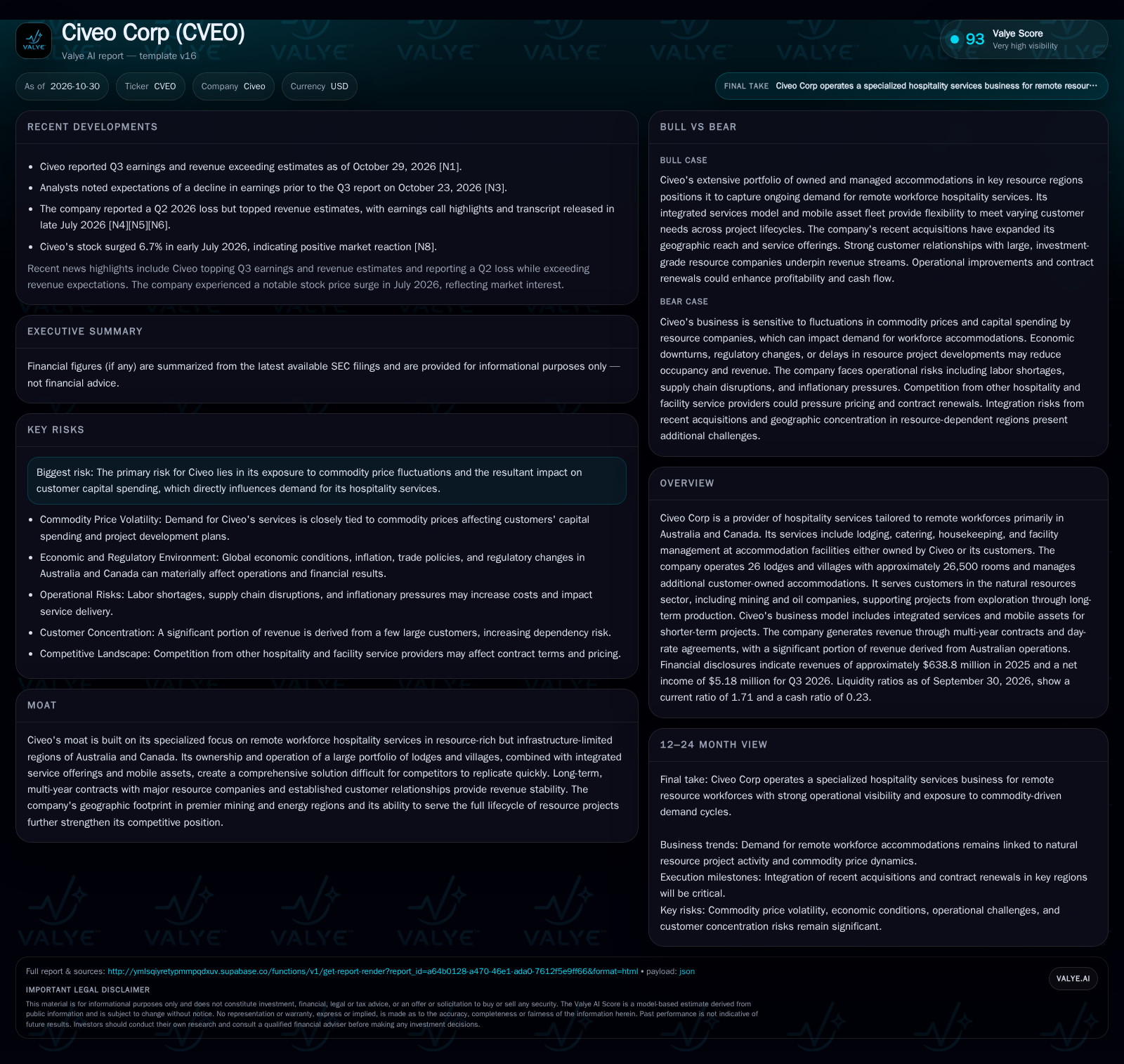
Civeo Corp operates a portfolio of remote lodges and villages primarily serving the mining and energy industries in Australia and Canada. The company’s Q3 2026 net income improved to $5.18 million following a Q2 loss, but annual revenues have trended downward since 2023. With 57% of 2025 revenue from owned facilities and 43% from customer-owned sites, Civeo’s business mix and contract structure expose it to both occupancy risk and commodity-driven swings in demand. The recent Qantac acquisition expands its Bowen Basin presence, but future performance will depend on contract visibility, commodity cycles, and cost discipline. [S2] [N1] [N4] [N5] [N6]
Civeo Corp stands at the intersection of remote hospitality and the natural resources sector, operating thousands of rooms in regions where mining and energy projects drive demand for workforce accommodations. After a challenging Q2, the company posted a Q3 2026 rebound in net income, but annual revenues have been on a downward trajectory since 2023. With customer concentration, contract renewals, and commodity cycles shaping its outlook, Civeo’s ability to flex its asset base and manage costs will be tested as it integrates new acquisitions and navigates shifting resource-sector dynamics.
Recent Earnings Volatility and Portfolio Expansion: What’s Changed for Civeo
Civeo reported a net income of $5.18 million for Q3 2026, reversing a Q2 loss and exceeding analyst expectations on both revenue and earnings [S2] [N1] [N4] [N5] [N6]. This earnings rebound came amid a broader trend of declining annual revenues, with 2025 revenue at $638.8 million compared to $700.8 million in 2023 [S2]. The company’s business remains heavily concentrated in Australia, which accounted for 72% of 2025 revenue, and in the Bowen Basin specifically. The May 2025 acquisition of Qantac Pty Ltd added four villages and 1,368 rooms, strengthening Civeo’s footprint in this key mining region [S2]. The mix of owned (57% of 2025 revenue) versus customer-owned (43%) facility operations continues to shape risk exposure and margin potential. Together, these developments frame Civeo’s current operating context: a business balancing sector concentration, contract renewal cycles, and the integration of new assets, all against the backdrop of volatile commodity-driven demand.
How Civeo’s Revenue Model Amplifies Commodity Cycles
Civeo’s economics are fundamentally tied to the activity cycles of its resource-sector customers. The company generates revenue primarily through day-rate contracts for lodging, catering, and integrated hospitality services, with agreements typically ranging from several months to six years and often including minimum nightly room commitments [S2]. This structure provides some baseline revenue visibility but leaves Civeo exposed to occupancy fluctuations when customer projects ramp down or are delayed. Owned facilities offer higher margin potential but require ongoing capital investment and carry fixed costs, while customer-owned sites provide more variable, lower-risk fee income but with thinner margins.
Operating leverage is significant: high occupancy can drive margin expansion due to the fixed-cost nature of lodge operations, but low occupancy rapidly erodes profitability. The company’s mobile assets, deployed for short-term projects like pipeline construction, offer flexibility to capture transient demand but are inherently less stable than long-term village contracts. Capital needs are moderate but persistent, as maintaining, upgrading, and occasionally expanding the room base is necessary to retain major customers and meet safety and regulatory standards. Cash generation is therefore cyclical, with peaks during periods of strong commodity prices and project activity, and troughs during downturns or customer retrenchment.
Defensible Niche or Vulnerable to Substitution? Competitive Pressures in Remote Hospitality
Civeo’s core advantage lies in its portfolio of large-scale, purpose-built accommodations in infrastructure-limited regions, particularly the mining-intensive Bowen Basin and Canadian oil and gas fields. This asset base, coupled with integrated service offerings (catering, housekeeping, facility management), creates switching frictions for customers who value reliability and operational continuity. Long-standing relationships with blue-chip resource companies further reinforce customer stickiness.
However, barriers to entry are not insurmountable. Competing hospitality and facility management providers, modular accommodation specialists, or even well-capitalized construction firms could bid aggressively for new projects, especially during commodity upswings. The risk of customers bringing some services in-house or fragmenting contracts to capture cost savings is also present. Geographic and customer concentration—such as reliance on Fortescue Metals Group and Suncor Energy for more than 10% of revenue each in 2025—heightens vulnerability if key clients shift procurement strategies or projects are delayed. In summary, Civeo’s moat is real but not absolute, and its durability depends on ongoing reinvestment and service differentiation.
What Would Signal a Sustained Margin and Revenue Upswing?
The most favorable outcome for Civeo would be a synchronized upcycle in mining and energy capital spending, driving high occupancy across its owned and managed assets, successful integration and ramp-up of Qantac’s villages, and renewal or expansion of key contracts at favorable rates. Evidence of this scenario would include rising multi-year contract signings with minimum room commitments, sustained high occupancy rates, and accelerating revenue growth—especially from owned facilities where margins are highest.
Additional upside could come from cost discipline, operating efficiencies, or incremental service offerings (such as digital facility platforms or premium services) that expand wallet share per customer. Confirmation would be visible in quarterly reports showing margin expansion, increased average daily rates, and improved free cash flow. A further signal would be customer announcements of new project launches or expansions in Civeo’s core geographies, translating into increased room demand.
Navigating Cyclical Volatility with Mixed Contract Tenure and Asset Flexibility
The most plausible outlook is a continued navigation of commodity-driven demand cycles, with periods of strong occupancy during active resource project phases, punctuated by intervals of softness as projects complete or are delayed. Civeo’s revenue mix—split between owned and customer-managed facilities—will likely buffer some downside, but not eliminate the impact of sector slowdowns. The company will continue to rely on a mix of multi-year and shorter-term contracts, offering some visibility but with regular exposure to renewal and rate pressures.
Confirmation of this scenario would be relatively stable—but not growing—revenues, modest operating income, and periodic earnings volatility tied to project timing and commodity price swings. Falsification would come from either a structural shift in contract wins (such as a major long-term renewal loss) or a step-change in occupancy and rates driven by new sector investment. The ability to flex mobile assets and integrate new acquisitions smoothly will determine whether Civeo can maintain operating margins and defend its niche in the face of rising competition and shifting customer procurement strategies.
Commodity Downturns and Contract Churn: How Weak Cycles Could Undermine Civeo’s Economics
If commodity prices fall sharply or remain depressed, capital spending by mining and energy customers could contract, reducing demand for remote workforce accommodations. In this scenario, Civeo would likely face lower occupancy, increased pricing pressure, and a higher risk of non-renewal or renegotiation of key contracts. Fixed costs associated with owned facilities would weigh heavily on margins, and the company could be forced to idle or mothball assets, impairing returns and cash flow.
Further downside risk stems from integration challenges with recent acquisitions, cost inflation (especially labor and utilities), and potential supply chain disruptions that impact service delivery. Evidence for this scenario would include a string of contract losses or renewals at lower rates, declining occupancy metrics, and negative operating income or cash burn. A loss of major customers or project cancellations in the Bowen Basin or Canadian oil sands would be particularly damaging given the company’s geographic and client concentration.
How to Gauge Civeo’s Resilience as Resource Cycles and Contract Dynamics Evolve
Quarterly occupancy rates by region and facility type—if disclosed—would clarify the real-time impact of project activity and contract churn.
Renewal rates and average contract duration for both owned and customer-owned locations would help test revenue visibility and pricing power.
Revenue and margin contribution from the recently acquired Qantac assets will reveal the success of integration and incremental growth potential.
Customer concentration metrics, especially revenue share from Fortescue Metals Group and Suncor Energy, should be monitored for shifts that could signal risk or diversification.
Capital expenditure trends and asset utilization rates would indicate whether Civeo is optimizing its footprint or carrying underperforming assets.
Evidence of new contract wins, expansions, or project launches in the Bowen Basin and Canadian oil sands would support the case for sustained demand.
Quarterly free cash flow and net leverage metrics—if disclosed—would provide insight into financial resilience and the ability to weather cyclical downturns.
Disclaimer: This is research-only, informational analysis and not investment advice. It may include AI-generated interpretation and general industry context. Always verify important details using primary sources.

Comments