
KOSS Corporation: Direct-to-Consumer Growth Confronts Tariff and Margin Pressures
KOSS Corporation’s recent results highlight the tension between direct-to-consumer sales growth and persistent profitability challenges from tariffs, cost pressures, and regional sales swings.
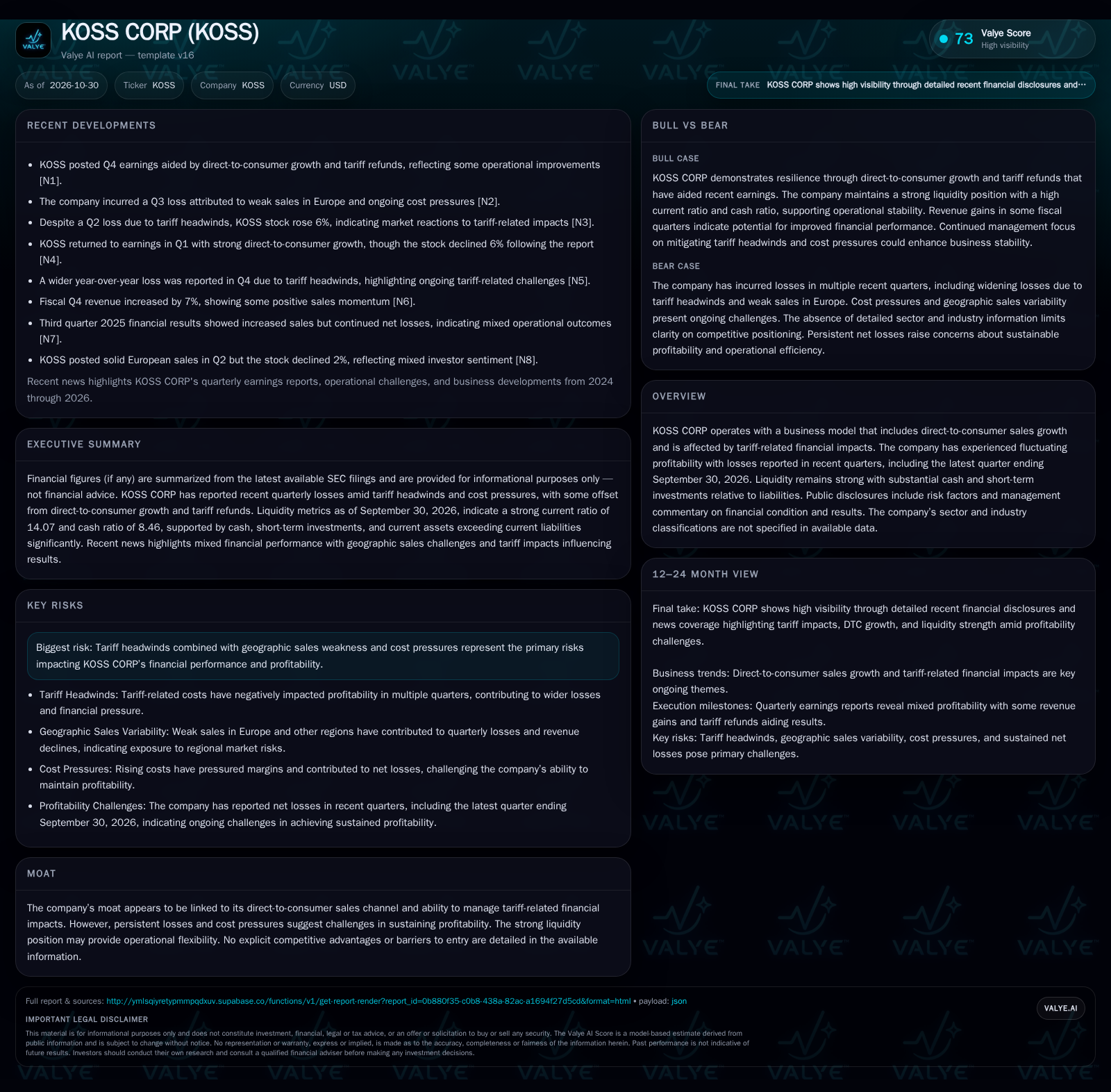
KOSS Corp’s financial story in 2026 is shaped by the interplay of DTC channel gains, tariff volatility, and uneven geographic sales. While reported liquidity position, quarterly losses persist as cost and tariff headwinds outpace revenue improvements. The company’s future hinges on translating DTC growth into operating leverage and navigating external risks.[S2] [N1] [N2] [N3]
KOSS Corporation’s evolving business model is defined by its push into direct-to-consumer (DTC) sales and its ongoing battle with tariff and cost headwinds. Despite reported liquidity position, the company has struggled to deliver consistent profitability, with losses reported in the most recent quarter. The key question for KOSS is whether DTC momentum and careful management of external shocks can eventually deliver sustainable operating leverage, or if persistent margin pressures and geographic volatility will continue to undermine earnings.
Recent Earnings Highlight Persistent Profitability Issues
KOSS Corporation reported a net loss of -$234,168 (EPS -$0.02) for the quarter ended September 30, 2026, continuing a sequence of quarterly losses even as select periods saw revenue growth or operational improvements. [S2] [S2] Recent quarters have been marked by mixed performance: while direct-to-consumer (DTC) channel growth and tariff refunds have helped in some periods, revenue gains have been inconsistent and cost pressures, especially tariffs and weak European sales, continue to drive losses.[N1] [N2] [N6] These facts frame a business at a crossroads: operational flexibility is high, but the path to sustained profitability is unclear.
Economic Impact of DTC Growth Coupled with Tariff Fluctuations
KOSS’s business model is evolving towards greater direct-to-consumer (DTC) engagement, which typically offers higher gross margins than traditional wholesale channels, assuming effective customer acquisition and retention. The DTC channel can reduce dependency on retail partners, allow for richer customer data, and provide more pricing control—potentially supporting better economics if scale is achieved. However, the company’s financials reveal that these benefits have not yet translated into consistent operating profits: cost pressures, especially from tariffs, have offset gains from DTC growth. Tariffs act as a direct drag on gross margin, while regional sales variability introduces further volatility.
Operating leverage could theoretically increase as DTC sales scale, with fixed costs spread over higher revenue. However, persistent losses suggest that either variable costs remain high (possibly due to customer acquisition costs, fulfillment, or product input inflation) or that revenue growth is insufficient to cover fixed overhead. The business remains exposed to external shocks—tariffs, currency, and regional demand swings—which complicate the path to stable profitability.
A critical factor in assessing the economic impact of DTC growth is the scalability of customer acquisition costs (CAC). If CAC remains disproportionately high relative to the incremental revenue generated per customer, the net contribution margin may stay compressed despite top-line gains. This dynamic is particularly relevant in competitive consumer electronics sectors, where digital marketing expenses can escalate rapidly without guaranteed retention. Additionally, fulfillment and logistics costs tied to DTC sales—such as warehousing, shipping, and returns management—can introduce variable expenses that partially offset the margin premium typically associated with direct sales. Thus, the interplay between CAC efficiency and fulfillment economics is pivotal for achieving sustainable profitability.
Another dimension to consider is the sensitivity of the supply chain to tariff changes and input cost inflation. If the company’s sourcing strategy remains concentrated in regions subject to fluctuating trade policies, the cost base will be inherently volatile. This volatility complicates pricing strategies, as frequent cost adjustments may erode consumer trust or dampen demand elasticity. Conversely, if the company can strategically diversify suppliers or negotiate tariff exemptions, it may reduce cost unpredictability, enabling more stable gross margins. However, such supply chain adjustments often require upfront investment and operational complexity, which could temporarily pressure earnings before benefits are realized.
DTC Channel Offers Edge Amid Ongoing Competitive Challenges
KOSS’s pivot toward DTC could offer some insulation from traditional retail competition and allow for more direct customer relationships. In the broader consumer electronics and audio accessories market, DTC brands can sometimes command loyalty and higher margins if they deliver product quality, brand recognition, and compelling digital experiences. However, barriers to entry in the headphone and audio market are low, with numerous established and emerging competitors ranging from mass-market electronics giants to digitally native startups.
Tariff exposure and cost pressures are not unique to KOSS; competitors importing from similar geographies may face similar challenges. However, larger competitors may have greater negotiating power, diversified supply chains, or the scale to absorb tariff shocks. The absence of clear evidence regarding proprietary technology, unique product features, or defensible intellectual property suggests that KOSS’s competitive position hinges largely on execution in DTC, cost management, and brand differentiation. If the company can leverage its liquidity to out-invest peers in customer acquisition and retention or develop distinctive products, it could carve out a defensible niche. Otherwise, it risks margin compression and further share erosion.
From a competitive standpoint, the ability to leverage proprietary customer data through the DTC channel can be a significant advantage if effectively utilized. Data-driven insights into purchasing behavior, preferences, and feedback can inform product development, targeted marketing, and personalized customer experiences—elements that foster brand loyalty and reduce churn. However, realizing this advantage depends on the company’s investment in analytics capabilities and its agility in responding to consumer trends. Without a robust data infrastructure and responsive organizational culture, the potential benefits of DTC data may remain unrealized, limiting differentiation in a crowded market.
Furthermore, brand equity plays a crucial role in sustaining competitive advantage within the DTC model. While the headphone and audio accessory market is saturated, companies that successfully cultivate a distinct brand identity—through design innovation, quality perception, or community engagement—can command pricing power and reduce sensitivity to tariff-driven cost increases. Achieving this differentiation requires consistent marketing investment and product innovation, which may strain financial resources in the near term but could yield higher margins and customer lifetime value over time. Failure to build such equity risks relegating the company to a price-competitive commodity position vulnerable to margin erosion.
Potential for Margin Improvement if DTC Success Reduces Tariff Exposure
A favorable scenario for KOSS would unfold if the company’s investment in DTC channels results in sustained revenue growth and higher gross margins, while tariff-related costs decline—either through external policy changes, supply chain adjustments, or successful cost pass-through to consumers. This would allow operating leverage to improve as fixed costs are spread over a larger sales base, converting revenue gains into bottom-line improvement.
Evidence confirming this scenario would include several consecutive quarters of growing DTC revenue and rising gross margin percentage, coupled with a reduction in the impact of tariffs on cost of goods sold. Further confirmation would come from improved operating income and a return to consistent profitability, as well as management commentary highlighting successful mitigation of cost pressures and positive customer response to DTC initiatives. Falsification would occur if DTC growth stalls, gross margins remain flat or decline, or tariff and cost headwinds continue to offset any channel gains.
DTC Expansion Faces Hurdles as External Pressures Continue
The most plausible outcome is that KOSS continues to experience a mix of operational wins and setbacks: DTC sales may grow, but not rapidly enough to fully neutralize ongoing tariff costs and regional sales swings, especially in Europe.
This scenario would be confirmed by ongoing reports of quarterly losses or only intermittent profitability, continued management commentary on tariff and cost headwinds, and news of uneven geographic sales performance. Evidence against this case would include a clear and sustained trend of margin improvement and consistent earnings, suggesting that the company has overcome the main structural obstacles.
Rising Tariffs and Costs Could Force Strategic Pullback
In a more adverse scenario, KOSS fails to generate enough DTC momentum to counteract rising input costs, persistent tariffs, and weakening demand in key markets. Losses widen, liquidity is gradually eroded by ongoing negative cash flow, and the company may be forced to curtail investment, seek external financing, or exit certain markets to preserve capital.
This scenario would be confirmed by accelerating net losses, a shrinking cash and investment balance, and management announcements regarding restructuring, layoffs, or asset sales. Evidence against this outcome would be stabilization or improvement in operating results, successful cost containment, or external events that reduce tariff exposure.
Factors Influencing KOSS’s Path to Steady Profitability
Quarterly DTC revenue growth rates—if disclosed—would clarify whether the channel is scaling fast enough to support margin improvement.
Gross margin percentage trends, particularly in relation to tariff and input cost fluctuations, would help test the thesis that DTC growth can offset external headwinds.
Updates on tariff-related costs as a share of COGS, or management commentary on supply chain adjustments, would indicate progress on risk mitigation.
Regional sales breakdowns, especially in Europe, would reveal whether geographic volatility remains a material drag on results.
Operating cash flow trends and changes in cash/investment balances would provide early warning of sustained negative cash generation.
Management disclosure of customer acquisition costs (CAC) and DTC retention rates—if reported—would shed light on the efficiency of the DTC model.
Announcements regarding new product launches, partnerships, or strategic pivots could signal attempts to differentiate or stabilize the business.
Disclaimer: This is research-only, informational analysis and not investment advice. It may include AI-generated interpretation and general industry context. Always verify important details using primary sources.

Comments