
Oil States International in 2026: Diversified Oilfield Services, Cyclical Risks, and the Stakes of Execution
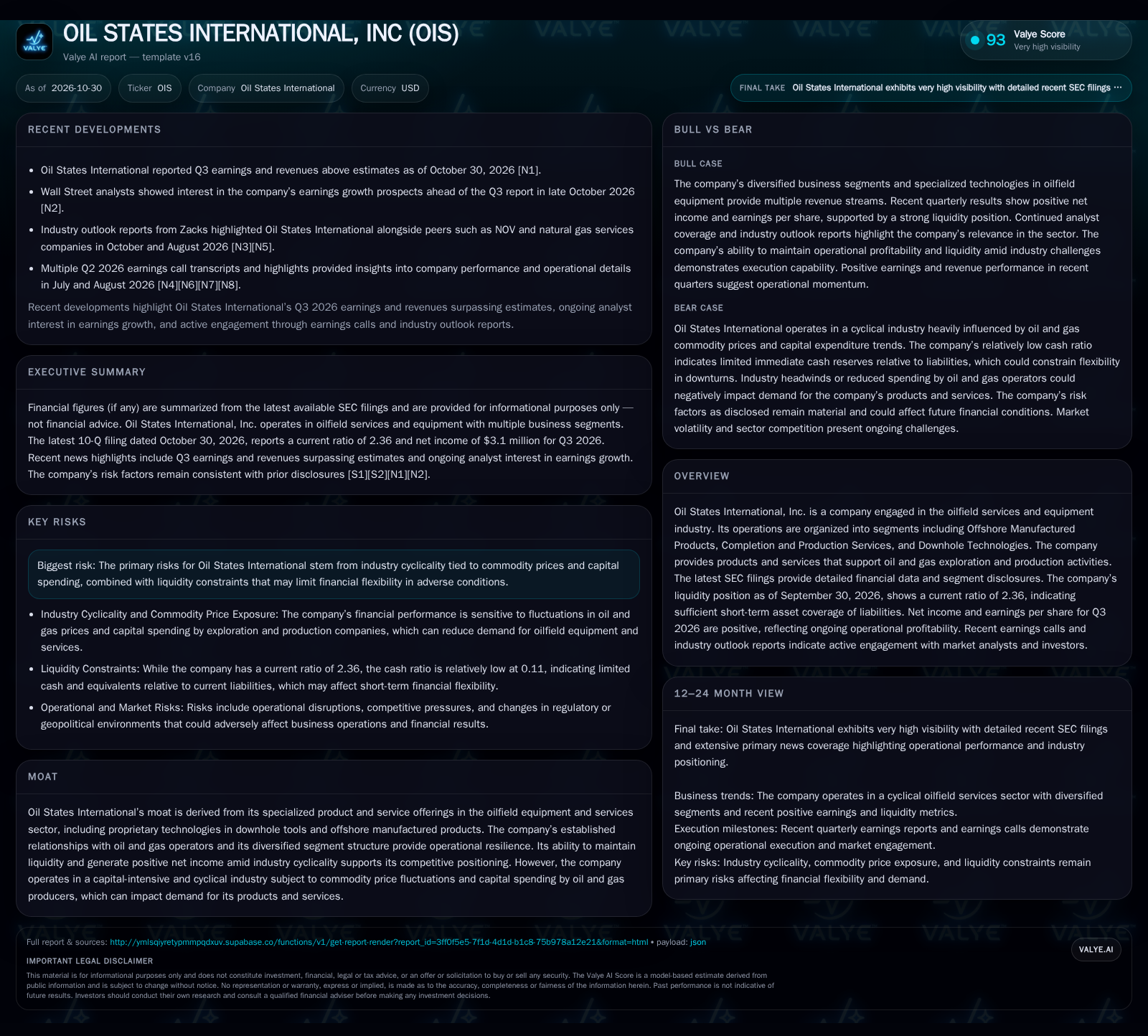
Oil States International reported positive Q3 2026 net income and exceeded earnings estimates, demonstrating ongoing operational execution across its three business segments.
Oil States International reported positive Q3 2026 net income and exceeded earnings estimates, demonstrating ongoing operational execution across its three business segments. The business remains exposed to commodity cycles, and its outlook will hinge on sustaining project wins and managing working capital.
Oil States International enters late 2026 with a diversified product portfolio and a record of recent operational profitability, as evidenced by Q3 earnings that beat analyst expectations. The company’s business segments span offshore manufactured products, completion and production services, and downhole technologies, positioning it to serve multiple facets of the oilfield lifecycle.While its current ratio signals adequate short-term asset coverage, a reported cash ratio reveals a vulnerability if sector conditions worsen. In an industry defined by capital intensity and commodity-linked cycles, Oil States’ ability to generate cash, secure project flow, and manage working capital will determine whether its recent momentum can be sustained or if it risks being caught by a downturn.
Recent Financial Results Highlight Profitability and Liquidity Dynamics
Oil States International reported net income of $3.1 million for Q3 2026, with both earnings and revenues surpassing analyst expectations. These results signal ongoing operational execution and suggest the company is benefiting from current oilfield activity levels [S2] [N1]. [S2] This split between accounting liquidity and true cash flexibility is material, especially in a sector prone to abrupt spending cuts and project delays. The company’s risk disclosures remain unchanged, reflecting continued exposure to industry cyclicality and capital spending trends [S1] [S2].
Segment Diversification and the Mechanics of Oilfield Profitability
Oil States International’s business spans three segments: Offshore Manufactured Products, Completion and Production Services, and Downhole Technologies [S1]. Each segment addresses different phases of the oil and gas lifecycle, from infrastructure for offshore drilling to well completion and production optimization. Revenue is likely driven by a mix of project-based equipment sales, recurring services, and technology-enabled solutions. Pricing power tends to be cyclical, with margins expanding during periods of elevated oilfield activity and compressing when operators cut capital expenditures.
Fixed costs are substantial due to manufacturing, engineering, and service infrastructure, making operating leverage a double-edged sword: higher volumes can rapidly expand margins, but downturns can quickly erode profitability. Capital requirements are significant, especially for inventory, equipment, and R&D—increasing the importance of working capital discipline. [S2] Thus, Oil States’ ability to convert working capital into cash and maintain project flow is central to its economics.
The interplay between fixed and variable costs within Oil States’ segments also affects its breakeven dynamics and strategic flexibility. In periods of rising demand, the company can capitalize on operating leverage, as incremental revenues contribute disproportionately to profits once fixed costs are absorbed. However, this leverage also means that during downturns, fixed cost burdens can rapidly erode margins, necessitating agile cost management and potential capacity adjustments. Moreover, the capital intensity of manufacturing and technology development creates a lag between investment and revenue realization, making forecasting accuracy and project timing critical to avoid cash flow mismatches. Effective supply chain management and inventory optimization thus become pivotal to balancing responsiveness with cost control.
Specialized Offerings Amid Commodity-Driven Rivalry
Oil States competes with diversified oilfield service providers and equipment manufacturers, including large global firms and specialized technology companies [N3] [N5]. Its competitive position is shaped by proprietary technologies in downhole tools and offshore products, as well as established relationships with upstream operators. These attributes can create switching frictions and customer stickiness, particularly for mission-critical equipment or integrated service packages.
However, the sector is intensely competitive, with pricing pressure during industry downturns and the ever-present risk of substitution by new technologies or lower-cost rivals. The company’s diversified segment structure offers some insulation, as exposure to both offshore and onshore, early- and late-cycle activities can smooth revenue volatility. Still, the ultimate determinant of competitive advantage will be the ability to deliver differentiated value—through reliability, technology, or efficiency gains—while managing costs and capital intensity.
The company’s competitive advantage is further influenced by its ability to innovate within a capital-constrained industry. Proprietary technologies and service integration can create barriers to entry and justify premium pricing, but only if they demonstrably reduce operational risks or enhance production efficiency for customers. Conversely, the rapid pace of technological change in oilfield services means that continuous R&D investment is essential to maintain differentiation. Additionally, Oil States’ diversified segment exposure can mitigate competitive risks by allowing resource reallocation between segments based on market conditions, though this requires effective cross-segment coordination and strategic prioritization to maximize overall portfolio value.
Sustained Project Flow and Margin Expansion Drive Outperformance
If oil and gas prices remain robust and industry capital expenditures continue at a healthy pace, Oil States could experience sustained demand across its business segments. In this scenario, project wins and backlog growth would enable the company to leverage its fixed cost base, driving margin expansion and improved free cash flow. Operational efficiency—such as faster inventory turns or improved receivables collection—could convert more of the current asset base into deployable cash, alleviating liquidity concerns.
Confirmation of this upside would include continued earnings beats, visible backlog or order growth (if disclosed), and upward revisions to analyst forecasts [N1] [N2]. Evidence of rising margins, reduced working capital days, and increased cash flow conversion would further support the case. Falsification would involve missed earnings, shrinking project pipelines, or persistent cash flow constraints despite reported profits.
Navigating Cyclical Volatility with Operational Discipline
The most plausible outlook is one where Oil States maintains moderate profitability but contends with periodic swings in project activity and pricing power. Revenue and earnings may fluctuate quarter-to-quarter, reflecting shifts in customer capital spending and the timing of major projects. The company’s diversified segment structure may allow it to offset weakness in one area with strength in another, but overall performance will remain tied to broader oilfield investment cycles.
In this scenario, working capital remains elevated relative to cash, requiring ongoing attention to collections and inventory management. The company’s ability to adjust costs in response to demand swings will be tested. Confirmation would come from stable, if unspectacular, quarterly results and ongoing analyst engagement [N2] [N3]. Falsification would involve a sudden drop in segment revenues, deteriorating margins, or warning signs in liquidity metrics.
Commodity Price Shock or Project Delays Expose Liquidity Weakness
A sharp decline in oil and gas prices or a freeze in upstream capital expenditures could quickly reduce demand for Oil States’ products and services. In this environment, project delays or cancellations would lead to underutilized capacity, margin compression, and potential inventory write-downs.
Signs of this scenario would include missed earnings, negative operating cash flow, or the need to access external financing on unfavorable terms. Deterioration in working capital metrics or the announcement of cost-cutting initiatives would further confirm downside pressure. Conversely, resilience in cash conversion or swift cost adjustments would challenge the bear case.
Testing the Thesis: What Will Determine Oil States’ Trajectory?
Quarterly trends in segment-level revenues and gross margins—if disclosed—would help assess demand strength and pricing power across the business.
Cash flow from operations versus reported net income: persistent gaps would signal working capital drag or collection risk.
Days sales outstanding and inventory turnover metrics—if disclosed—would provide early warning of liquidity or demand slowdowns.
Backlog or order book disclosures, particularly for Offshore Manufactured Products, would clarify future revenue visibility.
Capital expenditure plans and R&D investment levels: sustained investment may indicate confidence in long-term demand, while cuts may signal caution.
Any changes in analyst earnings forecasts or coverage intensity could reflect shifting sentiment on the company’s prospects.
Management commentary on customer capital spending intentions and project timing would help gauge near-term risk and opportunity.
Disclosure of new technology launches, major contract wins, or strategic partnerships would offer evidence of competitive positioning and growth potential.
Disclaimer: This is research-only, informational analysis and not investment advice. It may include AI-generated interpretation and general industry context. Always verify important details using primary sources.

Comments