
Robert Half’s Hybrid Talent and Consulting Model: AI Leverage, Market Pressures, and the Stakes of Execution in Staffing Cycles
Robert Half’s Q3 2026 results highlight the company’s scale in staffing and consulting, its ongoing AI-driven transformation, and the persistent challenges of cyclical demand and intense competition. The firm’s unified brand, global reach, and proprietary technology present both differentiation opportunities and execution risks as it navigates a fragmented industry and economic headwinds.
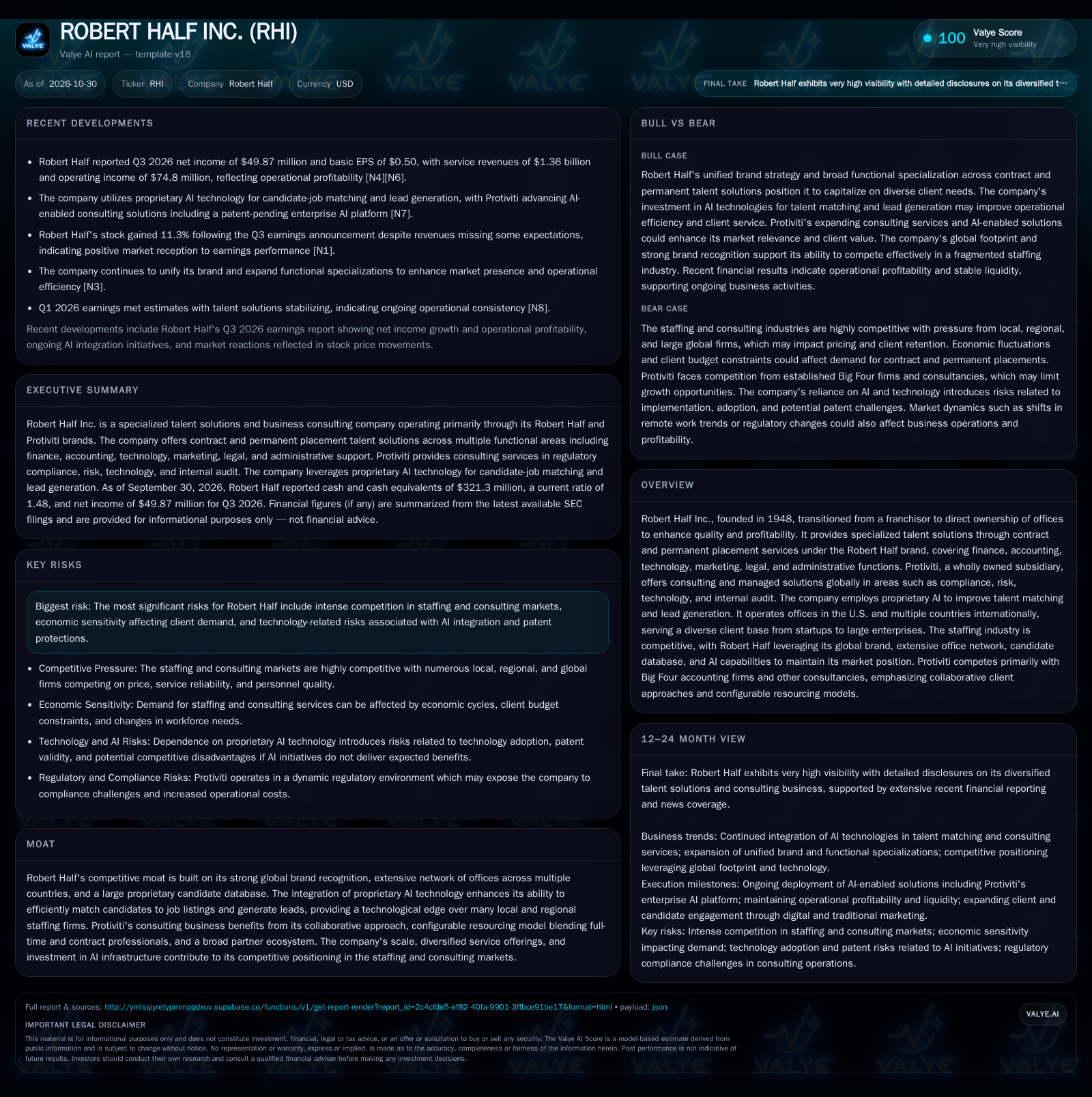
Q3 2026 saw Robert Half deliver $1.36B in service revenue and a positive market response despite some revenue misses, reflecting confidence in operational execution and AI-led strategy. The company’s dual focus on specialized staffing and consulting (through Protiviti), global footprint, and proprietary AI underpin competitive positioning, but margin resilience and demand stability remain exposed to economic cycles and aggressive rivals. Monitoring AI adoption, client mix, and consulting growth are critical for testing the durability of its moat and the plausibility of upside scenarios. [S2] [N1] [N3]
Robert Half’s latest quarter underscores the complex interplay between scale, specialization, and technology in the modern staffing and consulting landscape. With $1.36 billion in Q3 2026 service revenues and a notable stock rally following its earnings release, the company is clearly navigating market expectations and competitive threats with a blend of proprietary AI, global reach, and a unified brand. However, the durability of its competitive edge depends on the success of its technology investments, resilience in the face of cyclical demand, and the ability to sustain margin performance even as rivals and macroeconomic headwinds intensify. This analysis examines the core business drivers, economic mechanics, and scenario pathways that will shape Robert Half’s trajectory over the next 12–24 months.
Recent Performance and Strategic Moves Set the Stage
Robert Half reported Q3 2026 service revenues of $1.36 billion, generating a gross margin of $532.1 million and operating income of $74.8 million. Despite missing some revenue expectations, the company’s stock jumped 11.3% after earnings, suggesting the market is encouraged by operational execution, margin management, or forward-looking commentary. The company continues to unify its brand and expand its range of functional specializations—moves aimed at operational efficiency and market relevance. The company reported cash and liquidity metrics for the period; these figures do not by themselves establish operating runway, investment capacity, financial flexibility, or financing capacity. The ongoing integration of proprietary AI technology in both staffing and consulting operations remains a central strategic pillar. [S2] [N1] [N3]
How Robert Half’s Hybrid Staffing and Consulting Model Generates Value
Robert Half’s revenue engine is powered by two primary streams: talent solutions (contract and permanent placement) and consulting (Protiviti). In contract staffing, the company employs professionals directly, pays their wages, and bills client firms at a markup for hours worked. This model offers volume scalability but is inherently exposed to wage inflation, bill rate pressures, and the risk of idle bench time. Permanent placement generates fees from successful full-time hires, typically as a percentage of salary, resulting in more episodic but higher-margin transactions. Protiviti, the consulting arm, delivers project-based or managed solutions, with revenue often tied to time-and-materials or fixed-price contracts.
The company’s operating leverage is mixed: incremental contract placements can scale revenue with relatively stable overhead, but downturns can quickly compress margins due to wage and office fixed costs. Permanent placement is less capital-intensive but more volatile, as hiring freezes or economic contractions can sharply reduce volumes. Protiviti’s consulting revenue, while potentially less cyclical and higher-margin, is subject to project pipeline variability and competitive pricing. Investments in proprietary AI aim to improve candidate-job matching efficiency, reduce manual sourcing costs, and ultimately drive productivity per recruiter—if successful, this could structurally enhance margins and working capital rotation.
Competitive Arena: Where Scale, Technology, and Brand Collide
Robert Half operates in a hyper-competitive staffing market, facing thousands of local and regional players as well as global conglomerates. The firm’s advantages—global brand, extensive office network, and a vast proprietary candidate database—enable it to serve multinational clients and quickly fill roles across geographies. Proprietary AI for talent matching and lead generation may create workflow efficiencies and potentially improve placement speed, but such technologies are increasingly replicable and subject to rapid commoditization.
Protiviti’s consulting business competes with the Big Four accounting firms and a wide array of specialized consultancies. Here, the differentiators extend beyond price to include project methodologies, personnel expertise, and technology integration. Protiviti’s collaborative approach and configurable resourcing model offer flexibility, but the Big Four’s entrenched relationships and broader service portfolios remain formidable obstacles. In both segments, pricing pressure, client retention, and the ability to continuously source and develop high-quality talent are persistent battlegrounds.
AI-Led Productivity Gains and Consulting Expansion Drive Outperformance
A favorable scenario for Robert Half hinges on several reinforcing dynamics. First, the company’s proprietary AI materially improves candidate-job matching and lead generation, leading to higher fill rates, faster placements, and lower recruiter workloads. This would show up as rising productivity per internal staff and potentially higher gross margins in the staffing segment. If Protiviti’s planned enterprise AI platform (with a patent pending) gains traction, it could unlock new consulting mandates and could support premium pricing.
The upside case also assumes robust demand for specialized contract and permanent placements—especially in finance, tech, and compliance—and an uptick in cross-selling between staffing and consulting clients. Evidence supporting this scenario would include sustained margin expansion, above-industry placement growth, rising average fees per engagement, and strong growth in Protiviti’s project backlog. A differentiated success factor would be visible acceleration in digital client acquisition and measurable AI-driven efficiency gains. Conversely, failure to observe margin gains or stagnation in AI-enabled metrics would challenge this thesis.
Mixed Outcomes as Cyclical Demand and Execution Risks Interact
The most plausible outcome is one of moderate revenue growth with intermittent margin volatility, as Robert Half’s scale and brand help offset cyclical headwinds but do not fully immunize it from broader economic swings. Staffing volumes may stabilize or grow in line with macro employment trends, while permanent placement remains episodic and tied to client confidence. AI investments generate incremental, rather than transformational, gains—improving recruiter productivity and digital engagement, but not dramatically altering cost structures.
Protiviti continues to win business in regulatory, risk, and technology consulting, but faces fierce pricing and talent competition from both the Big Four and agile boutiques. The company’s unified brand and expanded functional specializations support operational efficiency, but wage inflation and competitive pricing pressure may weigh on gross margins. Evidence confirming this scenario would include revenue growth tracking industry averages, stable but unspectacular operating margins, and steady—but not breakout—growth in consulting revenues. Marked divergence from peer benchmarks or sudden margin compression would challenge this outlook.
Demand Shocks or AI Disappointment Erode Margins and Market Share
A negative scenario for Robert Half could unfold if macroeconomic contraction, hiring freezes, or client budget tightening sharply reduce demand for contract and permanent placements. This would drive down billable hours, exacerbate wage-to-bill rate mismatches, and potentially leave the company overstaffed relative to revenue. If AI investments fail to deliver meaningful productivity gains—or if competitors leapfrog with more effective platforms—the anticipated margin benefits could evaporate, and the company’s cost base would become more onerous relative to peers.
Protiviti could also lose share if regulatory or technology consulting demand weakens, or if the Big Four and niche consultancies undercut on price or outcompete on project scope. Evidence of this scenario would include revenue declines, margin compression, or rising client churn—especially in key verticals. If AI-driven metrics (such as placement speed or recruiter productivity) stagnate or deteriorate, and if Protiviti’s growth meaningfully lags industry benchmarks, the downside thesis would gain credibility.
Signals That Will Reveal the Strength and Durability of Robert Half’s Model
Productivity per internal staff recruiter—if disclosed—would help test whether AI investments are translating into efficiency gains.
Gross margin trends in both contract staffing and consulting; sustained improvement would support the upside case, while compression would warn of competitive or wage pressure.
Growth in Protiviti’s consulting backlog and win rates, especially for AI-integrated offerings and compliance projects.
Client retention and repeat business rates, particularly in contract staffing, as a proxy for brand strength and service differentiation.
Evidence of pricing power or fee rate improvement in permanent placement and consulting engagements.
Volume of cross-sold engagements between staffing and Protiviti clients, which would indicate successful integration and client expansion.
AI-enabled placement speed and fill rates—if disclosed—would provide quantitative evidence of technology-driven differentiation.
Mix of client industries and geographies; resilience or concentration in cyclical sectors could amplify or dampen demand volatility.
Disclaimer: This is research-only, informational analysis and not investment advice. It may include AI-generated interpretation and general industry context. Always verify important details using primary sources.

Comments