
Standard Motor Products: Efficiency Initiatives, Segment Diversification, and the Stakes of Aftermarket Cyclicality
Standard Motor Products is actively pursuing cost reductions, operational improvements, and segment expansion—including the integration of Nissens Automotive—to buffer the business against aftermarket volatility.
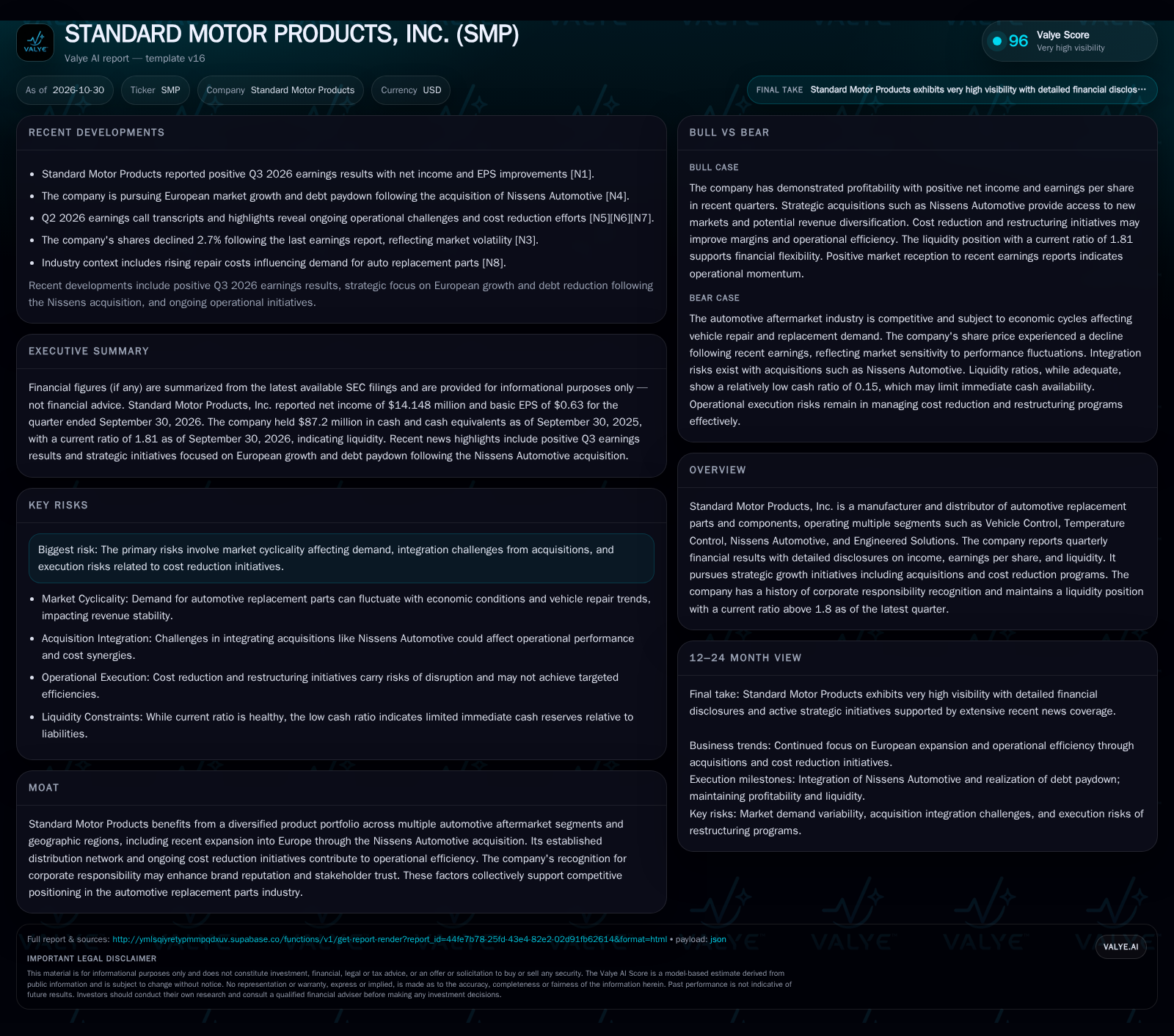
Standard Motor Products reported Q3 2026 profitability and continues to emphasize cost reduction and restructuring, while also integrating its Nissens Automotive acquisition. The company’s liquidity ratios are adequate, though immediate cash reserves are less robust. Success will depend on realizing operational efficiencies, managing integration risks, and navigating the cyclical nature of automotive aftermarket demand. [S2] [N1]
Standard Motor Products, a diversified player in the automotive replacement parts market, is navigating a pivotal period defined by operational streamlining, segment expansion, and the integration of its recent Nissens Automotive acquisition. While the company’s Q3 2026 results confirm profitability and a reasonable liquidity position, the underlying thesis now rests on whether management can deliver sustainable margin gains and growth amid a competitive, cyclical sector. The interplay between cost discipline, integration progress, and demand volatility will shape outcomes over the next several quarters. [S2] [N1]
Profitability, Liquidity, and Strategic Shifts: Where Standard Motor Products Stands
As of September 30, 2026, Standard Motor Products reported net income of $14.148 million and basic EPS of $0.63, marking continued profitability in a challenging industry. The company reported cash and liquidity metrics for the period; these figures do not by themselves establish operating runway, investment capacity, financial flexibility, or financing capacity. Management has initiated cost reduction and restructuring programs, aiming to improve operational efficiency and margins. The recent acquisition of Nissens Automotive broadens the company’s segment footprint and brings new geographic and product exposure, notably in Europe. However, the stock declined 2.7% post-earnings, highlighting ongoing market scrutiny and sensitivity to operational execution. [S2] [N1] [N3] [N4]
Beyond headline profitability and liquidity metrics, a deeper understanding of Standard Motor Products’ capital allocation priorities would clarify the sustainability of its financial position. For instance, if disclosed, the company’s investment in maintenance versus growth capital expenditures could reveal the balance between preserving existing operations and funding expansion initiatives. Additionally, the pace and scale of debt repayment or refinancing efforts would influence potential financial flexibility amid potential aftermarket cyclicality. Operationally, the timing and magnitude of restructuring charges relative to run-rate cost savings would help gauge the near-term earnings impact and longer-term margin trajectory. This level of granularity is critical for assessing whether the current liquidity and profitability can withstand external shocks or integration complexities.
How Segment Diversification and Cost Controls Shape Economic Outcomes
Standard Motor Products generates revenue by manufacturing and distributing automotive replacement parts across several segments, including Vehicle Control, Temperature Control, Nissens Automotive, and Engineered Solutions. The business is fundamentally volume-driven, with pricing power generally constrained by the competitive and commoditized nature of the aftermarket parts industry. Gross margins are sensitive to raw material costs, supply chain efficiency, and operational leverage.
Recent cost reduction and restructuring efforts are designed to lower the fixed cost base and enhance margin resilience. If these initiatives successfully reduce SG&A and manufacturing overhead, incremental sales growth could yield outsized profit gains due to operating leverage. The integration of Nissens Automotive introduces both additional scale and complexity, potentially enabling cross-segment synergies but also risking integration costs and temporary margin dilution.
Capital needs are moderate, with working capital and inventory management as ongoing priorities given the sector’s sensitivity to demand swings and supply chain disruptions. [S2]
The interplay between segment diversification and cost control also raises questions about the company’s capacity to leverage scale while managing complexity. While expanding into new product categories and geographies can spread fixed costs and reduce segment-specific volatility, it often introduces integration challenges such as aligning supply chains, harmonizing IT systems, and unifying sales channels. If these complexities are not effectively managed, the anticipated operating leverage benefits may be diluted or delayed. Furthermore, the company’s ability to negotiate favorable raw material contracts and optimize inventory levels across segments will be critical to maintaining gross margin stability. Monitoring the evolution of segment-level profitability, if disclosed, would provide insight into whether diversification is enhancing overall economic resilience or masking underperformance in specific areas.
Distribution Reach, Scale, and the Limits of Differentiation
Standard Motor Products operates in a highly competitive aftermarket landscape, contending with both large diversified parts suppliers and specialized niche providers. Its established distribution network and multi-segment breadth provide some scale advantages—particularly in procurement, logistics, and customer reach. The recent addition of Nissens Automotive enhances the company’s European presence and product portfolio, helping to diversify revenue streams.
However, barriers to entry in the aftermarket sector are moderate, with product differentiation often limited. Brand reputation, fill rates, and breadth of catalog are important, but switching costs for customers (such as auto repair shops and retailers) are not prohibitive. The company’s ongoing recognition for corporate responsibility may bolster stakeholder trust, but is unlikely to meaningfully insulate it from price-based competition or substitution by alternative parts suppliers.
Technology shifts—such as electrification and increased vehicle complexity—could gradually alter product mix and open the door to new competitors, especially those with advanced R&D or digital supply chain capabilities. The company’s ability to adapt its portfolio and maintain relevance in this evolving landscape will be a key test.
In a commoditized aftermarket environment, incremental differentiation may stem from operational excellence rather than product innovation alone. For example, superior logistics execution and inventory availability can reduce customer downtime, enhancing value propositions for repair shops and distributors. If Standard Motor Products can leverage data analytics to optimize demand forecasting and inventory replenishment, it may achieve higher fill rates and lower carrying costs, translating into competitive advantage. Additionally, cultivating strong supplier relationships to secure preferential pricing or exclusive products could help mitigate pricing pressures. However, these operational differentiators require sustained investment and organizational focus, and their efficacy depends on the company’s ability to adapt quickly to technological shifts and evolving customer expectations in a rapidly changing automotive landscape.
Margin Gains and Revenue Diversification Through Successful Execution
The most favorable scenario envisions Standard Motor Products realizing sustained margin expansion and top-line growth by executing on cost reduction programs and efficiently integrating Nissens Automotive. If management delivers on targeted SG&A and supply chain savings, operating leverage could drive meaningful EPS upside even in a flat market. Successful cross-selling and synergy capture from the Nissens acquisition could further diversify revenue and reduce dependence on any single segment or geography.
Confirmation of this scenario would come from sequential margin improvement, reduced operating expense ratio, and evidence of revenue growth in European markets attributable to the Nissens platform. Additional signs would include positive working capital trends, improved cash conversion, and outperformance relative to aftermarket peers on profitability metrics.
Falsification would be evident if integration costs consistently outweigh synergy gains, or if operating margins stagnate despite restructuring efforts—suggesting limited cost takeout or execution missteps.
Balancing Efficiency Efforts With Industry Volatility
The most plausible trajectory sees Standard Motor Products maintaining profitability while gradually improving margins through cost efficiencies, but with growth constrained by industry cyclicality. The company may realize some benefits from restructuring and the Nissens integration, but these gains could be partially offset by soft demand or competitive pricing pressure.
Confirmation of this scenario would be stable or slightly improving operating margins, modest EPS growth, and successful containment of SG&A as a percentage of revenue. Revenue growth would likely track broader industry trends, with periodic volatility tied to macroeconomic factors and vehicle repair demand.
This outcome would be challenged if either operational disruptions from restructuring or integration setbacks cause temporary margin compression, or if macro headwinds drive a sharper-than-expected decline in aftermarket volumes.
Integration Stumbles and Market Weakness Amplify Margin Pressure
A less favorable scenario unfolds if the company faces significant integration challenges with Nissens Automotive, leading to unexpected costs, operational inefficiencies, or customer attrition in new markets. Simultaneously, a downturn in vehicle miles driven or a slowdown in consumer spending could sharply reduce aftermarket demand, compressing volumes and limiting pricing flexibility.
This scenario would be confirmed by declining gross and operating margins, negative EPS revisions, and deteriorating working capital metrics—potentially forcing the company to draw on external financing or delay strategic initiatives. News of restructuring delays, missed synergy targets, or loss of key customer relationships would further support this adverse chain.
Falsification would require evidence of smooth integration, stable or growing margins, and resilience in aftermarket demand even amid broader economic softness.
Milestones and Metrics That Will Shape Standard Motor Products’ Strategic Outcome
Quarterly gross and operating margin trends, especially in the wake of cost reduction and restructuring initiatives.
Progress on integration milestones for Nissens Automotive, including synergy realization and new market penetration.
Segment-level revenue growth, particularly in European operations post-acquisition, if disclosed.
SG&A as a percentage of sales—a useful metric for assessing the durability of cost takeout.
Cash conversion cycle and working capital trends, which would indicate underlying liquidity resilience.
Any material changes in inventory levels or fill rates, as these directly impact customer retention and competitive positioning.
External signals of demand trends—such as vehicle miles driven or macroeconomic indicators relevant to automotive repair activity.
Emergence of new technology-driven competitors or shifts in product mix toward EV and advanced vehicle systems.
Disclaimer: This is research-only, informational analysis and not investment advice. It may include AI-generated interpretation and general industry context. Always verify important details using primary sources.

Comments