
ADP’s AI-Driven Expansion: Margin Leverage, Regulatory Stakes, and the Future of Payroll Services
ADP’s latest results highlight accelerating revenue and margin growth, underpinned by AI-enabled product rollouts and international HCM expansion. As regulatory complexity and co-employment liabilities loom, the company’s ability to convert scale and technology investments into durable advantage will determine whether recent momentum translates into sustained leadership.
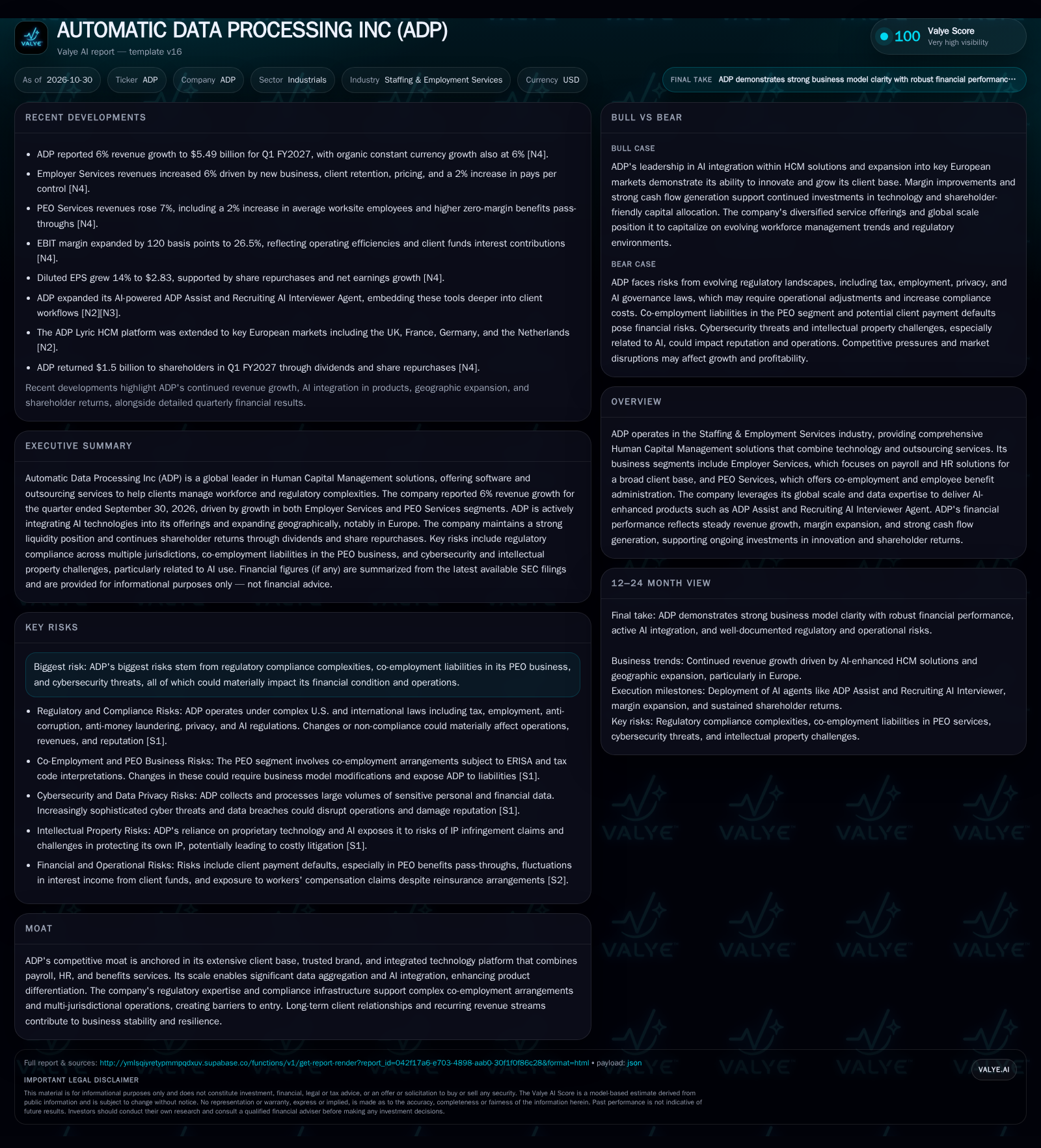
ADP reported 6% organic revenue growth and a 120-basis-point EBIT margin gain, propelled by strong client retention, pricing, and AI-driven product enhancements. Expansion of its ADP Lyric HCM platform into Europe and deeper integration of generative AI tools signal a push for global scale and workflow automation. Yet, the company faces mounting regulatory, co-employment, and cybersecurity risks, and its ability to sustain margin gains hinges on managing these exposures while outpacing increasingly sophisticated competitors. [S2] [N2] [N4]
Automatic Data Processing Inc (ADP) underscores its position as a global Human Capital Management leader with a 6% organic revenue increase and expanding EBIT margins in the latest quarter. The company’s rapid deployment of AI-driven products—coupled with international expansion into major European markets—signals a strategy aimed at deepening client integration and growing recurring revenues. However, as regulatory and co-employment risks intensify, the company’s long-term success will depend on its ability to translate technology investments into sustainable economic advantage, while navigating a complex and evolving risk landscape. [S2] [N2] [N4]
AI Rollouts, Margin Gains, and European Expansion Define ADP’s Latest Results
ADP reported total revenues of $5.49 billion for the quarter ended September 30, 2026, representing 6% year-over-year organic growth on a constant currency basis. Employer Services revenue climbed 6%, driven by a combination of new business bookings, high client retention, pricing increases, and a 2% rise in pays per control. PEO Services revenue grew 7%, with a 2% uptick in average worksite employees and higher zero-margin benefits pass-throughs. EBIT margin expanded by 120 basis points to 26.5%, attributed to operating efficiencies and greater client funds interest revenue. Meanwhile, the company has embedded generative and agentic AI tools—such as ADP Assist and the Recruiting AI Interviewer Agent—more deeply into client workflows, and expanded its ADP Lyric HCM platform into the UK, France, Germany, and the Netherlands. These developments suggest ADP is executing on both product and geographic growth vectors, while also delivering shareholder returns of $1.5 billion in the quarter through dividends and repurchases. [S2] [N2] [N4]
How ADP Converts Scale, Data, and Technology into Profitable Growth
ADP’s revenue engine is fundamentally built around high-volume, recurring payroll processing and HR outsourcing fees, supplemented by value-added services such as benefits administration and regulatory compliance support. Employer Services—its largest segment—benefits from economies of scale, as each incremental client can be onboarded with modest incremental cost once core platforms are established. PEO Services, while more complex due to co-employment and benefits pass-throughs, leverages pooled risk and scale to offer competitive benefit packages and spread fixed costs.
Pricing power in the core payroll business is historically modest, but retention is high due to integration with client HR workflows and regulatory compliance needs. The company’s recent margin expansion highlights the potential for operating leverage as technology investments (notably AI integration) streamline service delivery and reduce manual intervention. Additionally, ADP earns interest income from client funds held for payroll processing, which can be a material profit source when interest rates are elevated. The capital intensity of the business is moderate: while product development and compliance investments are ongoing, the core platform model does not require large physical infrastructure outlays. Shareholder returns are enabled by robust cash flow, but future margin gains will likely depend on continued efficiency improvements, AI-driven automation, and the ability to cross-sell higher-margin services.
Defending the Moat: Data, Compliance, and the AI Arms Race in HCM
ADP’s competitive defenses rest on its scale, brand trust, and deep regulatory expertise—qualities that are reinforced by long-term client relationships and the complexity of switching HCM providers. The aggregation of payroll and HR data across millions of employees enhances ADP’s ability to train and deploy AI models, which could further differentiate its offerings if these tools deliver measurable productivity or compliance gains for clients.
However, the competitive landscape is increasingly dynamic. Cloud-native HCM providers and focused software disruptors are targeting both the SMB and enterprise segments with modern, flexible platforms—often emphasizing user experience, rapid deployment, and lower switching costs. The widespread adoption of generative AI in HR tech, including by newer entrants, could erode ADP’s technology lead if innovation cycles accelerate. Additionally, global expansion brings new competitors with deep local expertise, especially in Europe, where regulatory fragmentation is high. Still, ADP’s ability to bundle compliance, payroll, and benefits with AI-driven workflow automation gives it a toolkit that few peers can match at scale; the question is whether these advantages remain durable as the market evolves.
If AI Integration Drives Measurable Productivity and Retention Gains
In the most favorable scenario, ADP’s aggressive AI rollout yields tangible improvements in client workflow efficiency, driving higher customer satisfaction, lower churn, and the ability to price premium services. If tools like ADP Assist and the Recruiting AI Interviewer Agent demonstrably reduce HR workload or improve recruiting outcomes, adoption rates could accelerate—especially among large, process-driven clients. International expansion, particularly of the Lyric HCM platform into Europe, could unlock incremental growth as multinational clients seek unified solutions with embedded compliance support.
The upside would be confirmed by sustained above-market revenue growth in both Employer Services and PEO, further EBIT margin expansion, and evidence of rising average revenue per client. Early signs might include increased penetration of AI modules among existing clients, positive customer satisfaction/retention metrics (if disclosed), and a growing share of new business bookings attributed to AI-enabled offerings. Disclosures around reduced manual HR workload, lower client support touchpoints, or improved regulatory accuracy would further bolster the case.
AI as Table Stakes: Efficiency Gains Offset by Competitive and Regulatory Complexity
The most plausible outcome is that ADP’s AI investments deliver incremental efficiency and modest client stickiness, but do not dramatically alter the competitive balance. Revenue growth remains in the mid-single digits, supported by ongoing pricing discipline, high retention, and steady expansion of value-added services. Margin gains continue, but at a slower pace as competitors deploy similar AI tools and as regulatory/compliance costs rise—particularly with new privacy and AI governance requirements in both the U.S. and Europe.
This scenario would be validated by continued steady growth in pays per control, stable or gradually increasing EBIT margins, and no major change in client churn or average contract size. If disclosed, metrics around AI adoption rates and the proportion of workflows automated would help confirm that AI is enhancing efficiency but not fundamentally transforming the economics. Signs that regulatory or co-employment risks are being managed without material cost spikes or litigation would further support the base case.
Regulatory Shocks or AI Missteps Disrupt Growth and Margin Trajectory
The principal risk is that regulatory, co-employment, or cybersecurity shocks force ADP to incur sharply higher compliance costs, alter its business model, or face reputational damage. If U.S. or EU authorities tighten rules on co-employment, data privacy, or AI governance, ADP may need to invest heavily in compliance, withdraw or rework certain offerings, or absorb legal liabilities—particularly in its PEO segment. A major data breach or high-profile AI failure could trigger client defections, regulatory penalties, or loss of trust.
This scenario would be confirmed by a sudden spike in compliance, legal, or insurance expenses; stagnation or decline in PEO enrollment; or material margin compression. Watch for disclosures of regulatory investigations, class-action litigation, or costly retroactive compliance measures. Negative trends in client retention, especially in regulated industries or international markets, would also signal downside realization.
What Will Determine Whether ADP’s AI and Margin Story Holds Up
Sustained organic revenue growth in Employer Services and PEO, particularly as a result of new AI-enabled product adoption or international expansion. [S2] [N4]
Trends in EBIT margin and operating expense ratios, especially as AI-driven automation is scaled and as compliance costs evolve. [S2]
Client retention rates and churn trends, particularly among large and multinational clients. If disclosed, this would test the stickiness of ADP’s integrated platform.
Adoption rates and customer satisfaction metrics for new AI modules such as ADP Assist and Recruiting AI Interviewer Agent. If disclosed, these would validate technology differentiation.
Incidence and financial impact of regulatory investigations, compliance cost spikes, or co-employment litigation—especially in the PEO segment. [S1]
Material cybersecurity incidents or data breaches, and their impact on client trust and regulatory posture. [S1]
Average revenue per client and the mix shift toward higher-margin advisory or AI-driven services. If disclosed, this would illuminate cross-sell and margin dynamics.
Pace of international expansion, particularly the uptake of the Lyric HCM platform in new European markets. [N2]
Disclaimer: This is research-only, informational analysis and not investment advice. It may include AI-generated interpretation and general industry context. Always verify important details using primary sources.

Comments