
Amazon’s Dual Engines: AWS Acceleration, AI Investment, and the Stakes of Scale
Q3 2026 showed AWS surging toward a five-year growth high, even as overall revenues missed estimates and Amazon ramped up AI-related spending.
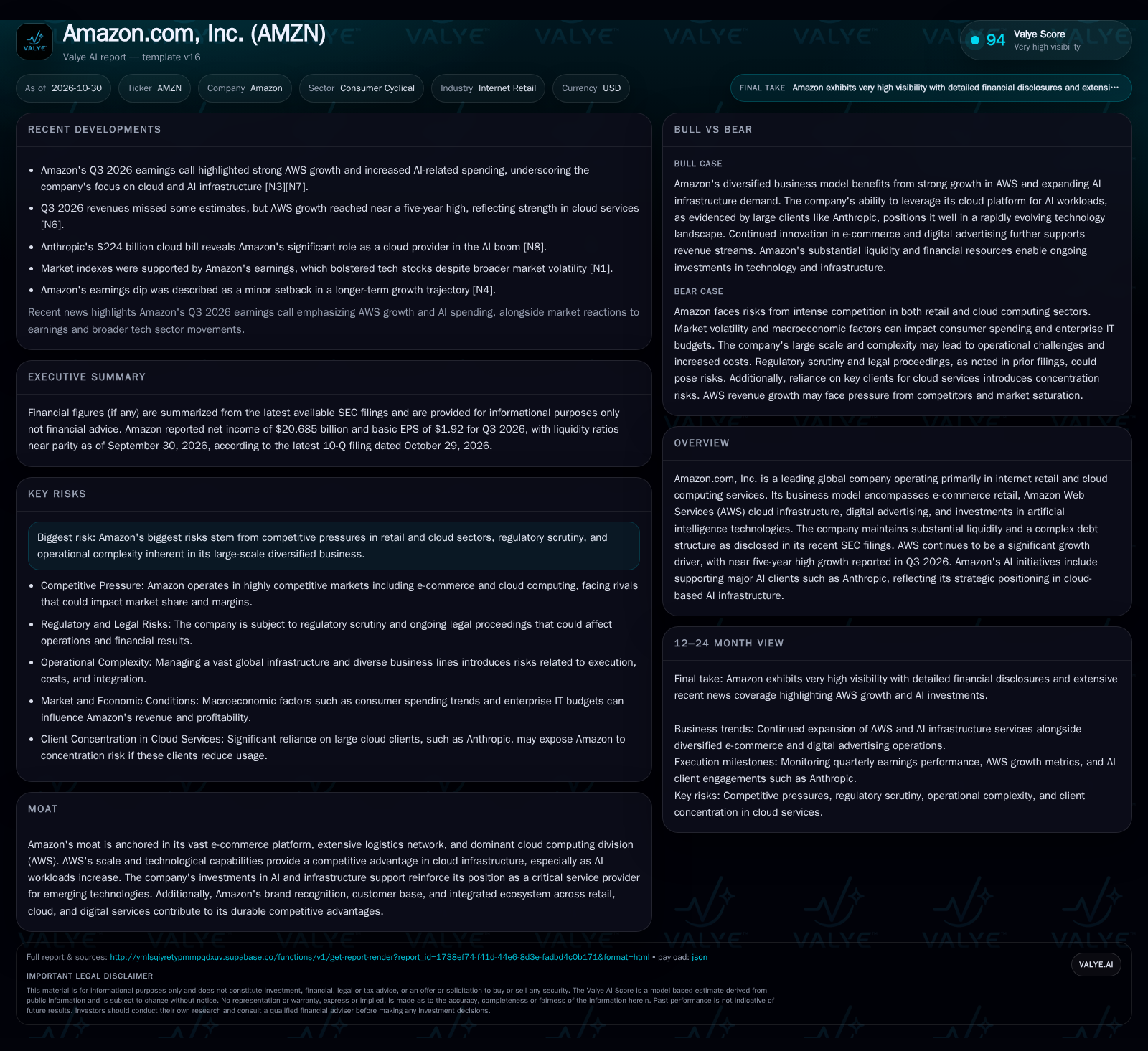
Amazon’s Q3 2026 results highlight accelerating AWS growth and major AI infrastructure investments, even as overall revenues fell short of consensus. The company’s substantial liquid assets and diversified business mix continue to provide strategic flexibility, but near-parity current assets and liabilities, rising AI spend, and competitive intensity in both cloud and retail introduce new stakes for execution and capital allocation. AWS’s performance and the durability of large AI clients like Anthropic will be pivotal in shaping Amazon’s next phase.
Amazon’s Q3 2026 results spotlight a business in transition: AWS delivered its strongest growth in nearly five years even as overall revenues missed estimates, underscoring the growing centrality of cloud and AI infrastructure to Amazon’s future. With tech and retail competition intensifying, Amazon’s ability to convert scale, innovation, and its AI client base into durable economic advantage will define its next chapter.
AWS Growth Surges as AI Investments Take Center Stage
Amazon’s Q3 2026 saw AWS growth approach a five-year high, even as total revenues fell short of consensus estimates. This outperformance in cloud services contrasted with a minor earnings dip described as a short-term setback rather than a shift in the long-term growth trajectory [N6] [N4]. The company reported $20.685 billion in net income and basic EPS of $1.92 for the quarter [S2]. Liquidity remains substantial, with $55.78 billion in cash and $58.44 billion in short-term investments as of September 30, 2026, though the current ratio stood at 0.99, indicating near-equal current assets and liabilities [S2]. Amazon continues to ramp up AI infrastructure spending, with large-scale clients like Anthropic incurring significant cloud bills through AWS [N7]. These developments reinforce the narrative of AWS and AI as pivotal growth engines while highlighting the operational and capital allocation challenges of managing scale, investment, and competition.
Revenue Streams, Spending Leverage, and the Stakes of AI Infrastructure
Amazon’s business economics rest on four primary pillars: e-commerce retail, AWS cloud infrastructure, digital advertising, and emerging AI infrastructure services. AWS has become the most scalable and margin-rich segment, with high fixed costs in data centers and R&D offset by variable cloud usage and software-driven gross margins. As AI workloads proliferate, AWS’s ability to capture high-value, compute-intensive contracts—such as those with Anthropic—could further boost mix and margin if these relationships are sticky and usage remains high.
E-commerce, while massive in volume, is structurally lower margin, with logistics, fulfillment, and customer acquisition costs exerting pressure on profitability. Digital advertising offers incremental margin expansion as Amazon monetizes its retail platform audience, but remains sensitive to macro and retail cycles.
Amazon’s capital allocation is shifting toward AI infrastructure and cloud, with increased spending on both hardware and talent to support next-generation workloads. This capital intensity may be partially offset by operating leverage if AWS growth outpaces fixed cost expansion. The company reported cash and liquidity metrics for the period; these figures do not by themselves establish operating runway, investment capacity, financial flexibility, or financing capacity.
How Scale, Ecosystem, and Cloud Depth Shape Amazon’s Defenses
Amazon’s competitive position is anchored by its global e-commerce reach, logistics infrastructure, and, increasingly, AWS’s scale and technical capability. In cloud, Amazon faces formidable competition from other hyperscalers, including Microsoft Azure and Google Cloud, each vying for leadership in AI infrastructure and enterprise digital transformation. AWS’s early-mover advantage, broad service catalog, and ability to attract large AI-native clients like Anthropic provide differentiation, but switching costs for cloud customers can be moderate if competitive offerings close the gap on performance, pricing, or ecosystem integration.
On the retail side, Amazon’s moat is supported by its logistics network, Prime ecosystem, and data-driven personalization, but faces ongoing margin pressure from both traditional retailers and digital-native competitors. Digital advertising leverages Amazon’s first-party data, but must contend with platform and regulatory shifts that could impact targeting and measurement.
The company’s breadth is both a strength and a vulnerability: while cross-segment integration could create network effects and cross-selling opportunities, it also increases operational complexity and regulatory exposure, especially as Amazon becomes a critical infrastructure provider in AI and cloud.
AI Workloads Drive AWS Flywheel: What Would Confirm Durable Leadership
In a favorable scenario, AWS’s near five-year high growth rate accelerates further, fueled by surging demand for AI training and inference workloads from both established and emerging technology clients. If Amazon’s investments in AI infrastructure yield differentiated performance, reliability, or cost advantages—leading to expanded multi-year contracts and higher average revenue per cloud client—AWS could capture an outsized share of the next wave of enterprise and AI-native spending.
Amazon’s advertising and e-commerce flywheels may benefit from further integration of AI-driven personalization and supply chain optimization, supporting incremental margin gains despite retail competition. Substantial free cash flow from AWS would enable continued reinvestment, strategic M&A, or shareholder returns without jeopardizing potential financial flexibility.
Evidence supporting this scenario would include sustained or accelerating AWS growth rates, public disclosure of additional large-scale AI client wins, and signs of margin expansion in both cloud and advertising segments.
Diversification Sustains Growth, but Margin and Execution Risks Persist
The most plausible trajectory is that Amazon continues to deliver mid- to high-single-digit top-line growth, with AWS as the primary engine offsetting slower retail and advertising expansion. AI workload adoption remains robust but competitive intensity in cloud limits pricing power, and large clients periodically rebalance spend across providers, preventing runaway margin expansion.
E-commerce and advertising contribute stable, if cyclical, cash flows, but face ongoing cost pressures from logistics, fulfillment, and customer acquisition. Amazon’s capital allocation remains disciplined, with incremental spending on AI and data center infrastructure matched by improvements in operating efficiency.
Confirmation of this scenario would be AWS growth rates stabilizing at or near current highs but not accelerating further, operating margins remaining flat or expanding modestly, and working capital metrics indicating continued financial discipline. Signs of execution risk would include missed milestones in AI infrastructure deployment, client churn in AWS, or a reacceleration of cost growth outpacing revenue gains.
Operational Complexity and Competitive Pressures Erode Advantage
In an adverse scenario, Amazon’s operational complexity and capital intensity outpace the benefits of scale. If AWS growth slows due to price competition, technological leapfrogging by rivals, or regulatory headwinds limiting AI infrastructure expansion, the impact on consolidated margins could be significant given AWS’s outsized contribution.
E-commerce may face renewed margin compression as consumer spending softens or fulfillment costs rise, while digital advertising could come under pressure from privacy regulation or shifts in advertiser budgets. Should a major AI client like Anthropic reduce cloud usage or switch providers, AWS may be exposed to sudden revenue concentration risks.
Regulatory actions or legal proceedings with material financial impact would further exacerbate downside risk.
Milestones and Metrics That Will Shape Amazon’s AI and Cloud-Driven Future
AWS segment growth rates—particularly year-over-year comparisons and sequential acceleration or deceleration.
Disclosure of new large-scale AI infrastructure clients or expansion of existing contracts (if disclosed).
Operating margin trends in both AWS and digital advertising segments, as these drive consolidated profitability.
Capital expenditures and R&D outlays related to AI and data center infrastructure, and their relationship to AWS revenue growth.
Churn or renewal rates among major AWS clients, especially in AI workloads (if disclosed).
Regulatory developments or antitrust actions affecting cloud, AI, or e-commerce operations.
E-commerce segment profitability and logistics cost trends, as they impact overall margin structure.
Disclaimer: This is research-only, informational analysis and not investment advice. It may include AI-generated interpretation and general industry context. Always verify important details using primary sources.

Comments