
Consumer Portfolio Services: Navigating Sub-Prime Auto Finance with Securitization-Driven Growth and Leverage Constraints
Consumer Portfolio Services, Inc. remains a key player in U.S. sub-prime auto lending, leveraging securitizations and a broad dealer network to drive portfolio growth. Yet, its high indebtedness and exposure to credit risk raise questions about resilience in a shifting economic and funding environment.
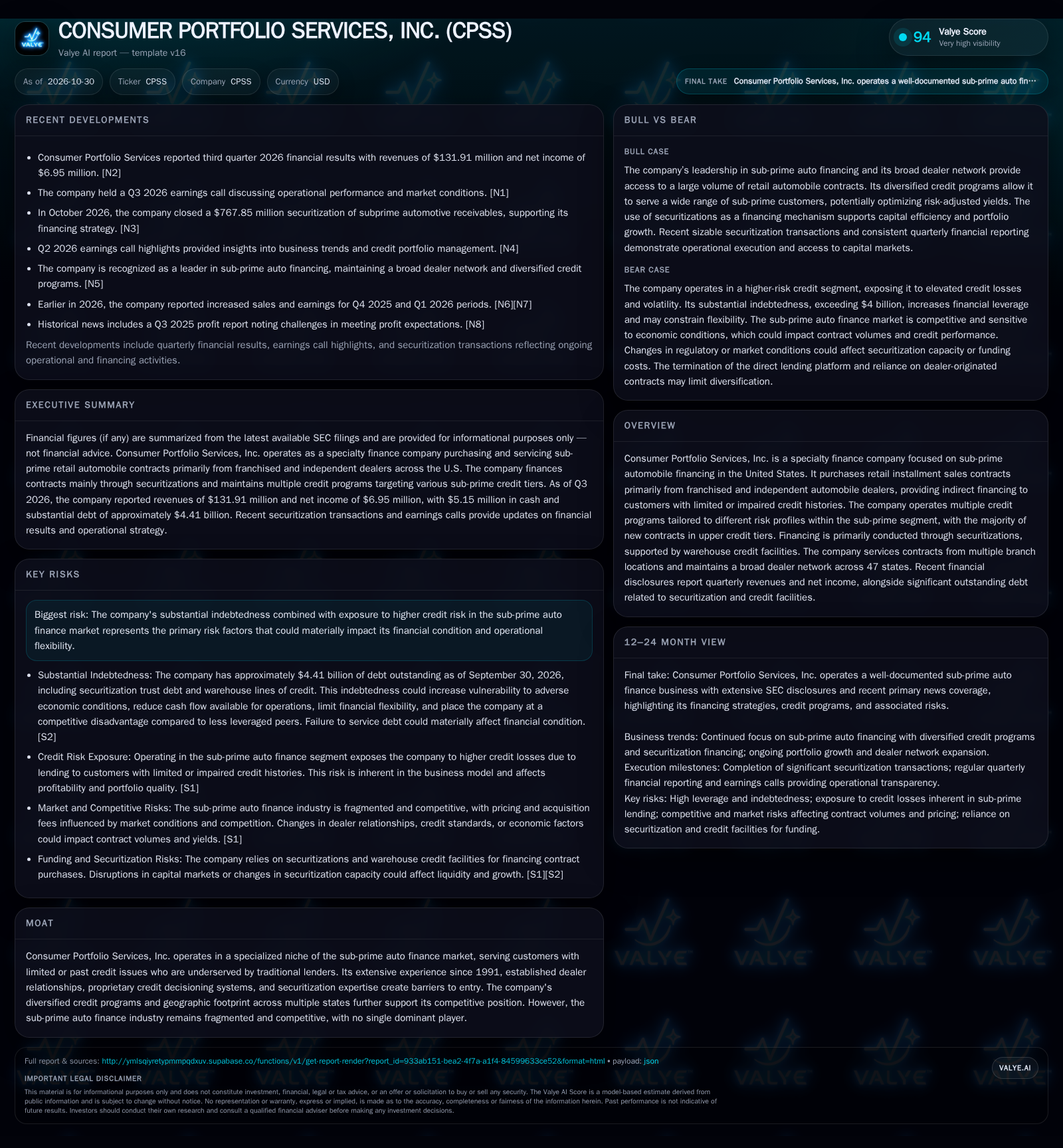
CPSS operates at the intersection of sub-prime credit demand and securitization market access, enabling scale and reach across the U.S. auto finance landscape. While recent originations skew toward higher-quality sub-prime tiers and sizable securitizations have supported growth, the company faces mounting leverage and persistent credit risks that could amplify volatility if market or funding conditions tighten. Future outcomes hinge on credit performance, funding cost evolution, and the ability to adapt credit models as macro and competitive dynamics shift. [S1] [S2] [N3]
Consumer Portfolio Services, Inc. (CPSS) has carved out a significant presence in the U.S. sub-prime auto finance market by purchasing and servicing retail automobile contracts from a vast network of franchised and independent dealers. Its recent portfolio growth, fueled by robust securitization activity and a focus on higher-tier sub-prime borrowers, demonstrates operational adaptability. However, this expansion is matched by substantial leverage and ongoing credit exposure—structural realities that could both enable and constrain the company’s trajectory as credit cycles and funding conditions evolve.
Recent Portfolio Expansion and Funding Moves Reshape CPSS’s Risk-Reward Profile
As of December 31, 2025, Consumer Portfolio Services managed $3.898 billion in automobile contracts, reflecting its sizable footprint in the sub-prime auto finance market. In 2025, approximately 90% of new contract acquisitions were in upper credit tier programs, indicating a deliberate skew toward less risky segments within sub-prime. The company completed a $767.85 million securitization in October 2026, maintaining its reliance on capital markets to fund ongoing originations. However, as of September 30, 2026, CPSS reported only $5.15 million in cash against $4.41 billion in debt, highlighting a highly leveraged balance sheet. These developments underscore both the company’s ability to scale through securitization and the heightened financial leverage that shapes its risk profile. [S1] [S2] [N3]
How Securitization and Credit Mix Drive CPSS’s Economic Model
Consumer Portfolio Services earns money by purchasing auto retail installment contracts at a discount, collecting borrower payments, and retaining a spread after funding and loss costs. Revenue is generated from interest income, servicing fees, and possibly gain-on-sale income in securitizations. CPSS’s variable economics hinge on the yield spread between its contract portfolio and the blended cost of funds—primarily determined by securitization rates and warehouse line costs. Fixed costs include its nationwide sales and servicing infrastructure, while variable costs track origination volumes and loss provisioning.
The company’s tilt toward upper-tier sub-prime contracts may compress gross yields but can moderate credit losses, smoothing earnings in benign cycles. Securitization allows for capital-efficient growth but introduces refinancing risk and exposes CPSS to changes in investor appetite and funding costs. High leverage magnifies both returns and downside risk, making the company’s economics acutely sensitive to credit performance, funding market volatility, and recovery rates on repossessed vehicles. The company reported cash and liquidity metrics for the period; these figures do not by themselves establish operating runway, investment capacity, financial flexibility, or financing capacity.
Dealer Relationships and Credit Program Breadth as Differentiators—But Not Moat-Proof Shields
CPSS’s competitive position is anchored in its broad dealer network—over 7,700 dealers in 47 states, with 73% being franchised new car dealerships. This reach, combined with eight distinct credit programs covering the sub-prime risk spectrum, enables the company to source and price risk granularly. Its proprietary credit decisioning and servicing capabilities further support scale and efficiency.
However, the sub-prime auto finance market remains highly fragmented, with competition from other specialty finance companies, captive auto lenders, and fintech entrants. Barriers to entry include regulatory compliance, dealer relationship stickiness, and securitization expertise, but pricing pressure and credit risk volatility limit the durability of any one player’s advantage. The company’s recent exit from direct lending and subsequent launch of a refinance product illustrate ongoing adaptation but also signal that competitive dynamics and product-market fit are in flux.
If Credit Performance Holds and Securitization Markets Remain Open, Earnings Leverage Can Compound
A favorable outcome for CPSS would be driven by stable-to-improving credit performance among its upper-tier sub-prime borrowers, allowing loss provisions to remain manageable and net interest margins to stay robust. Continued access to securitization markets at reasonable spreads would support portfolio growth without forcing dilutive equity issuance or expensive alternative funding. If the company’s new refinance product gains traction and dealer relationships deepen, origination volumes could accelerate, further leveraging its fixed-cost base and driving operating margin expansion.
Confirmation of this scenario would include sustained low delinquency and charge-off rates (if disclosed), successful and cost-effective execution of future securitizations, and evidence of stable or rising net income despite competitive and macro headwinds. Falsification would come from rising credit losses, tightening securitization spreads, or signs that origination volumes are stagnating or declining despite stable macro conditions.
Portfolio Growth Moderates as Funding Costs and Credit Trends Normalize
The most plausible scenario is that CPSS continues to grow its managed portfolio at a measured pace, but faces modest pressure on net interest margins as funding costs reflect broader interest rate and credit market trends. Credit performance among upper-tier sub-prime borrowers is likely to remain within historical ranges, but with periodic spikes in losses tied to economic fluctuations or used car price volatility.
In this environment, earnings remain positive but volatile, with periodic need to adjust credit models and underwriting standards. Securitization remains available, but spreads may widen or transaction volumes may slow during periods of market stress. This scenario would be confirmed by steady (but not accelerating) portfolio growth, stable warehouse line utilization, and earnings that track with macroeconomic cycles rather than outperforming them. Falsification would involve a sustained inability to access securitization markets, a material rise in loss rates, or a sharp contraction in dealer-originated application flow.
Funding Disruption or Credit Deterioration Could Trigger a Negative Spiral
The primary risk for CPSS is a shock to either securitization market access or a significant deterioration in portfolio credit quality. Should investor appetite for sub-prime auto ABS wane—due to macro stress, regulatory changes, or a tightening credit cycle—the company could face higher funding costs, reduced warehouse capacity, or even inability to roll maturing securitizations. Simultaneously, if loss rates spike due to borrower stress or used car value declines, net income could evaporate quickly given the company’s high leverage.
Such a scenario could force CPSS to curtail new originations, sell off portfolio assets at a discount, or pursue dilutive capital raises. Confirmation would come from missed or delayed securitizations, rising delinquency and charge-off metrics, and negative operating cash flow. Falsification of this downside path would require resilient funding execution and no material increase in credit losses even in a challenging macro backdrop.
Operational and Market Developments That Could Shift the CPSS Thesis
Delinquency and charge-off rates on the managed portfolio—if disclosed—would provide direct insight into credit performance and loss trends.
Execution, size, and pricing of future securitization transactions will test ongoing market access and funding cost stability.
Origination volume growth by credit tier, especially in the new refinance segment, will indicate the company’s ability to adapt and expand.
Dealer application flow and active dealer count, particularly among franchised versus independent dealers, would help gauge franchise strength and competitive positioning.
Net interest margin trends, separating yield compression from funding cost changes, would clarify profitability sensitivity to external conditions.
Warehouse line utilization and renewal terms could signal liquidity risk or changing lender confidence.
Any regulatory or capital market developments affecting sub-prime ABS appetite or structure would directly impact CPSS’s model.
Servicing cost per contract and recovery rates on repossessed vehicles—if disclosed—would shed light on operating leverage and loss mitigation effectiveness.
Disclaimer: This is research-only, informational analysis and not investment advice. It may include AI-generated interpretation and general industry context. Always verify important details using primary sources.

Comments