
Tactical Resources (TREO): Rare Earth Ambitions Meet Capital Constraints in a Strategic U.S. Setting
Tactical Resources, newly public via SPAC as TREO, targets U.S.-based rare earth development with a focus on Texas projects and defense supply chain resilience.
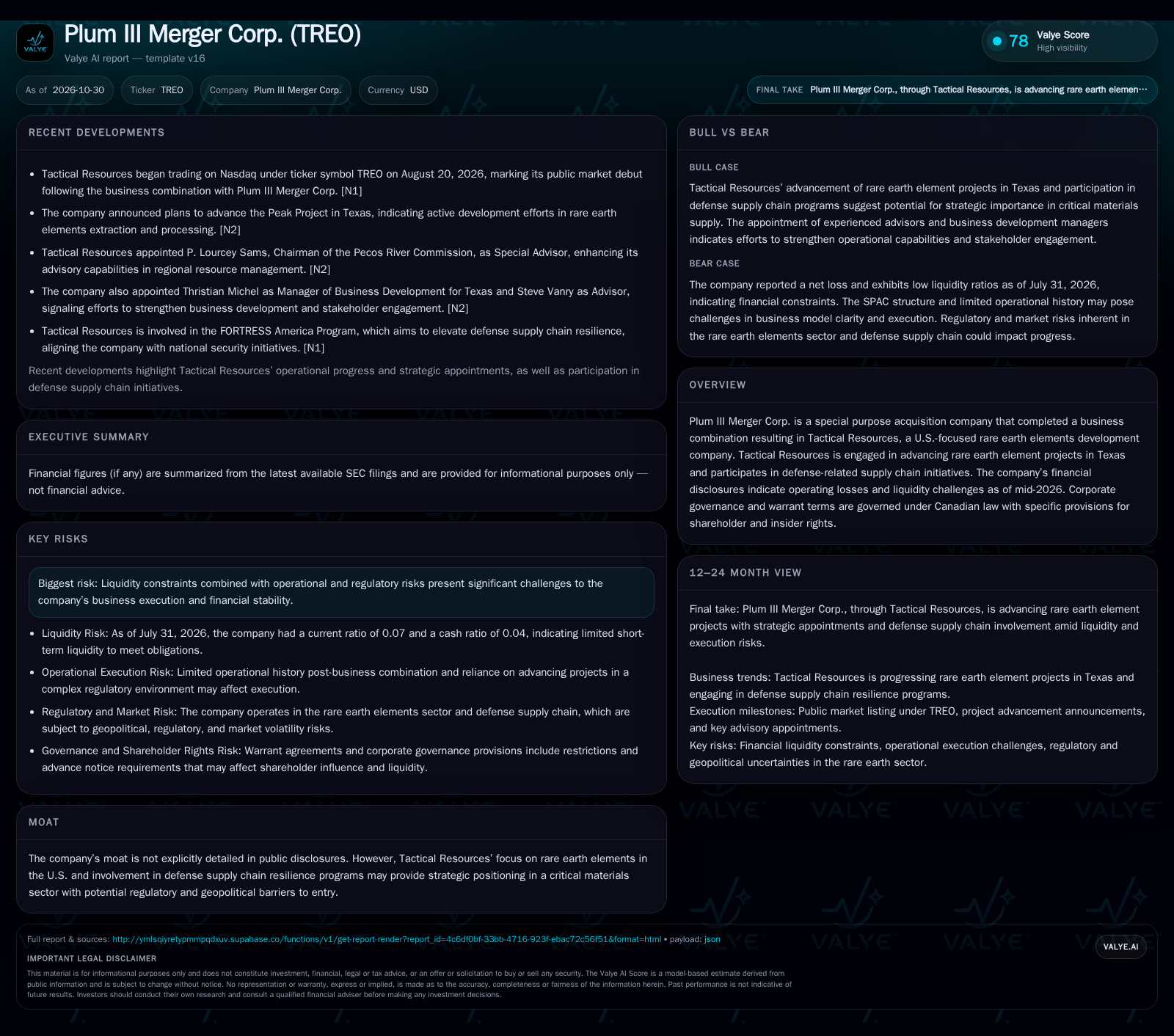
Tactical Resources (TREO) emerges from its SPAC merger as a U.S.-centric rare earth exploration company, advancing the Peak Project in Texas and engaging in defense supply chain initiatives.Despite strategic positioning, its current balance sheet is highly constrained, with a reported current ratio and substantial operating losses. The company’s ability to secure capital and achieve technical milestones will determine whether it can move beyond the exploration stage and capture value in a geopolitically important sector. [S1]
Tactical Resources (TREO) has entered the public markets via a SPAC transaction, positioning itself at the confluence of rare earth element development and U.S. defense supply chain resilience. The company’s future hinges on its ability to raise funds, navigate regulatory hurdles, and prove out the technical and economic viability of its rare earth assets in a competitive and geopolitically charged sector. [S1]
Acute Liquidity Pressure and Early-Stage Project Define Tactical’s Starting Line
Tactical Resources, now trading as TREO following its business combination with Plum III Merger Corp., is advancing the Peak Project in Texas with a stated focus on rare earth elements and involvement in U.S. defense supply chain initiatives. As of July 31, 2026, the company reported a net loss of $2.93 million for the prior fiscal year alongside cash and equivalents of just $282,146. Current liabilities of $7.43 million far exceed current assets, resulting in a current ratio of only 0.07 and a cash ratio of 0.04. These metrics highlight severe liquidity stress. The Peak Project remains in the exploration stage, with no established mineral reserves or commercial production, meaning all future development depends on successful exploration, permitting, and—critically—new capital formation. [S1]
In capital-intensive sectors like rare earth mining, the timing and terms of financing rounds can significantly affect shareholder dilution and project economics. The company’s ability to extend its financial runway through strategic partnerships or non-dilutive funding sources will be critical to maintaining momentum. Moreover, early-stage projects often require multiple rounds of financing before reaching feasibility; thus, the risk of capital shortfall at any stage can lead to project delays or abandonment, underscoring the importance of robust financial planning and contingency strategies.
Mining Economics: Capital Intensity, Exploration Risk, and the Path to Cash Flow
The rare earth mining business is structurally capital-intensive, with high upfront costs for exploration, permitting, and eventual development of processing infrastructure. At the exploration stage, as with TREO’s Peak Project, expenditures are largely fixed (geological surveys, drilling, permitting) and yield no revenue until a commercially viable resource is proven and developed. Once (and if) resources are confirmed, the company would face further major capital outlays for mine development, processing facilities, and working capital. Only after commercial production starts could variable costs—labor, reagents, energy, logistics—scale with output. Operating leverage is significant but only materializes after transition to production. The company’s acute liquidity constraints mean that funding for even early technical milestones is in question, and any move toward production would require multi-stage financing, likely involving equity dilution or high-cost debt. Until production, there is effectively no revenue, so the business remains a cash sink with substantial funding risk.
The path from exploration to cash flow in rare earth mining is further complicated by the unique metallurgy and processing challenges associated with these elements. Rare earths often occur in complex mineral matrices requiring specialized extraction techniques that can be cost-prohibitive at small scales. This implies that even if geological surveys confirm resource presence, the economic viability depends heavily on developing efficient processing methods and securing access to downstream infrastructure. Additionally, environmental and social governance (ESG) considerations increasingly influence permitting and financing decisions. Companies like TREO must anticipate potential regulatory changes and community engagement costs that could extend timelines and increase capital requirements, thereby affecting the overall project economics.
Strategic Appeal Meets Entrenched Competition and High Barriers
TREO’s U.S. rare earth focus and participation in defense supply chain resilience programs could, in principle, offer strategic advantages—especially given concerns over foreign (notably Chinese) control of global rare earth supply. Domestic projects may benefit from regulatory tailwinds, government grants, or preferred procurement if they reach production. However, the competitive field includes much larger, well-capitalized mining incumbents and vertically integrated global players with established processing capacity, customer relationships, and supply chain integration. The technical complexity of rare earth extraction and processing, permitting hurdles, and environmental scrutiny further raise barriers. Without proven resources, off-take agreements, or demonstrated processing capabilities, TREO’s current moat is aspirational rather than realized; any advantage would depend on successful project advancement and capital formation in a sector marked by long timelines and high failure rates.
While TREO’s strategic positioning within the U.S. defense supply chain could yield preferential treatment, this advantage is conditional on the company demonstrating credible progress toward production readiness. Larger incumbents benefit not only from scale economies but also from established relationships with government agencies and customers, which can translate into more favorable contract terms and financing options. Furthermore, the rare earth sector’s geopolitical sensitivities may lead to shifting policy priorities, where government support could be contingent on meeting stringent milestones or aligning with broader strategic objectives. Therefore, TREO’s competitive moat will depend on its ability to navigate these dynamics effectively and differentiate itself through technical innovation, cost control, or unique resource characteristics.
If Peak Project Delivers: Strategic Value Creation Through Resource Validation and Partnership
The most favorable scenario involves successful technical validation of the Peak Project—demonstrating mineral resources of sufficient grade and volume to justify commercial development—and securing the necessary permits. This could unlock substantial value if paired with government support, defense-related procurement, or strategic partnerships with offtakers or processors eager to secure non-Chinese supply. News of resource confirmation, permitting progress, government grants, or a major financing round would be strong confirming evidence. Early-stage agreements with downstream manufacturers or defense contractors would also support this scenario. Falsification would come from negative drilling results, inability to secure permits, or failure to raise capital, which would limit the company’s ability to advance beyond the exploration phase.
Navigating Exploration: Dilutive Funding and the Long Road to Feasibility
The most plausible near-term path for TREO is a series of incremental technical steps—geological work, drilling, preliminary economic assessments—funded by dilutive equity issuance or convertible instruments, given the lack of operating cash flow and acute liquidity constraints. Progress would be measured by technical milestones rather than commercial output. The company may secure small grants or government support, but major investment would likely require resource validation first. Confirming evidence would include successful fundraising, technical reports indicating progress, and continued regulatory engagement; negative evidence would be further balance sheet deterioration or project delays due to lack of funds or permitting setbacks.
Liquidity Crunch and Exploration Stagnation Threaten Project Viability
An adverse scenario would see TREO unable to raise sufficient capital to fund ongoing exploration and permitting, leading to project delays, asset impairment, or effective suspension of activity. Given current liabilities far outstripping assets, the risk of creditor pressure, default, or forced asset sales is non-trivial if new funding does not materialize. In this scenario, the company could lose control of its core asset or face delisting. Confirming evidence would be failed or highly dilutive financing attempts, further declines in reported cash, or public disclosures of project suspension or workforce reductions.
Milestones and Events That Will Clarify TREO’s Rare Earth Trajectory
Securing non-dilutive or strategic funding (such as government grants, defense contracts, or offtake/prepayment agreements) to bridge the company to resource validation.
Release of technical reports or drilling results confirming resource size, grade, and potential commercial viability at the Peak Project.
Permitting progress and successful navigation of U.S. and Texas regulatory frameworks, including environmental and land-use approvals.
Announcements of partnerships or alliances with established rare earth processors, defense contractors, or downstream manufacturers.
Changes in balance sheet health—particularly cash levels and current liabilities—following any fundraising, as reported in future filings.
Evidence of cost discipline and management’s ability to control exploration and overhead spend relative to available resources (if disclosed).
Any indication of government policy shifts, grant awards, or defense supply chain initiatives that could directly benefit domestic rare earth development.
Disclaimer: This is research-only, informational analysis and not investment advice. It may include AI-generated interpretation and general industry context. Always verify important details using primary sources.

Comments