
Here Group Ltd’s IP-Driven Pop Toy Strategy: Diversification, Execution Stakes, and the Shifting Economics of Collector Culture
Here Group Ltd has exited its legacy businesses to become a pure-play pop toy company, leveraging a portfolio of 22 proprietary and licensed IPs—most notably WAKUKU and SIINONO—which together constitute over three-quarters of revenue.
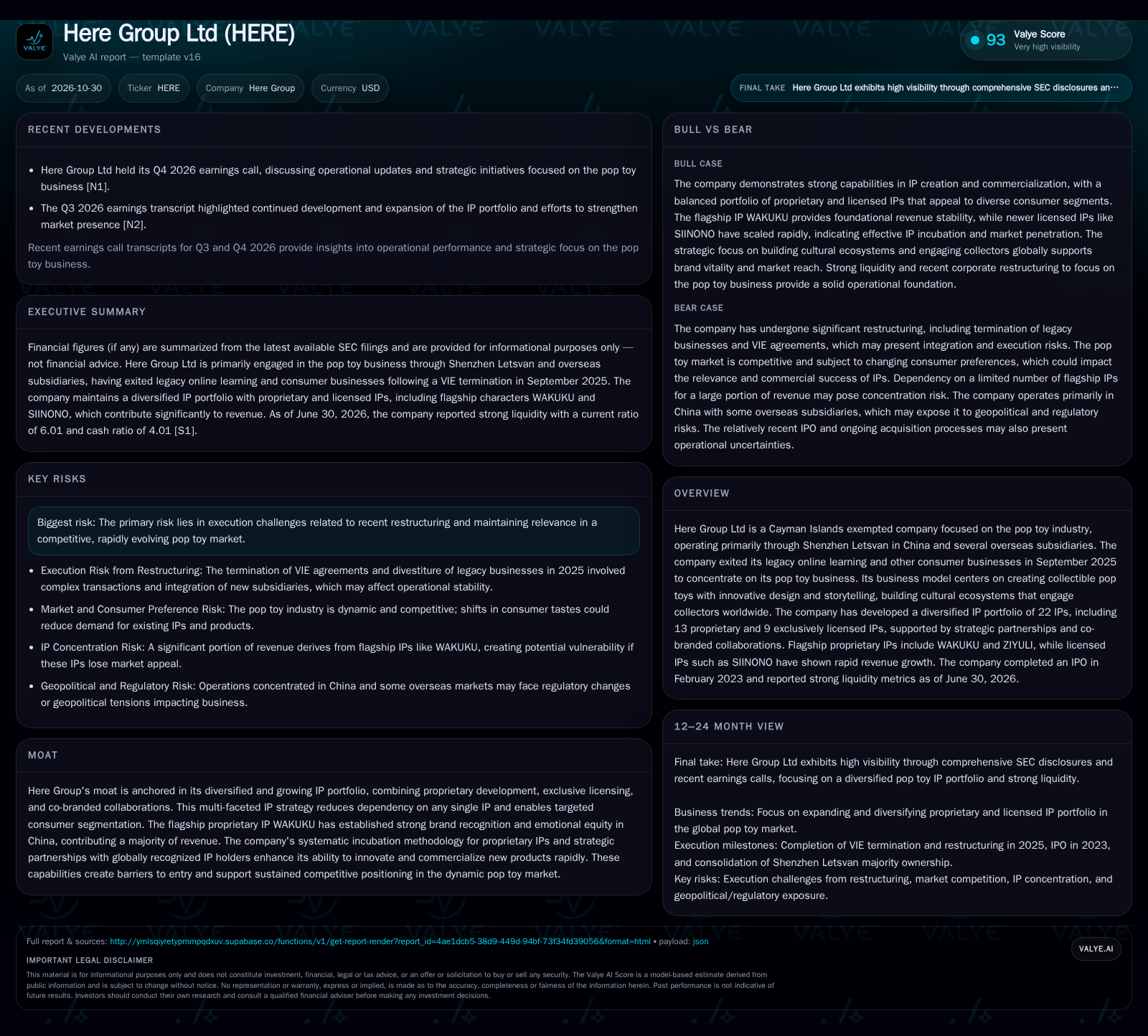
Here Group Ltd has exited its legacy businesses to become a pure-play pop toy company, leveraging a portfolio of 22 proprietary and licensed IPs—most notably WAKUKU and SIINONO—which together constitute over three-quarters of revenue. [S1]
Here Group Ltd’s rapid pivot from online learning to the pop toy collectibles market reflects both strategic opportunism and a bet on the staying power of character-driven consumer culture. With 22 IPs spanning proprietary inventions and licensed icons, Here is now positioned as a portfolio player in an industry where hit creation, brand management, and collector engagement drive the economics. Yet, the company’s heavy reliance on a handful of properties, recent structural upheaval, and the fickle nature of collector demand mean the next phase will hinge on the depth of its IP bench, its ability to execute on new launches, and its resilience to competitive and regulatory shifts.
Recent Restructuring and Revenue Mix Define Here Group’s New Phase
Here Group Ltd has completed a fundamental transformation, exiting its legacy online learning and consumer businesses in September 2025 and emerging as a focused pop toy company operating primarily through Shenzhen Letsvan and several overseas subsidiaries. The company’s pop toy revenues now depend heavily on two core intellectual properties: WAKUKU, a proprietary character responsible for 61.9% of total revenue (RMB369.3M) in the fiscal year ended June 30, 2026, and SIINONO, a licensed IP launched in July 2025 that already contributes 15.5% of revenue (RMB92.7M). This concentrated revenue mix underscores both the commercial power and potential vulnerability of hit-driven content strategies. [S1]
The company’s liquidity position is described by $63.53 million in cash and $26.27 million in short-term investments on the June 30, 2026 balance sheet, supporting a current ratio of 6.01 and a cash ratio of 4.01. These reported figures indicate a high level of liquid resources relative to current liabilities, but do not by themselves establish a specific operating runway, investment capacity, or potential financial flexibility for future phases. [S1]
How Here Group’s Portfolio Model Shapes Its Economics
Here Group’s economics are fundamentally driven by its ability to create, license, and commercialize intellectual property through collectible pop toys. Proprietary IPs, such as WAKUKU, likely carry higher gross margins owing to the absence of external royalty obligations and greater control over product extensions, merchandising, and cross-media adaptations. Licensed IPs like SIINONO, while providing access to established fan bases and potentially faster revenue ramp, typically involve royalty payments or minimum guarantees that compress margins, but can diversify risk if consumer tastes shift.
The company’s portfolio approach—13 proprietary and 9 exclusively licensed IPs as of mid-2026—enables experimentation with different character archetypes, design aesthetics, and storytelling strategies, potentially smoothing revenue volatility inherent in hit-driven markets. However, the fixed costs associated with design, prototyping, marketing, and inventory management can be significant, especially for new IP launches. If successful, operating leverage is possible as design and development costs are amortized across larger production runs and as collector engagement translates into repeat purchases, community-building, and secondary market activity.
Capital needs in this model are moderate relative to traditional manufacturing businesses, as working capital is tied up in inventory and production rather than heavy fixed assets. However, funding requirements can spike around major launches, licensing deals, or geographic expansions. The company reported cash and liquidity metrics for the period; these figures do not by themselves establish operating runway, investment capacity, financial flexibility, or financing capacity.
Assessing Barriers and Vulnerabilities in the Pop Toy Ecosystem
Here Group’s competitive position hinges on the strength and breadth of its IP portfolio, its ability to foster collector communities, and its execution in design and storytelling. Proprietary IPs offer defensibility through brand equity and consumer emotional attachment, particularly when supported by narrative depth and consistent product refreshes. Exclusive licensing arrangements can provide access to new audiences but are subject to contract renewal risks and potential competition from other licensees if exclusivity lapses.
The broader pop toy sector is characterized by low switching costs for consumers—collectors often chase novelty and cultural relevance—making sustained engagement and brand-building essential. Here faces competition from global and regional players with established IPs, diversified distribution, and deeper media integration. Technology substitution is a modest threat: while digital collectibles (NFTs, in-game skins) have emerged, physical collectibles remain resilient due to their tactile and social value. The question is whether Here can translate its diversified IP matrix into network effects (through collector clubs, events, or digital engagement) that increase switching frictions and customer lifetime value.
Execution risk remains high in this sector: failure to anticipate consumer trends, missteps in co-branded collaborations, or overreliance on a single hit IP can erode market share quickly. Regulatory and geopolitical factors, especially given the company’s China-centric operations, add another layer of uncertainty.
If Portfolio Expansion Spurs Collector Fandom and Margin Upside
A favorable scenario sees Here Group successfully leveraging its liquidity and operational focus to incubate and commercialize a series of new proprietary and licensed IPs, broadening its revenue base and reducing dependence on WAKUKU and SIINONO. If new IP launches—such as YEAOHUA, VIVIMANI, or fluffy lili—gain traction, the company could diversify its collector cohort, deepen engagement through limited editions or cross-media storytelling, and command premium pricing.
This scenario would likely result in improved gross margins as proprietary IPs scale, while a more balanced revenue mix reduces volatility. Confirmation would come from accelerating revenue contributions from new and recently licensed IPs, evidence of successful cross-selling or collector club engagement, rising average order values, and positive commentary on margin trends in earnings calls. Falsification would be signaled by persistent revenue concentration, limited traction for new launches, or margin compression due to increased reliance on licensed IPs or promotional activity.
Portfolio Concentration Persists Amid Moderate Expansion
The most plausible scenario is that Here Group continues to rely on WAKUKU and SIINONO for the bulk of its revenue, while new IPs contribute incrementally but do not immediately reach flagship status.
In this case, revenue growth tracks with the expansion of existing IPs into new geographies and formats, but is periodically interrupted by shifts in collector sentiment or competitive launches. Margins remain stable, with some fluctuation depending on the mix of proprietary versus licensed sales. Confirmation would come from steady, if modest, increases in the revenue share of new IPs and continued strong performance of the top two brands. Falsification would involve either a sudden drop in flagship IP sales or an inability to commercialize new launches despite investment.
Execution Gaps or Consumer Shifts Expose Concentration Risk
In an adverse scenario, Here Group’s recent restructuring and integration challenges lead to operational missteps—such as delayed launches, supply chain disruptions, or ineffective marketing—that erode consumer trust and collector engagement. If WAKUKU or SIINONO lose cultural relevance or face competitive displacement, the company’s revenue base could contract sharply, given the current concentration.
A downturn could also be triggered by broader shifts in collector preferences—toward digital collectibles or new physical formats not addressed by Here’s portfolio—or by regulatory actions impacting licensing or manufacturing in China. Margin compression would likely follow as the company turns to discounting or licensing more third-party IPs to compensate for lost proprietary momentum. Confirmation would come from declining revenue, negative gross margin trends, and commentary on operational setbacks or market share losses. Falsification of this scenario would require evidence of rapid recovery in flagship sales or the emergence of a new hit IP.
Thesis-Testing Developments to Track in Here Group’s Next Phase
Quarterly revenue and gross margin contributions by individual IPs, particularly the trend in WAKUKU and SIINONO versus newer launches, would help test concentration risk and diversification progress if disclosed.
Evidence of successful proprietary IP incubation—such as new characters reaching material revenue contribution within 12-18 months of launch—would validate the portfolio model.
Average order value, repeat purchase rates, and collector club/community engagement metrics, if disclosed, would indicate the depth of consumer loyalty and the potential for network effects.
Commentary or detail on royalty rates, licensing costs, and the mix of proprietary versus licensed sales from earnings disclosures would help clarify margin dynamics.
Pipeline visibility for new IP launches, including production timelines and marketing campaigns, would help assess execution risk.
Regulatory updates or changes in the operating environment in China and overseas markets could materially impact Here’s risk profile.
Management’s approach to capital allocation—such as reinvestment in IP development versus returning capital—would clarify long-term growth priorities.
Disclaimer: This is research-only, informational analysis and not investment advice. It may include AI-generated interpretation and general industry context. Always verify important details using primary sources.

Comments