
Southern Copper’s Capital Ambition: The Stakes of Cost, Execution, and Commodity Exposure in the Next Growth Cycle
The company’s ambitious growth—and its ability to defend margins—depends on the timely, cost-effective delivery of major projects like Tia Maria and El Arco, and on the resilience of copper prices.
The company’s ambitious growth—and its ability to defend margins—depends on the timely, cost-effective delivery of major projects like Tia Maria and El Arco, and on the resilience of copper prices.
Southern Copper Corporation stands at a critical juncture: it is delivering record profitability thanks to high copper and molybdenum prices, but its future growth hinges on complex, capital-intensive projects in Peru and Mexico. The real test for Southern Copper is whether it can convert its ambitious pipeline into production growth without succumbing to cost overruns, project delays, or external shocks that could erode its current margin and market position.
Record Earnings, Reported Liquidity Position, and the Reality of Project Delays
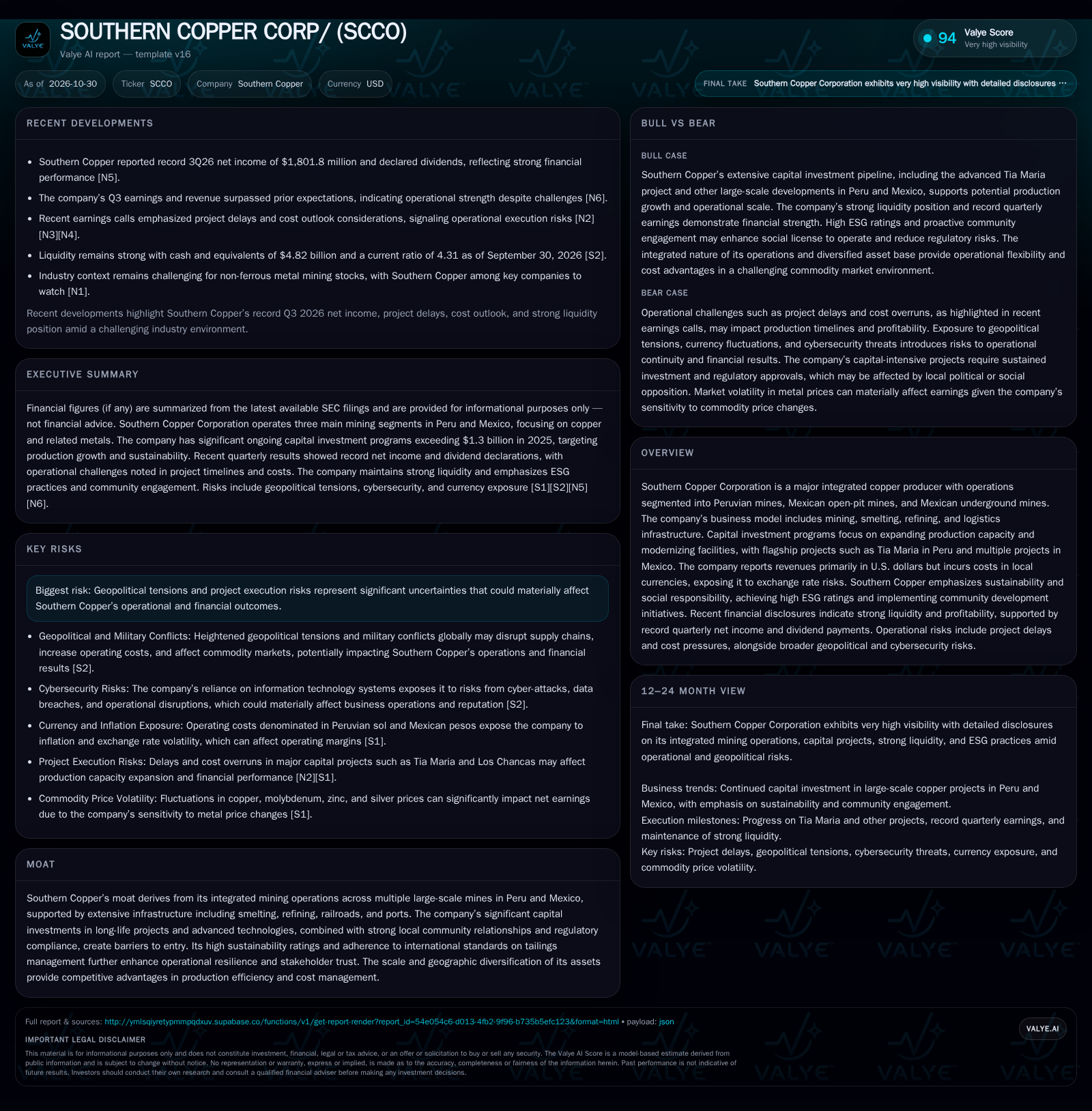
Southern Copper reported record net income of $1,801.8 million in Q3 2026, underscoring the powerful impact of high copper and molybdenum prices on its bottom line [N5] [S2]. The company reported cash and liquidity metrics for the period; these figures do not by themselves establish operating runway, investment capacity, financial flexibility, or financing capacity. [S2] However, recent earnings calls have highlighted that major project timelines, especially for flagship developments like Tia Maria and El Arco, are slipping, and cost outlooks are uncertain [N2] [N3] [N4].
Capital investments topped $1.3 billion in 2025 and exceeded $1 billion in 2024, targeting both capacity expansion and sustainability commitments [S1]. Yet, with Tia Maria only 24% complete as of year-end 2025—despite a $1.8 billion budget—the pace and cost of project execution are now central variables for the company’s future cash flow and competitive standing [S1].
The interplay between capital allocation and project execution efficiency is critical in determining Southern Copper’s future financial health. If capital is deployed without rigorous project management controls, the risk of cost overruns escalates, which can erode margins and strain liquidity. Conversely, effective capital discipline combined with adaptive project scheduling can mitigate some risks associated with external shocks such as inflation or regulatory delays. Additionally, the company’s ability to secure financing on favorable terms amid shifting global credit conditions will influence its capacity to sustain investment levels without compromising balance sheet robustness.
How Southern Copper Converts Scale and Capital into Margin—and Where Leverage Cuts Both Ways
Southern Copper’s economic engine depends on the interplay of three forces: commodity price leverage, fixed-cost absorption, and capital deployment. With roughly three-quarters of revenue derived from copper and the remainder spread among molybdenum, silver, zinc, and gold, the company’s financial results are highly sensitive to movements in global metal markets [S2]. For example, LME copper prices surged 44% year-over-year in Q3 2026, directly boosting revenue and margin. Molybdenum, a key by-product, saw a 35.5% price increase over the same period [S2].
The company’s integrated model—mining, smelting, refining, and logistics—amplifies operating leverage: high fixed costs mean that incremental output can generate outsized profit when prices are strong, but this also increases downside exposure when prices fall. Capital intensity is a defining feature: multi-year, multi-billion dollar projects like Tia Maria, Los Chancas, and El Arco require sustained funding before yielding cash flow. Delays or overruns can stretch payback periods and compress returns. Additionally, Southern Copper’s cost base is largely in Peruvian sol and Mexican pesos, creating a persistent currency mismatch against USD-denominated sales. Inflation or adverse FX movements can erode operating margins quickly if commodity prices soften or costs escalate [S1] [S2].
The sensitivity of Southern Copper’s margins to commodity price fluctuations is further complicated by the lag between capital expenditures and production ramp-up. During the construction phase, significant cash outflows occur without immediate revenue generation, creating a temporal mismatch that heightens financial exposure if prices decline. Moreover, the company’s fixed-cost structure means that any delays in scaling output can disproportionately impact unit costs, as overheads are spread over lower production volumes. Currency volatility adds another layer of complexity; a weakening local currency can reduce operating costs in USD terms but may also signal inflationary pressures domestically, which if unchecked, could feed back into higher input costs and labor expenses.
Integrated Assets and ESG Credentials: Defensible Scale or Entrenched Exposure?
Southern Copper’s competitive position is anchored in its large-scale, integrated operations across Peru and Mexico, with production supported by in-house smelting, refining, railroad, and port infrastructure [S1]. This scale creates cost advantages and operational resilience compared to smaller regional or single-mine operators. The company’s high S&P Global sustainability ratings and strong track record in tailings management and occupational safety further enhance stakeholder trust, which is increasingly critical for securing permits and community support.
However, these same strengths expose Southern Copper to unique risks: large footprints invite greater regulatory scrutiny, and social license is never guaranteed in mining-intensive regions. The company competes with other global diversified miners—many of which have equally deep pockets and are also pursuing growth in Latin America and beyond. Substitution risk is low for copper in the short term, but new regional entrants, evolving environmental standards, or disruptive technologies in mining or recycling could eventually pressure margins and market share.
Southern Copper’s integrated asset base provides operational synergies but also concentrates risk, particularly in geopolitical and regulatory terms. The company’s reliance on large-scale infrastructure investments increases its exposure to political shifts that may affect mining policy or taxation frameworks in Peru and Mexico. Additionally, while ESG credentials enhance social license and investor appeal, evolving environmental regulations could necessitate costly retrofits or operational changes, impacting project economics. Competitive pressures from diversified global miners also mean that Southern Copper must continuously innovate in cost management and community relations to maintain its relative advantage, especially as new technologies and recycling trends could alter long-term copper demand dynamics.
If Project Delivery Aligns with Commodity Strength, Earnings Power Could Reset Higher
The most favorable scenario for Southern Copper is a confluence of timely, cost-effective completion of major projects—especially Tia Maria and El Arco—alongside sustained high copper and by-product prices. If the company executes its development pipeline on schedule and within budget, new capacity could meaningfully boost production volumes, lower unit costs through scale, and drive EBITDA expansion even if spot prices moderate from recent highs.
This scenario would be confirmed by a steady cadence of project milestones—such as Tia Maria progressing from 24% to majority completion, securing necessary permits for Los Chancas and El Arco, and disciplined capital spending that tracks or beats guidance. A supportive commodity environment would further amplify these gains, potentially creating upside surprise relative to current market expectations.
Sustained Profitability with Execution Friction: Growth Moderates as Delays and Costs Mount
The most plausible path is that Southern Copper maintains healthy profitability and liquidity, supported by its existing asset base and high copper prices, but faces continued friction in bringing new projects online. Project delays, permitting hurdles, and cost inflation—already cited as concerns in recent earnings calls—may persist, stretching out timelines for Tia Maria, Los Chancas, and El Arco. Production growth occurs, but at a slower pace and with higher capital intensity than originally targeted.
Confirmation would come from further updates showing partial project progress, ongoing community negotiations, and periodic upward revisions to capital budgets. Falsification would include a material acceleration in project delivery or a sustained drop in operating costs, neither of which is currently evident.
When Execution Risk Meets External Shocks: Margin Compression and Growth Stalls
The adverse scenario materializes if project execution falters—cost overruns, delays, or regulatory setbacks coincide with a downturn in copper prices or adverse currency movements. Under this chain of events, Southern Copper could see margin compression from both sides: lower realized prices and higher input costs (worsened by inflation or FX swings).
This scenario would be confirmed by repeated project postponements, escalating capex guidance, and signs of local or national opposition to key developments. Additional external shocks—such as geopolitical instability or cyber incidents—could further amplify downside risks, especially if they disrupt operations or supply chains.
Milestones and Metrics That Will Reveal Whether Southern Copper Can Convert Ambition into Durable Value
Progress updates on Tia Maria, Los Chancas, Michiquillay, and El Arco—specifically, percentage completion, permitting status, and any changes to budget or timeline.
Quarterly unit production costs in both USD and local currencies, as well as any disclosed breakdown of cost inflation or FX impact.
Updates on community engagement initiatives and any disclosed information on local opposition, social unrest, or regulatory challenges near project sites.
Trends in copper, molybdenum, and silver prices, and the company’s realized pricing versus global benchmarks.
ESG ratings movements or new regulatory requirements that could affect project approvals or ongoing operations.
Disclosure of any cyber incidents, supply-chain disruptions, or geopolitical events materially impacting operations.
Disclaimer: This is research-only, informational analysis and not investment advice. It may include AI-generated interpretation and general industry context. Always verify important details using primary sources.

Comments