
Enterprise Financial Services in 2026: Deposit Growth, Margin Dynamics, and the Stakes of Regional Expansion
Enterprise Financial Services Corp’s recent branch acquisitions and robust balance sheet have fueled asset and deposit growth, but rising noninterest expenses and the evolving rate environment present both opportunity and risk. The company’s ability to leverage its broadened footprint while managing margin and expense pressures will determine whether recent gains translate into durable, above-peer performance.
Enterprise Financial Services Corp’s 2025–2026 performance reflects successful market expansion via branch acquisitions, rising net interest and noninterest income, and strong asset quality. However, higher noninterest expenses and sensitivity to interest rate shifts highlight the challenge of converting footprint growth into sustainable returns, particularly as competition and regulatory pressures persist.
Enterprise Financial Services Corp has emerged from a period of strategic expansion, highlighted by the acquisition of 12 new branches and a significant increase in both deposits and loan balances. This move has driven healthy growth in net interest and noninterest income, while asset quality metrics remain strong. Yet, the cost of expansion—visible in rising noninterest expenses—and the challenges of sustaining margin expansion in a shifting rate environment pose crucial questions about the durability and efficiency of EFSC’s growth model. As the company integrates new markets and navigates competitive and regulatory headwinds, its ability to translate scale into sustained profitability will be tested.
Recent Acquisitions, Earnings, and Margin Trends Set the Stage
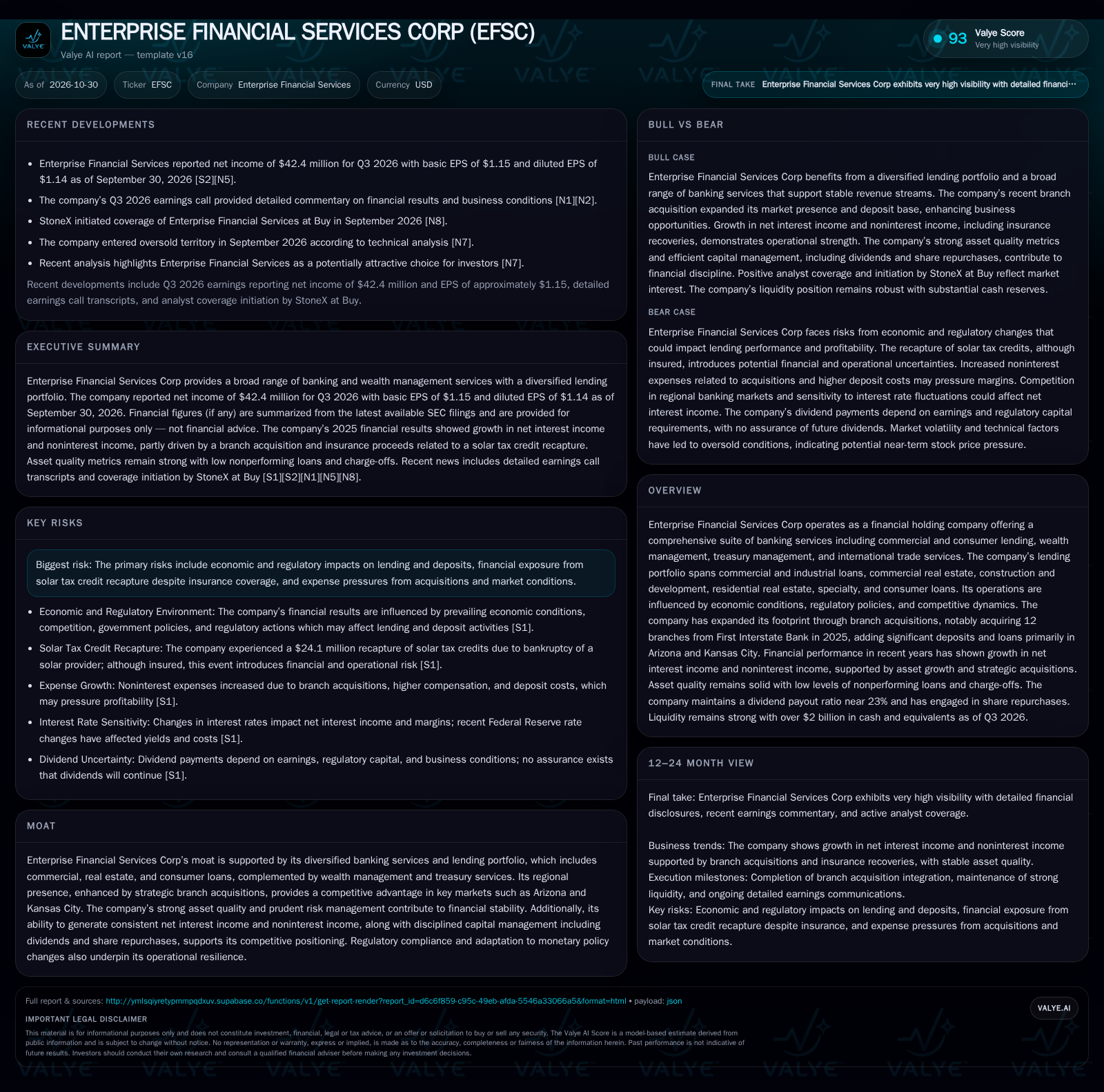
Enterprise Financial Services Corp reported net income of $42.4 million for Q3 2026, with diluted EPS of $1.14 [S2] [N5]. The company’s 2025 results showed net interest income of $626.7 million (up from $568.1 million in 2024) and a modest improvement in net interest margin to 4.21% [S1]. The acquisition of 12 branches from First Interstate Bank in 2025 added $609 million in deposits and $292 million in mostly commercial loans, expanding EFSC’s footprint in Arizona and Kansas City [S1]. Noninterest income rose to $113.1 million, supported by $32.1 million in insurance proceeds related to a solar tax credit recapture [S1]. However, noninterest expense increased 12% to $429.8 million, reflecting higher deposit costs, compensation, and acquisition-related outlays [S1]. StoneX initiated coverage at Buy in September 2026, signaling positive market sentiment toward EFSC’s expansion strategy [N8].
How EFSC’s Revenue and Cost Structure Shapes Return Potential
EFSC’s core earnings engine is net interest income, driven by the spread between loan yields and funding costs. The 2025 net interest margin of 4.21% is robust by regional bank standards, benefiting from a favorable mix of commercial loans and relationship-driven deposit growth [S1]. The acquisition of branches has increased average interest-earning assets, but sustaining margin expansion will depend on the company’s ability to manage funding costs—especially as the industry faces ongoing deposit competition and shifting Federal Reserve policy.
Noninterest income, while historically a smaller contributor, spiked in 2025 due to a one-off insurance recovery, but underlying streams (such as wealth management and treasury services) could provide incremental stability if grown organically. On the cost side, EFSC’s efficiency ratio of 58.1% in 2025 reflects moderate operating leverage, but expense growth—driven by compensation, deposit costs, and acquisition integration—poses a challenge. The company’s capital return profile includes a dividend payout ratio near 23% and share repurchases, supporting shareholder returns but also requiring consistent earnings generation [S1].
Asset quality remains a strength, with low nonperforming loan ratios and charge-offs at 0.21% of average loans in 2025 [S1]. This supports both capital preservation and the ability to deploy balance sheet capacity for further growth or capital return.
Regional Expansion and Product Breadth: Offense and Defense in a Crowded Field
EFSC’s competitive position is anchored in its diversified business mix—spanning commercial and consumer lending, wealth management, and treasury services—and its growing regional presence. The acquisition of First Interstate Bank branches materially increased scale in key growth markets like Arizona and Kansas City, enhancing access to commercial clients and local deposits [S1].
However, regional banks face intense competition from both large national banks and fintech entrants, who can often undercut on price, technology, or product features. EFSC’s advantage may lie in relationship banking, local decision-making, and specialized lending, particularly in commercial real estate and C&I segments. The question is whether EFSC can maintain pricing discipline and customer loyalty as competitors target its expanded footprint.
Switching costs for depositors and borrowers in banking are typically low, but full-service relationships and local market knowledge can create some customer stickiness. The breadth of services—especially wealth management and treasury—may help defend margins if cross-selling is effective, but these advantages are not insurmountable if competitors aggressively pursue the same client base.
If Integration and Loan Growth Outpace Expense Pressures
The most favorable scenario is one in which EFSC successfully integrates its acquired branches, deepens client relationships, and accelerates loan origination in new markets. If the company can convert its enlarged deposit base into high-quality, higher-yielding commercial loans while maintaining asset quality, net interest income could grow faster than expenses. Cross-selling of wealth and treasury services would add fee income and improve relationship depth.
Expense growth would need to moderate post-integration, with efficiency gains realized from scale and process standardization. In this scenario, the efficiency ratio could improve, supporting both earnings and capital return. Confirmation would come from above-peer loan and deposit growth in acquired markets, stable or improving net interest margin, and positive operating leverage (i.e., revenue growth outpacing expense growth). Falsification would be evident if integration costs persist or loan growth in new markets disappoints.
Sustaining Margins Amid Competitive and Rate Headwinds
The most plausible path is for EFSC to realize incremental growth from its expanded footprint, but with margin and expense pressures offsetting some benefits. Net interest income continues to grow, but at a slower pace as deposit competition intensifies and rate cuts by the Federal Reserve compress spreads. Noninterest income normalizes as insurance recoveries are not repeated, leaving underlying fee growth to drive future gains.
Expense growth remains elevated in the near-term due to integration and inflationary compensation pressures, but moderates as synergies are realized. Asset quality stays strong, supporting capital return via dividends and share repurchases. This scenario is confirmed by steady, mid-single-digit earnings growth, a stable efficiency ratio, and resilience in asset quality metrics. It would be challenged by a sharp jump in noninterest expense, deteriorating loan performance, or an inability to grow fee income meaningfully.
Margin Compression and Integration Drag Could Erode Returns
The primary risk scenario is that EFSC’s expense base remains elevated due to protracted integration challenges, higher compensation costs, or persistent inflation in deposit funding. If loan growth lags—either from economic slowdown, increased competition, or credit tightening—net interest income could stagnate or decline, especially if the rate environment becomes less favorable.
Noninterest income may revert to lower levels as one-time items fade, exposing the underlying weakness of fee-generating businesses if cross-selling proves less effective than anticipated. A deterioration in asset quality, though not currently evident, could further pressure earnings and capital. Confirmation would come from rising efficiency ratios (above 60%), flat or shrinking net interest margin, and a spike in nonperforming assets or charge-offs. Falsification would require a clear, sustained reversal in these trends.
Milestones and Metrics That Will Reveal the Sustainability of EFSC’s Growth
Quarterly loan and deposit growth rates, especially in Arizona and Kansas City, would help assess whether the branch acquisition is delivering on its promise of market expansion.
Net interest margin trend: Sustained improvement or stability above peer averages would indicate pricing discipline and effective funding cost management.
Efficiency ratio movement: A declining or stable ratio near or below 58% would signal that expense growth is under control relative to revenue gains.
Noninterest income (excluding one-time items): Growth in recurring fee streams from wealth and treasury services would confirm progress in cross-selling and diversification.
Asset quality metrics: Net charge-offs, nonperforming loan ratios, and early-stage delinquency trends should be closely monitored for signs of credit deterioration.
Expense breakout post-acquisition: If disclosed, detail on integration and compensation costs versus projected synergies would clarify whether expense pressures are temporary or structural.
Market share in key acquired geographies: If disclosed, data on client retention and new account openings would test whether EFSC is effectively leveraging its expanded presence.
Disclaimer: This is research-only, informational analysis and not investment advice. It may include AI-generated interpretation and general industry context. Always verify important details using primary sources.

Comments