
Veralto’s Global Diversification, Portfolio Expansion, and the Stakes of Execution in Water Technology and Risk Management
Veralto’s robust Q3 2026 financials, continued share repurchases, and strategic push into water treatment highlight its operational strength and portfolio ambitions. The company’s global reach and risk management discipline support its competitive standing, but success hinges on its ability to integrate acquisitions, defend margins against regulatory and geopolitical pressures, and sustain innovation across diversified markets.
Veralto delivered strong Q3 2026 results, maintains a sizable cash position and active share repurchase program, and continues strategic expansion in water treatment. Its global footprint and risk management discipline underpin resilience, but long-term value depends on execution amid regulatory, economic, and competitive headwinds. Watch for acquisition integration, margin trends, and evolving global risks as key thesis tests.
Veralto Corp enters late 2026 with clear markers of operational strength: Q3 net income of $253 million, a cash position of $1.785 billion, and a current ratio above 2.0. Its ongoing share repurchase program and recent outperformance against earnings expectations signal management’s focus on shareholder value and disciplined execution. Meanwhile, Veralto’s strategic portfolio moves—particularly in water treatment—show ambition to capture durable growth opportunities amid mounting regulatory and economic complexity. The company’s ability to integrate acquisitions, sustain margin quality, and navigate global risk will be central to its long-term value creation.
Q3 2026 Results Demonstrate Financial Resilience and Strategic Progress
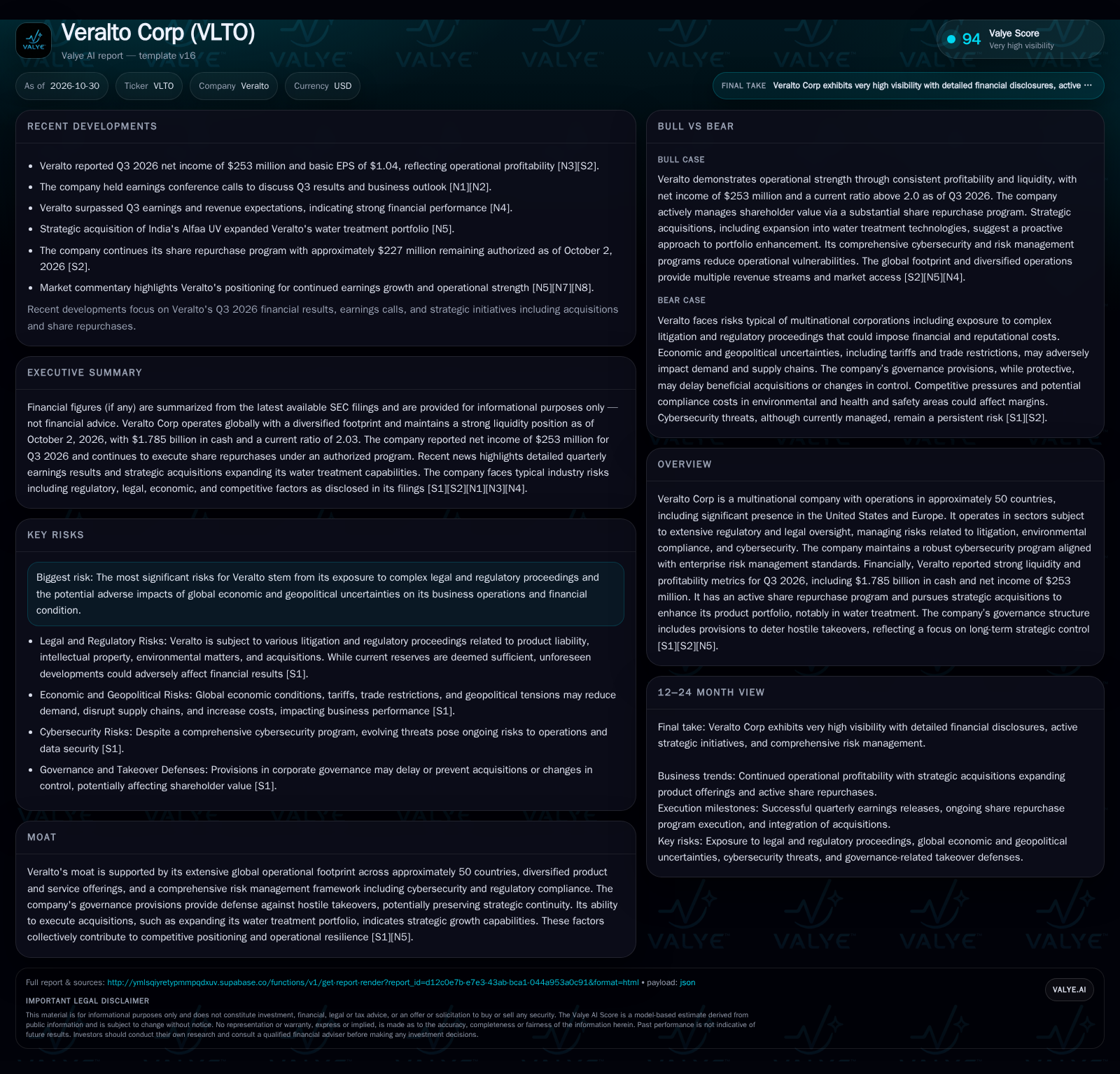
Veralto reported net income of $253 million for Q3 2026, alongside basic earnings per share of $1.04, demonstrating substantial operating profitability [S2] [N3] [N4]. The company finished the quarter with $1.785 billion in cash and cash equivalents and a current ratio of 2.03, indicating a reported liquidity position [S2]. Ongoing share repurchases, with $227 million remaining authorized, reflect a continued commitment to shareholder returns [S2]. Recent earnings outperformance and continued portfolio expansion, especially in water treatment technologies, are cited as drivers of market optimism [N4] [N5]. Together, these facts signal a business with both the resources and intent to pursue further growth and defend its financial resilience.
Veralto’s Scale and Portfolio Composition Underpin Earnings Stability
Veralto’s economics are shaped by a blend of diversified industrial and technology offerings across nearly 50 countries, with revenue streams likely spanning equipment sales, consumables, and service contracts. While the report does not disclose segment details or margin structures, the company’s ability to generate $253 million in quarterly net income suggests a mix of moderate-to-high gross margins and disciplined cost control [S2]. Fixed costs are likely significant given the global footprint, but scale can enable operating leverage if revenue expands faster than overhead. Capital needs are influenced by both organic investments and acquisition activity—recent moves in water treatment imply allocation toward high-value, potentially recurring-revenue verticals. The ongoing share repurchase program suggests Veralto is generating sufficient free cash flow to return capital while funding growth. A critical economic question is how effectively the company can integrate acquisitions and capture synergies without diluting margins or straining its balance sheet.
Further examination of Veralto’s capital allocation strategy reveals the importance of balancing investment in innovation with maintaining financial discipline. Given the capital-intensive nature of industrial and technology sectors, especially in water treatment, the company must prioritize projects with clear paths to scalable returns. The company reported cash and liquidity metrics for the period; these figures do not by themselves establish operating runway, investment capacity, financial flexibility, or financing capacity. Conversely, disciplined prioritization of high-margin, recurring revenue streams—such as service contracts or digital monitoring solutions—can enhance cash flow stability and support sustainable growth. Additionally, the company’s ability to manage working capital efficiently, particularly inventory and receivables across diverse geographies, will influence liquidity and operational resilience.
Distinctive Global Presence and Risk Solutions Face Competitive Challenges
Veralto’s presence in approximately 50 countries and its broad portfolio provide customer diversification and some insulation from localized downturns [S1]. Its risk management framework, including advanced cybersecurity and governance measures, is designed to mitigate operational disruptions and hostile takeovers [S1]. The company’s recent strategic moves in water treatment may position it to capture growth in environmental and infrastructure markets, which are increasingly prioritized by governments and industry. However, Veralto faces competition from other diversified industrials and specialized water technology firms. Regulatory complexity, especially in environmental compliance and global trade, could erode operational agility or margins. While its scale and risk controls are strengths, they do not guarantee pricing power or customer lock-in; competitive advantages may hinge on continuous innovation, successful integration of acquisitions, and the ability to respond nimbly to shifting global risks.
Potential Synergies from Acquisition Integration and Water Tech Growth
A favorable scenario would see Veralto successfully integrating recent water treatment acquisitions, realizing both revenue synergies and operational efficiencies. Expansion into water technologies could open new recurring-revenue streams—such as service contracts, consumables, or digital monitoring—potentially lifting margins and smoothing earnings volatility. If the company leverages its global reach to cross-sell these solutions and maintains disciplined cost management, operating leverage could drive outsized profit growth. Evidence confirming this scenario would include sustained above-peer revenue and margin expansion, growing contributions from new water technology offerings (if disclosed), and positive commentary or KPIs around acquisition integration and customer adoption. Demonstrated ability to deploy free cash flow into both growth and buybacks without eroding balance-sheet strength would further validate the bull case.
If Veralto capitalizes on its global footprint to foster innovation ecosystems around water treatment technologies, it could accelerate product development cycles and enhance competitive differentiation. Collaborations with local research institutions or technology partners in key markets may enable tailored solutions that address region-specific water quality challenges, regulatory requirements, and infrastructure needs. This localized innovation approach can strengthen customer relationships and create barriers to entry for competitors. Moreover, embedding digital capabilities such as IoT sensors and predictive analytics into water treatment offerings could generate valuable data streams, enabling subscription-based models and improved operational efficiencies. Such developments would not only diversify revenue but also increase customer stickiness and long-term profitability.
Operationally, leveraging advanced data analytics and automation across Veralto’s manufacturing and service networks could yield significant cost savings and quality improvements. If the company successfully integrates digital tools to optimize maintenance schedules, supply chain logistics, and customer support, it can reduce downtime and enhance service responsiveness. These efficiencies would be particularly valuable in water treatment, where system reliability and regulatory compliance are critical. Furthermore, data-driven insights could inform product innovation and customization, creating a virtuous cycle of continuous improvement. Realizing these synergies depends on effective change management and talent acquisition, underscoring the importance of organizational agility alongside technological investment.
Maintaining Profit Margins Amid Complex Global and Market Dynamics
The most plausible trajectory is that Veralto continues to deliver steady profitability, supported by its diversified portfolio and disciplined risk management. Revenue and earnings may grow at a moderate pace, reflecting incremental gains from portfolio expansion and operational improvements, but are also tempered by periodic regulatory, legal, or macroeconomic headwinds. The company is likely to maintain its share repurchase program and pursue selective acquisitions, but integration benefits may be gradual and margin accretive only in phases. Confirmation of this scenario would include stable or modestly improving operating margins, consistent free cash flow generation, and no material adverse developments in legal, regulatory, or cybersecurity risks. Disclosures showing balanced capital allocation and measured acquisition activity would further support this middle path.
Risks from Integration Failures, Margin Pressure, and External Disruptions
A negative outcome could materialize if Veralto faces significant integration challenges with recent or future acquisitions, resulting in unexpected costs, operational disruptions, or customer attrition. Margin compression could stem from rising compliance costs, supply chain volatility, or price competition—especially in regulated or commoditized segments. Regulatory actions, unforeseen litigation, or a material cybersecurity incident could further destabilize earnings or force a strategic pivot. Evidence of this scenario would be declining or volatile margins, negative working capital trends, stalled or reversed earnings growth, or large one-time charges. Early warning signs might include management commentary about integration delays, missed synergy targets, or elevated legal reserves.
Factors Influencing Veralto’s Strategic Direction and Financial Outcomes
Margin trends by business segment (if disclosed), especially after major acquisitions, would help test whether integration is accretive or dilutive.
Revenue growth in water treatment and other targeted portfolio expansions (if disclosed) would clarify whether strategic moves are translating into durable top-line gains.
Updates on acquisition integration progress—including synergy realization, retention of key talent, or customer churn—would indicate execution quality.
Trends in free cash flow and capital allocation between buybacks, dividends, and reinvestment would provide insight into financial discipline and flexibility.
Any material changes in legal, regulatory, or cybersecurity risk disclosures could signal emerging headwinds or resilience.
Geographic revenue mix and exposure to regions with heightened regulatory or macroeconomic risk (if disclosed) would illuminate sensitivity to external shocks.
Management guidance or commentary on pricing power, cost inflation, or competitive dynamics would help gauge operational headroom and risk.
Disclaimer: This is research-only, informational analysis and not investment advice. It may include AI-generated interpretation and general industry context. Always verify important details using primary sources.

Comments