
Isabella Bank Corp: Earnings Momentum, Volatility, and the Structural Stakes of Regional Banking
The company's performance underscores both the operating leverage and inherent risks typical of smaller regional banks.
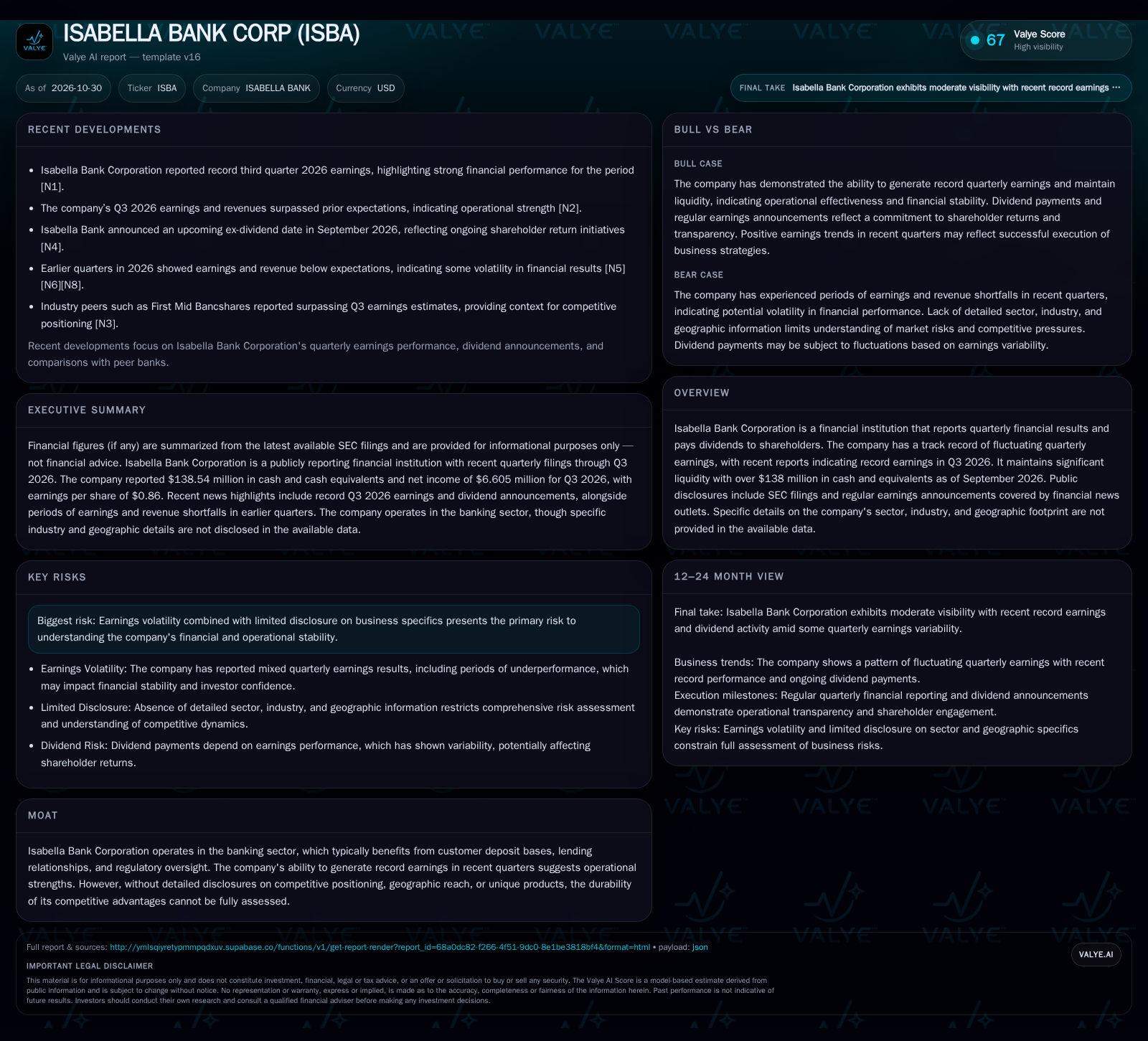
Isabella Bank Corp posted record Q3 2026 earnings and holds $138.54 million in cash and equivalents, while continuing to pay dividends. Despite this strong recent performance, earlier quarters saw earnings and revenue misses, highlighting ongoing volatility. The absence of detailed disclosure on sector, industry, or geographic exposure limits the visibility of its competitive position and risk profile. These dynamics position Isabella as a bank with operational strengths, but also with material uncertainties.
Isabella Bank Corp’s record Q3 2026 earnings and reported cash position mark a period of operational strength, but the company’s recent history reveals notable swings in performance. The lack of detailed disclosure on market focus, business mix, and competitive landscape means that investors face material uncertainty about the durability and sources of Isabella’s current momentum. Understanding how this regional bank navigates the cyclical and structural challenges facing smaller institutions is key to evaluating its future trajectory.
Recent Performance: Record Quarter Amid Persistent Earnings Fluctuations
Isabella Bank Corp reported record net income of $6.605 million for Q3 2026, with both basic and diluted earnings per share at $0.86 [S2] [N1] [N2]. This performance marks a clear operational high point for the company, especially in the context of a challenging year for many regional banks. The company’s cash and cash equivalents totaled $138.54 million as of September 30, 2026 [S2], underscoring a significant liquidity position relative to its likely scale.
However, this strong quarter follows earlier periods in 2026 where both earnings and revenues missed expectations [N5] [N6] [N8]. The cited source reports dividend-related activity; that disclosure alone does not establish dividend-policy continuity, management confidence, or a material constraint on capital flexibility. [N4] Together, these facts depict a bank capable of delivering strong performance in the right conditions, but one that remains exposed to underlying volatility and sector headwinds.
The interplay between macroeconomic conditions and regional banking dynamics further complicates Isabella’s earnings volatility. Interest rate fluctuations, for instance, impact not only the net interest margin but also borrower demand and credit risk profiles. In periods of rising rates, loan growth may slow as borrowing costs increase, while deposit costs could rise as competitors seek to attract funds, compressing margins. Conversely, in a declining rate environment, refinancing activity might boost volume but also pressure yields. This cyclical sensitivity means that Isabella’s quarterly results can swing significantly based on external economic factors beyond its immediate control, underscoring the importance of agile risk management and strategic asset-liability positioning.
How Isabella’s Banking Model Drives Profitability—and Where Leverage Cuts Both Ways
Isabella Bank’s economics are grounded in the traditional regional banking model: generating interest income from loans and investments, collecting deposit-related and wealth management fees, and managing interest expense and credit costs [S2]. In this structure, profitability is highly sensitive to the spread between interest earned on assets and interest paid on deposits, with credit quality and operating efficiency as primary swing factors.
A bank of Isabella’s likely size typically exhibits significant operating leverage. Fixed costs (such as personnel, technology, and branch infrastructure) mean that incremental revenue growth can disproportionately lift profits—explaining the record Q3 earnings when conditions align. Conversely, adverse shifts in net interest margin, increased credit provisioning, or rising funding costs can quickly erode profitability. Capital needs are moderate for organic growth but can spike with acquisitions, new branch openings, or regulatory changes. Dividend payments further constrain retained earnings, limiting the buffer for absorbing shocks unless profitability remains robust.
In addition to traditional interest spread management, Isabella’s profitability is influenced by its capacity to optimize non-interest income streams such as fees from wealth management, payment processing, and ancillary services. These revenue sources can provide a valuable buffer against interest rate volatility, but their scale and growth potential are often constrained by the bank’s regional footprint and competitive environment. Furthermore, operational efficiency gains through technology adoption and process automation can materially impact the cost base, enhancing the bank’s ability to leverage fixed expenses. However, investments in digital infrastructure must be balanced against capital constraints and the risk of disrupting established customer relationships, particularly in markets where personal service remains a key differentiator.
Regional Banking Pressures: Scale, Substitution, and the Visibility Gap
While Isabella Bank benefits from the customer stickiness and regulatory barriers typical of community and regional banks, its precise competitive advantages remain opaque due to a lack of public detail on sector, product, or geography. In the broader context, regional banks face structural pressures from larger national banks, digital-first fintechs, and shifting customer behaviors—particularly as technology lowers switching costs and raises expectations for digital service delivery.
Without disclosure of unique product offerings, geographic concentration, or differentiated capabilities, it is difficult to determine whether Isabella’s recent performance reflects sustainable competitive strengths or cyclical factors. The bank’s ability to maintain or grow its deposit base, defend net interest margins, and avoid credit losses will be tested as industry competition intensifies and as interest rate cycles evolve.
The competitive landscape for regional banks like Isabella is increasingly defined by the pace of technological adoption and the ability to offer seamless digital experiences. While larger banks and fintechs can leverage scale to invest heavily in innovation, smaller institutions must prioritize targeted enhancements that reinforce customer loyalty and operational efficiency. Geographic concentration can be a double-edged sword: it may foster deep community ties and localized knowledge but also expose the bank to regional economic downturns or demographic shifts. Without clear disclosure on these dimensions, assessing Isabella’s resilience against substitution risk and its capacity to capture emerging market opportunities remains challenging, emphasizing the need for granular transparency to reduce investor uncertainty.
Sustained Margin Expansion and Stable Credit Could Drive Outperformance
If Isabella Bank can continue expanding its net interest margin—through disciplined loan growth, stable funding costs, and prudent asset-liability management—while maintaining strong credit quality, it could deliver a string of above-peer earnings. Consistent dividend payments would further attract yield-seeking investors, potentially supporting valuation and access to capital.
Additional transparency on business mix, geographic markets, or successful integration of acquisitions would strengthen the case for durable outperformance.
Earnings Oscillate Around Trend as Sector Cycles and Disclosure Limits Persist
The most plausible trajectory for Isabella Bank is continued earnings volatility, with periods of strong performance interspersed with occasional shortfalls as sector and macroeconomic factors ebb and flow. Net interest margin pressure, credit cycle normalization, and competition for deposits will likely buffet results, while the bank’s operating leverage amplifies swings in profitability.
Investors would remain reliant on summary financials rather than deep insight into underlying drivers.
Margin Compression or Credit Deterioration Exposes Volatility and Capital Constraints
Should Isabella face sustained margin compression—due to rising funding costs, an inverted yield curve, or aggressive deposit competition—profitability could quickly erode. A credit event, such as rising loan losses in a recession or from a concentrated exposure, would further stress earnings and could force a dividend cut or capital raise.
Confirmation of this adverse scenario would be visible in sequential declines in net interest income, a spike in credit loss provisions, dividend suspensions or reductions, and negative surprises in regulatory filings. A lack of proactive disclosure or transparent risk management would exacerbate investor concerns.
What Will Test Isabella Bank’s Earnings Power and Resilience in the Next Cycle?
Quarterly trends in net interest margin and net interest income: these will indicate the direction of core profitability and the impact of changing rate cycles, if disclosed.
Loan and deposit growth rates relative to regional peer averages: would help test whether Isabella is gaining market share or defending its customer base in a competitive environment, if disclosed.
Provision for credit losses and non-performing asset trends: a useful metric for early warning of credit quality deterioration.
Dividend continuity and payout ratio: tracking not just payment dates but the sustainability of distributions as profits fluctuate.
Operating expense trends and efficiency ratio: would signal whether the bank is achieving scale benefits or facing cost pressures, if disclosed.
Disclosure of major acquisitions, branch expansions, or entry into new business lines: these would clarify growth strategy and capital allocation priorities.
Changes in regulatory capital ratios: would help assess potential financial flexibility and vulnerability to shocks, if disclosed.
Management commentary or investor communications that provide greater granularity on market focus, risk management, or competitive differentiation.
Disclaimer: This is research-only, informational analysis and not investment advice. It may include AI-generated interpretation and general industry context. Always verify important details using primary sources.

Comments