
Aware, Inc. and the Stakes of Biometric Identity: Navigating Losses, Liquidity, and Competitive Pressures
Despite a reported liquidity position and experienced leadership, Aware, Inc. faces ongoing net losses and revenue declines amid intensifying competition in biometric and digital identity markets. The company’s ability to convert its specialized expertise and intellectual property into sustainable growth remains an open question as operational execution and market adoption pressures mount.
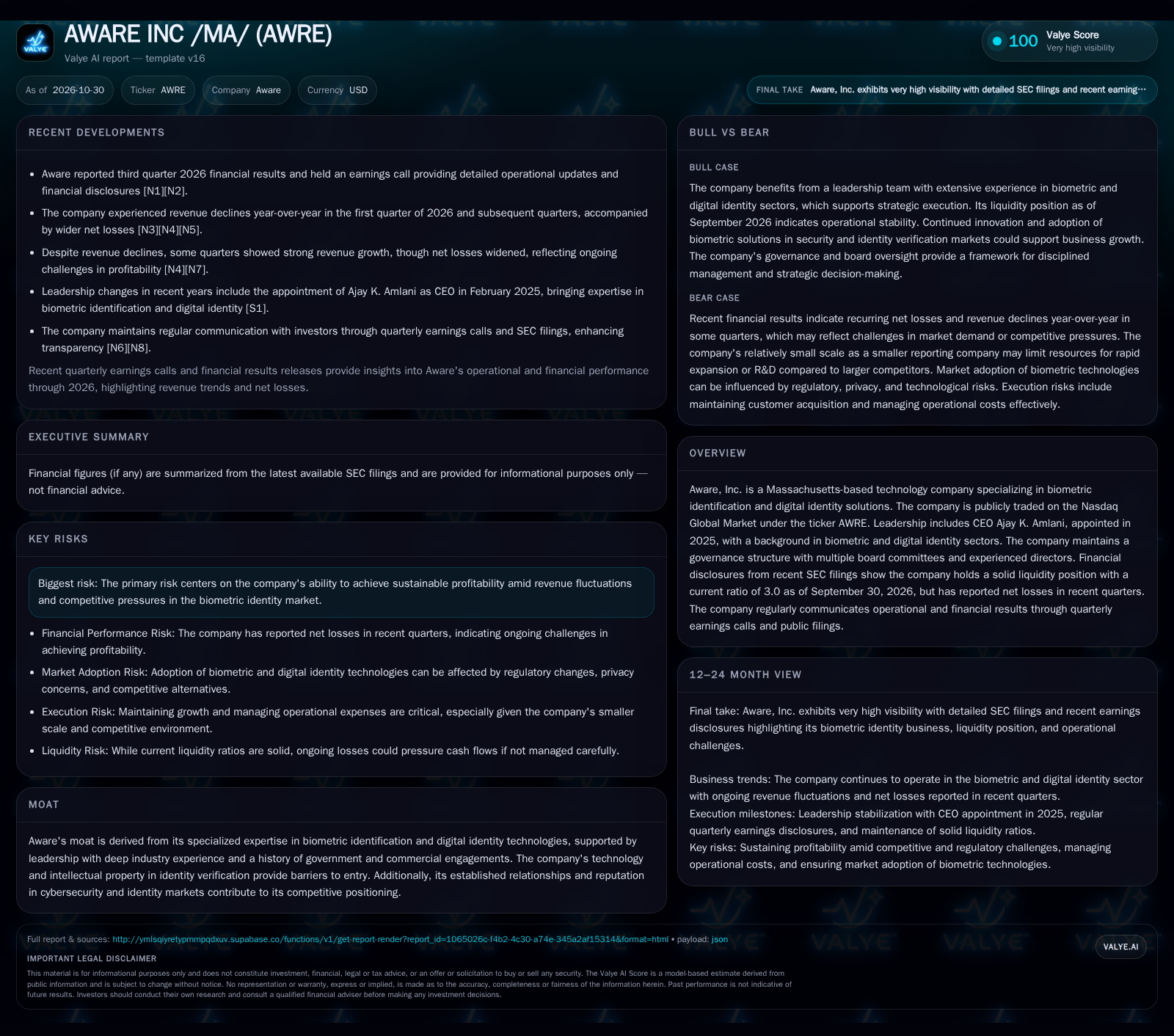
Aware, Inc. specializes in biometric and digital identity solutions but continues to report net losses and year-over-year revenue declines through 2026. The core question is whether Aware can leverage its expertise and IP to capture market share and reverse recent negative financial trends. [S2] [N1] [N4] [N5]
Aware, Inc. sits at the intersection of opportunity and challenge in the rapidly evolving biometric and digital identity sector. While the company boasts a reported liquidity position and an executive team with deep industry roots, its recent financial results reveal persistent net losses and revenue declines through 2026. As competitive pressures in identity technology intensify, Aware’s long-term trajectory hinges on whether it can translate its specialized expertise and intellectual property into profitable, scalable growth—or whether continued operational headwinds and market adoption risks will constrain its ambitions. The company’s next phase will test not just its technology, but its ability to execute amid mounting industry complexity.
Recent Financial Performance and Leadership: A Mixed Signal
As of September 30, 2026, Aware, Inc. reported a cash balance of $2.428 million, current assets of $22.526 million, and current liabilities of $7.503 million, yielding a current ratio of 3.0 and a cash ratio of 0.32 [S2]. However, this position is set against a backdrop of sustained net losses: Aware posted a net loss of $791,000 and EPS of -$0.04 for Q3 2026 [S2].
Year-over-year revenue declines have persisted across the first three quarters of 2026, with some quarters showing temporary revenue rebounds but ultimately resulting in wider losses [N4] [N5]. The leadership team, notably CEO Ajay K. Amlani (appointed in 2025), brings significant expertise in biometric and digital identity, but so far this has not translated into a reversal of negative financial trends [S1].
Biometric Solutions: Revenue Model and Operational Leverage in Question
Aware’s core business centers on providing biometric identification and digital identity solutions, which typically generate revenue through a mix of software licensing, recurring SaaS contracts, and professional services. The company’s intellectual property portfolio and history of government and enterprise engagements suggest potential for higher-margin, sticky contracts if adoption accelerates.
However, the company’s recent financials point to challenges in achieving scale: recurring net losses imply that either gross margins are under pressure, operating costs are elevated, or both. In the biometric sector, significant up-front R&D and ongoing technical support are required, often resulting in a high fixed-cost base. The absence of sustained top-line growth, despite sector tailwinds, suggests that either pricing power is limited or competitive discounting is eroding margins.
Operating leverage could be realized if Aware is able to secure multi-year, high-value contracts or successfully transition more customers to subscription models. However, if contract wins remain sporadic or customer churn is high (undisclosed), the company may continue to struggle to cover its fixed costs without additional capital infusions.
In addition to the challenges in scaling revenue, the capital intensity inherent in biometric technology development necessitates a careful balance between investment and return. R&D expenditures, while crucial for maintaining technological differentiation, can strain cash flow if not matched by corresponding contract wins or licensing revenue. Moreover, the sales cycle in biometric solutions often involves lengthy evaluation and integration phases, particularly with government and large enterprise clients, which can delay revenue recognition and exacerbate working capital demands. Therefore, the timing of contract closures and the predictability of recurring revenue streams are critical factors in assessing Aware’s path to operational leverage.
Specialization vs. Scale: Aware’s Place in the Identity Ecosystem
Aware’s moat stems from its specialized expertise in biometric identification and digital identity, supported by intellectual property and a leadership team with sector pedigree. In theory, this specialization could enable the company to win contracts requiring advanced, high-assurance authentication or compliance with stringent regulatory standards.
Yet, the biometric and digital identity landscape is increasingly crowded. Competitor categories include larger diversified technology vendors (with broader product suites and deeper sales channels), pure-play biometric firms, and emerging cloud-native identity providers. Many rivals can outspend Aware on R&D and sales, potentially compressing margins and accelerating feature commoditization.
Switching costs for enterprise and government clients can be significant due to integration complexity and security requirements, but unless Aware’s technology demonstrably outperforms, customer stickiness may not translate into pricing power. The absence of publicly disclosed retention rates, backlog, or multi-year contract wins leaves open the question of whether Aware’s relationships are translating into durable revenue streams.
From a strategic standpoint, Aware’s specialization may offer both advantages and vulnerabilities in the identity ecosystem. While niche expertise can command premium pricing in segments requiring high assurance, it may limit the company’s addressable market compared to competitors offering broader identity management suites. This trade-off implies that Aware’s growth potential is contingent on its ability to deepen penetration within specialized verticals or geographies where biometric authentication is mandated or highly valued. Conversely, failure to expand beyond a narrow client base could expose the company to demand shocks or technological obsolescence if alternative authentication methods gain traction.
Unlocking Operating Leverage Through Adoption and Innovation
A favorable scenario would see Aware leveraging its intellectual property and sector expertise to capture a disproportionate share of new biometric identity deployments as digital security and regulatory requirements intensify. If the company can win multi-year enterprise or government contracts, particularly those with recurring revenue structures, operating leverage could rapidly improve as fixed costs are amortized over a larger revenue base.
Confirmation of this scenario would require evidence of sustained sequential revenue growth, margin expansion, and a narrowing of net losses or a return to profitability. Public disclosures of major contract wins, customer retention rates, or successful launches of new biometric platforms would further validate the bull case. Conversely, continued revenue stagnation, lack of new contract announcements, or persistent losses would falsify this pathway.
Incremental Progress Amid Structural Headwinds
The most plausible near-term outcome is that Aware continues to operate with modest revenue volatility, ongoing net losses, and periodic liquidity pressures. While the company’s leadership and technology may enable selective contract wins, the absence of breakout growth suggests that competitive intensity and customer procurement cycles are slowing adoption.
The base case would be confirmed by a continuation of current trends: flattish or modestly declining revenues, net losses in the low seven figures per quarter, and no material change in customer composition or contract structure. A clear deviation—such as a significant improvement in gross margins, customer disclosure, or a major capital raise—would challenge this thesis.
Prolonged Losses and Strategic Options Under Pressure
A negative scenario could unfold if Aware’s revenue base continues to erode or if competitive/technological shifts accelerate customer attrition. In this case, persistent net losses would begin to deplete the company’s cash reserves, forcing either a dilutive equity raise, cost-cutting that further impairs growth potential, or exploration of strategic alternatives (such as asset sales or partnerships).
Indicators supporting this scenario would include sequential declines in cash and current assets, a deteriorating current ratio, further widening of net losses, or public disclosure of going-concern warnings or restructuring initiatives. External shocks—such as regulatory setbacks or a major competitive loss—could further accelerate downside risk.
Milestones That Will Determine Aware’s Trajectory in Biometric Identity
Quarterly revenue growth or decline: Sequential and year-over-year trends will reveal whether demand is stabilizing, recovering, or deteriorating. [N1] [N4] [N5]
Gross margin trends: If disclosed, margin expansion would suggest improved pricing power or cost control, while compression would signal intensifying competition or operational inefficiency.
Contract wins and pipeline disclosures: Announcements of major customer additions, multi-year agreements, or backlog would demonstrate commercial traction.
Customer retention and churn: If disclosed, these metrics would reveal the stickiness of Aware’s solutions and the sustainability of its revenue base.
Operating expense levels: Evidence of disciplined cost control or, conversely, ballooning expenses relative to revenue would affect the company’s ability to achieve profitability.
Leadership commentary on adoption and pipeline: Management’s qualitative updates on market conditions, product launches, and customer feedback will provide context for future performance.
Regulatory or industry developments: Changes in biometric standards, privacy laws, or government procurement policies could materially alter Aware’s addressable market.
Disclaimer: This is research-only, informational analysis and not investment advice. It may include AI-generated interpretation and general industry context. Always verify important details using primary sources.

Comments