
Everest Group in 2026: Regulatory Transition, Catastrophe Volatility, and Portfolio Realignment in Global Re/Insurance
Everest Group faces a pivotal twelve-month transition under Bermuda’s new group supervision, while Q3 2026 results highlight both the earnings resilience of its diversified model and the volatility from elevated catastrophe losses. An announced divestiture in Chile signals active portfolio management as the company adapts to rising compliance demands and evolving global insurance dynamics.
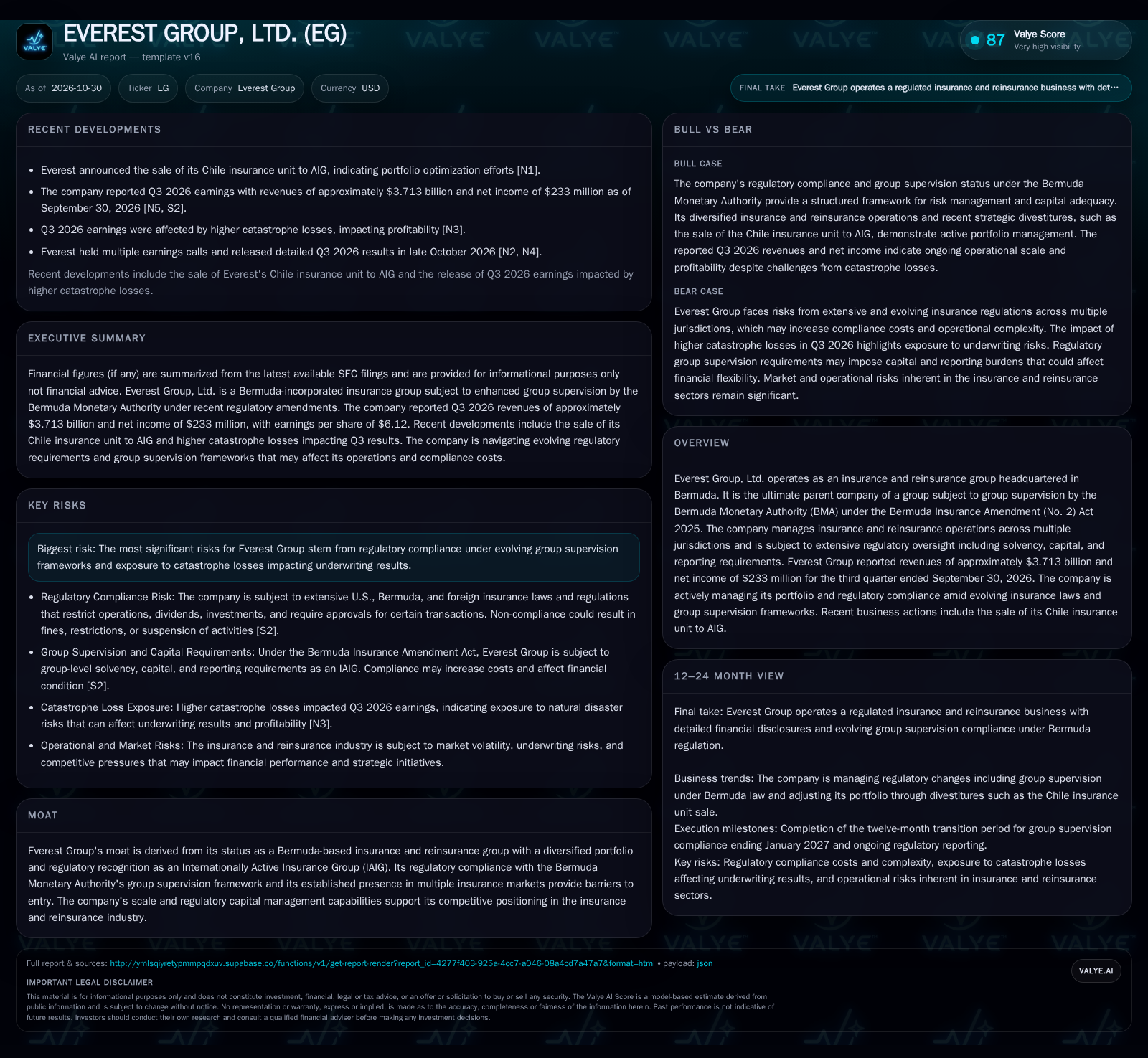
Everest Group reported Q3 2026 revenues of $3.713 billion and net income of $233 million, but results were pressured by higher catastrophe losses. The company is undergoing a critical regulatory transition as a Bermuda group-supervised insurer, with a twelve-month period to meet new Internationally Active Insurance Group (IAIG) standards. The sale of its Chile insurance unit to AIG reflects a focus on portfolio optimization amid mounting compliance and risk management demands. Future performance will hinge on catastrophe risk, regulatory execution, and the ability to sustain underwriting discipline.
Everest Group, Ltd. enters late 2026 at an inflection point, shaped by both external regulatory change and the internal drive to optimize its global insurance and reinsurance footprint. While Q3 financials demonstrate the group’s scale—$3.713 billion in revenue and $233 million in net income—profitability was pressured by elevated catastrophe losses, underscoring the sector’s inherent volatility. Simultaneously, Everest’s transition to full group supervision under Bermuda’s revised regulatory regime and the divestiture of its Chilean unit to AIG reveal a leadership team actively reshaping the business to meet the rising bar for compliance, risk management, and capital efficiency. The next twelve months will test Everest’s ability to execute on both regulatory and commercial fronts.
Regulatory Overhaul and Earnings Volatility Define the Present
Everest Group’s current landscape is shaped by two defining developments: the twelve-month transition to group supervision under the Bermuda Monetary Authority (BMA), and a Q3 2026 earnings result that, while profitable, was impacted by higher-than-expected catastrophe losses [S2] [N3] [N5]. The regulatory shift requires Everest to align with Internationally Active Insurance Group (IAIG) standards, which entails enhanced solvency, capital, and reporting obligations. This transition period, ending January 2027, is likely to affect both operational focus and compliance costs. At the same time, the company’s reported Q3 revenues of $3.713 billion and net income of $233 million reflect ongoing scale, but also expose the volatility inherent in its underwriting risk profile. The announced sale of the Chile insurance unit to AIG suggests Everest is actively managing its portfolio, potentially to streamline its geographic exposure and reallocate capital as regulatory demands intensify [N1].
Insurance and Reinsurance Economics: Navigating Margin, Risk, and Capital
Everest Group’s core business model is built around collecting premiums in exchange for assuming insurance and reinsurance risks across multiple geographies and lines. The economics are fundamentally a balance between premium volume, pricing adequacy, claim frequency/severity (especially catastrophe events), and investment returns generated on the float before claims are paid. Fixed costs include regulatory compliance, operations, and technology, while variable costs are dominated by paid and reserved claims. In the current environment, regulatory capital requirements—especially under IAIG standards—may drive the need for higher capital buffers and influence investment allocation and risk appetite.
The sale of the Chile insurance unit to AIG could allow Everest to redeploy capital to higher-margin or more strategically aligned segments, potentially improving its return on equity. However, the Q3 spike in catastrophe losses underscores the sector’s inherent volatility: even with prudent underwriting, a single quarter can materially impact earnings. Operating leverage is present, but subject to sharp reversals in adverse loss periods. The group’s profitability will thus depend on its ability to price risk accurately, diversify exposures, and control expenses in the face of rising compliance overhead.
How Regulatory Status and Portfolio Breadth Shape Competitive Standing
Everest’s competitive position is anchored by its status as a Bermuda-incorporated group with recognized regulatory standing and a diversified global portfolio. Regulatory recognition as an IAIG under the BMA may provide market credibility and facilitate access to multinational clients that require counterparties with robust solvency and compliance regimes. However, this also raises Everest’s cost base and complexity relative to less-regulated or mono-line peers.
In the broader insurance and reinsurance landscape, Everest competes against other global multiline reinsurers and specialty insurers—many of whom are also adapting to evolving regulatory regimes and climate-driven catastrophe exposures. The ability to dynamically manage the portfolio, as evidenced by the Chile divestiture, could be a source of relative advantage if capital can be redeployed to segments with better risk-adjusted returns. However, the company’s exposure to high-severity, low-frequency events remains a core vulnerability shared across the sector. Technology-driven risk selection, reinsurance purchasing, and capital market alternatives (such as insurance-linked securities) could either erode or reinforce Everest’s positioning, depending on execution.
If Regulatory Execution and Cat Risk Management Converge
A favorable scenario for Everest would see the company successfully completing its IAIG transition without major compliance setbacks, demonstrating to clients and investors that it can operate under heightened regulatory scrutiny while maintaining underwriting discipline. If catastrophe losses revert to historical norms or are offset by improved risk selection and pricing, the group’s earnings power could recover quickly. The redeployment of capital from the Chile divestiture into higher-margin markets or innovative reinsurance structures could further enhance returns.
This scenario would be confirmed by a sustained improvement in combined ratios, stable or rising return on equity, and evidence of new business wins in lines or geographies where regulatory credibility is a differentiator. Conversely, if compliance costs spiral or if Everest is unable to redeploy capital effectively, the upside may be capped.
Adapting to Regulatory Demands Amid Persistent Volatility
The most plausible trajectory is that Everest manages the IAIG transition with moderate increases in compliance and capital costs, while maintaining its diversified underwriting portfolio. Catastrophe losses may remain elevated relative to long-term averages due to climate trends, but Everest’s scale and risk management infrastructure allow it to absorb volatility without threatening solvency. The Chile divestiture modestly improves capital efficiency, but is offset by ongoing margin pressure from competitive markets and regulatory overhead.
Evidence supporting this scenario would include steady, if unspectacular, profit margins, successful regulatory filings, and incremental portfolio adjustments. A sharp deviation—such as regulatory non-compliance or outsized loss events—would falsify the base case and suggest either the upside or downside scenario is playing out.
When Catastrophe Losses Compound with Compliance Drag
Adverse outcomes could materialize if Everest faces above-average catastrophe losses in multiple quarters, straining both earnings and capital. If the costs and operational complexity of IAIG compliance prove higher than anticipated, Everest may be forced to retain additional capital, reduce dividends, or slow growth in select markets. Regulatory missteps or delays in the transition could trigger fines, reputational damage, or even restrictions on business activities.
Confirmation of this downside chain would come from a material deterioration in underwriting results, regulatory filings citing compliance deficiencies, a spike in combined ratios, or evidence that portfolio realignment is reactive rather than strategic (e.g., asset sales to shore up capital rather than redeploy for growth).
What Will Prove Everest Group’s Strategic and Regulatory Resilience?
Progress toward full IAIG compliance by January 2027, including timely regulatory filings and absence of material deficiencies.
Quarterly combined ratio trends—especially underlying combined ratio ex-catastrophes—to assess core underwriting performance.
Magnitude and volatility of catastrophe losses versus peer averages and historical norms.
Return on equity and capital redeployment outcomes following the Chile divestiture (if disclosed).
Changes in regulatory capital requirements and the impact on dividend capacity or business growth (if disclosed).
Earnings call disclosures on portfolio strategy, risk appetite, and reinsurance purchasing shifts.
Evidence of new or lost business in segments where IAIG status or regulatory standing is a competitive factor.
Disclaimer: This is research-only, informational analysis and not investment advice. It may include AI-generated interpretation and general industry context. Always verify important details using primary sources.

Comments