
Bright Horizons in 2026: Employer-Sponsored Child Care Model Tested by Profitability and Liquidity Pressures
The company’s ability to sustain growth, manage operating leverage, and navigate evolving employer priorities will determine whether its scale and embeddedness can offset structural headwinds.
The company’s continued relevance hinges on its ability to deepen employer partnerships, increase service utilization, and maintain quality while addressing financial and operational risks.
Bright Horizons Family Solutions stands at a crossroads as its long-standing model of employer-sponsored child care and education services faces mounting financial strain. As employers continue to seek comprehensive care benefits for workforce engagement, the company’s ability to maintain quality, manage costs, and adapt to evolving market pressures will be critical to future performance.
Impairment Charge and Liquidity Pressures Redefine the Financial Landscape
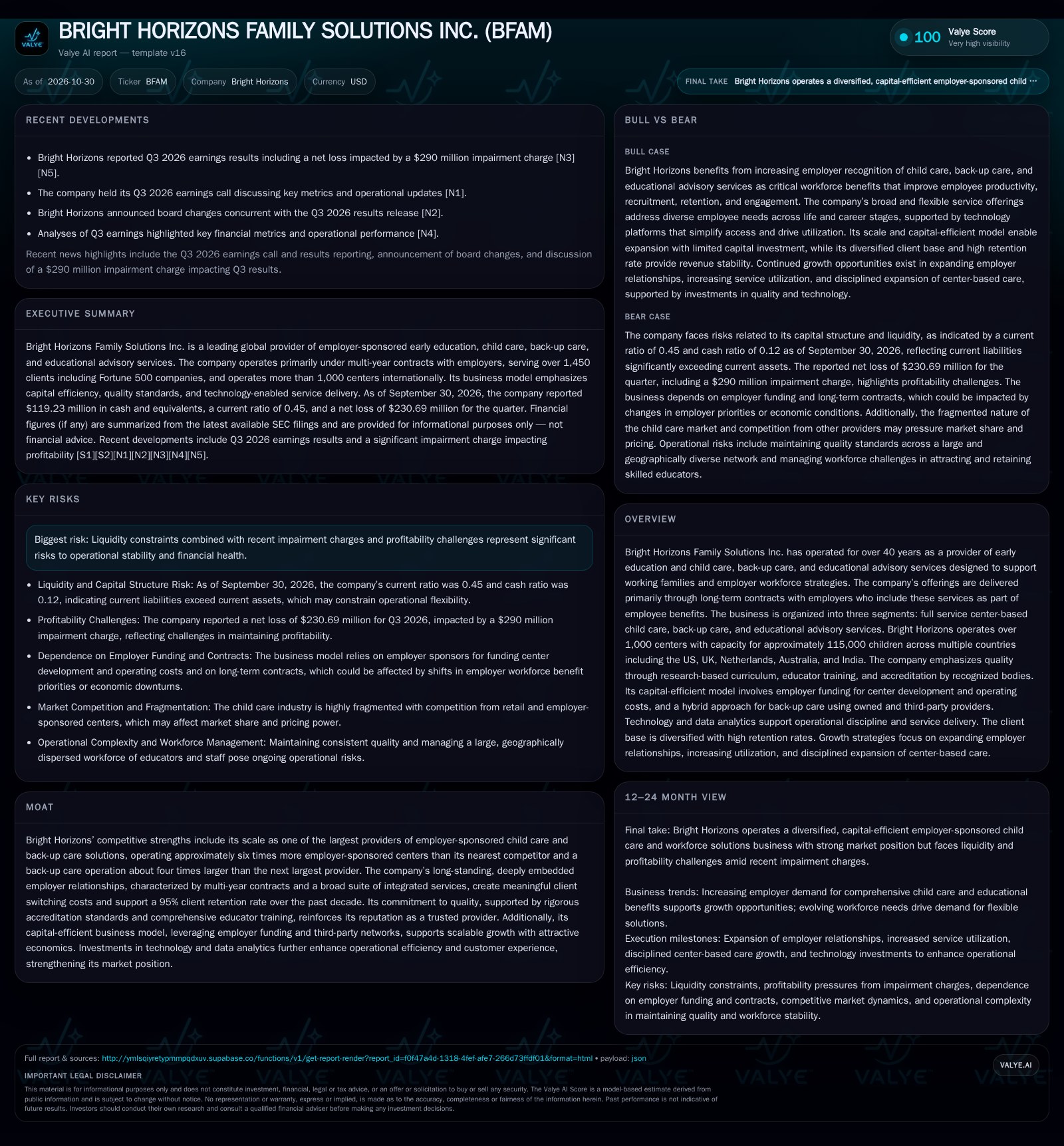
Bright Horizons reported a net loss of $230.69 million for Q3 2026, driven by a $290 million impairment charge recognized in the quarter [S2] [N5]. This development marks a sharp departure from the company’s historical profitability and underscores the financial strain on legacy assets or underperforming operations. [S2]This liquidity profile suggests reported liquidity metrics that do not by themselves establish financial flexibility, making operational discipline and cash flow generation urgent priorities. These acute financial pressures come amid ongoing recognition of Bright Horizons’ role in supporting working families and workforce engagement, but the company’s ability to sustain its growth strategy is now more tightly linked to restoring profitability and maintaining sponsor support.
Employer Funding and Capital Efficiency: The Mechanics Behind Bright Horizons’ Model
Bright Horizons’ economics are defined by employer-sponsored, multi-year contracts that fund new center development and ongoing operations. This capital-light approach typically limits the company’s need for upfront investment, with employers absorbing much of the financial risk and supporting stable cash flows. The business is diversified across three segments: full service center-based child care (71% of 2025 revenue), back-up care (25%), and educational advisory services (4%) [S1]. The largest segment relies heavily on occupancy and utilization rates—fixed costs (real estate, staffing) are high, so incremental children enrolled drive disproportionate margin improvement (operating leverage). Back-up care, delivered via a mix of owned and third-party centers, offers more flexible cost structures but potentially lower margins due to revenue-sharing and variable pricing. The advisory segment is small but may offer higher margins due to lower capital intensity. The risk is that sustained underutilization or shifts in employer benefit priorities can erode economic efficiency quickly, especially if fixed costs remain high and pricing power is constrained by market fragmentation. The most recent impairment charge signals that certain assets or business lines may no longer generate expected returns, raising questions about the sustainability of historical economics.
Scale, Switching Costs, and the Fragmented Child Care Landscape
Bright Horizons commands a leading position among employer-sponsored child care providers, operating approximately six times more sponsored centers than its nearest competitor and a back-up care network about four times larger [S1]. This scale enables the company to standardize quality, invest in technology, and deliver integrated services that create client switching costs—multi-year contracts and embedded HR processes make it costly and disruptive for major employers to switch providers. Its client base is highly diversified, with no single client accounting for more than 1% of revenue and the top 10 clients representing only about 8%, further reducing concentration risk [S1]. However, the broader child care industry is highly fragmented, with numerous local and regional providers competing on price, location, and niche services. Retail-based child care centers and emerging digital-first platforms (including gig-economy models for back-up care) represent plausible substitutes, particularly for employers seeking lower-cost or more flexible solutions. The company’s ability to maintain its moat depends on continuing to deliver superior quality, technology-enabled access, and convenience—advantages that could be eroded if competitors achieve scale or if employers shift toward more decentralized or in-home care models.
Restoring Profitability Through Utilization Gains and Deeper Employer Integration
A favorable outcome for Bright Horizons would involve stabilization of asset values post-impairment, a return to positive net income, and renewed cash flow generation. This could be achieved if employers continue to prioritize comprehensive child care and back-up care benefits, leading to rising enrollment and higher utilization rates across the company’s center portfolio. Increased adoption of back-up care and advisory services—potentially enabled by further technology integration—would enhance cross-selling and deepen client relationships, raising switching costs and supporting contract renewals. The model’s capital efficiency could be preserved if new center investments remain largely employer-funded, limiting the company’s own capital at risk. Evidence supporting this scenario would include: a return to operating profitability, sequential improvement in utilization and enrollment metrics (if disclosed), renewal or expansion of large employer contracts, and stabilization or improvement in liquidity and current ratios.
Navigating Stagnant Utilization and Tight Liquidity with Operational Discipline
The most plausible near-term trajectory is one in which Bright Horizons manages to maintain its core employer relationships and high client retention, but faces slow or uneven recovery in center utilization. Profitability remains pressured as fixed costs outpace sluggish revenue growth, and the company is forced to prioritize cost containment, asset rationalization, and selective investment. The company’s embeddedness in large employer benefit programs provides some stability, but there is little room for error if additional impairments or cash outflows occur. Confirmation of this scenario would come from muted or only modest sequential improvements in profitability and utilization, continued emphasis on operational efficiency in management commentary, and little change in the current ratio or overall liquidity profile.
Erosion of Employer Demand and Asset Value Triggers Financial Distress
A more adverse pathway would see further declines in asset values, additional impairment charges, and sustained net losses driving Bright Horizons into a liquidity crisis. This could be triggered by a macroeconomic downturn, widespread employer cost-cutting, or a shift in workforce benefit preferences away from traditional center-based care. Underutilization of centers would force the company to absorb high fixed costs, while competitive pressures limit pricing power and margin recovery. In this scenario, the company could be forced to close underperforming centers, renegotiate contracts under less favorable terms, or seek external capital at unattractive rates. Warning signs would include additional large impairment charges, worsening net losses, further deterioration in liquidity ratios, and disclosures of contract non-renewals or major client losses.
Testing the Resilience of Bright Horizons’ Model: Metrics and Milestones to Monitor
Sequential trends in center enrollment and utilization rates, if disclosed, would clarify whether the company is regaining operating leverage and approaching break-even economics.
Any further impairment charges or asset write-downs disclosed in future filings would indicate persistent asset value risk and potential for continued net losses.
Renewal, expansion, or loss of major employer contracts—especially among Fortune 500 clients—would signal shifts in the business’s embeddedness and revenue visibility.
Reported developments in workforce recruitment, retention, and wage costs for educators and staff, if disclosed, would shed light on operational risks and cost pressures.
Expansion or contraction of the center portfolio—openings, closures, or asset sales—would reflect management’s response to utilization trends and capital constraints.
Adoption rates and revenue mix for back-up care and educational advisory services, if disclosed, would reveal the effectiveness of cross-selling and service diversification efforts.
Technology investments or new platform features aimed at improving client access, utilization, or operational efficiency could be leading indicators of renewed growth or margin improvement.
Disclaimer: This is research-only, informational analysis and not investment advice. It may include AI-generated interpretation and general industry context. Always verify important details using primary sources.

Comments