
Republic Airways: Contracted Stability, Scale Ambitions, and the Realities of Regional Airline Economics
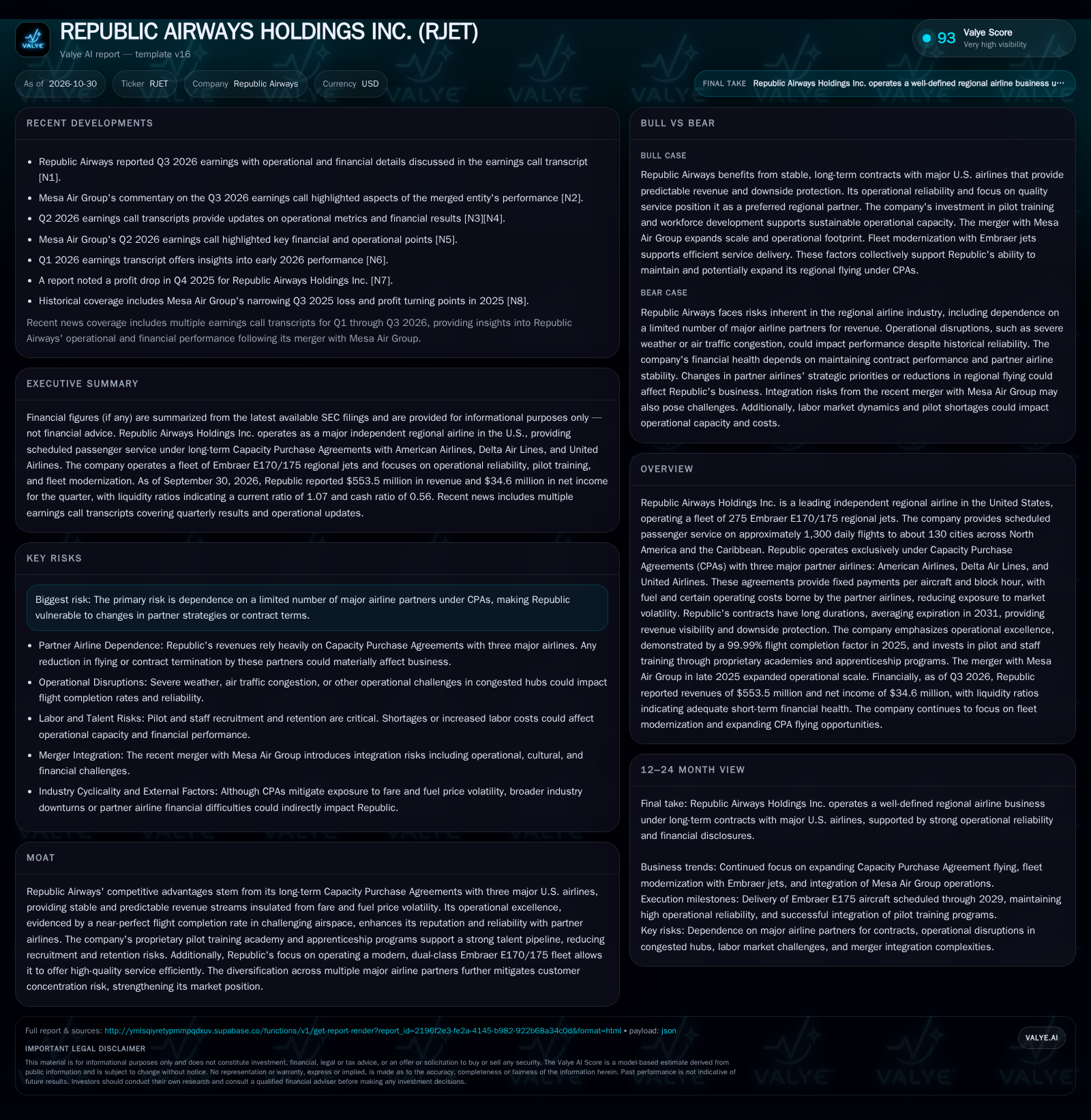
Republic Airways operates as the second largest independent regional airline in the U.S., flying 275 Embraer E170/175 jets under long-term capacity purchase agreements (CPAs) with American, Delta, and United. Its revenue model is insulated from fare and fuel volatility but highly dependent on partner airline strategies and utilization. The recent Mesa merger expands scale, but integration, labor dynamics, and partner reliance remain central to the investment case.
Republic Airways delivers consistent revenues and operational reliability under long-term CPAs with major U.S. airlines, offering downside protection from industry shocks. The Mesa Air Group merger expands its operational footprint, but execution around integration, pilot supply, and evolving partner strategies will shape future outcomes. While fixed-fee contracts provide predictability, the business remains exposed to partner-driven volume decisions and evolving regional airline economics.
Republic Airways Holdings Inc. stands out as a scale-driven, operationally focused regional airline, flying exclusively under long-term, fixed-fee capacity purchase agreements with the three dominant U.S. network airlines. This structure shields Republic from direct exposure to passenger demand swings, fares, and fuel prices, offering unusually stable revenue in a volatile sector. Yet, the business model’s resilience is ultimately tethered to partner airline priorities, contract renewal cycles, and Republic’s ability to deliver reliable, cost-effective flying at scale—especially as the merged Mesa operation ramps up and regional airline labor markets remain tight. Understanding Republic’s future means dissecting the interplay of contract economics, partner leverage, and the realities of integrating and staffing a large, multi-brand regional fleet.
Why Contracted Scale and Recent Expansion Matter Now
As of September 30, 2026, Republic Airways operates 275 Embraer E170/175 jets, providing approximately 1,300 daily flights to 130 cities throughout North America and the Caribbean. Its entire flying is governed by capacity purchase agreements (CPAs) with American Airlines, Delta Air Lines, and United Airlines, under which Republic receives fixed payments per aircraft and block hour, with fuel and certain direct costs paid by the partners. This model produced $553.5 million in Q3 2026 revenue and $34.6 million in net income, and the average CPA contract expiry is October 2031, offering meaningful revenue visibility. The November 2025 merger with Mesa Air Group expanded Republic’s scale, increasing both departures and block hours in 2026. However, the company’s CPAs centralize volume and scheduling control with its airline partners, and its financial health remains closely tied to their evolving regional strategies. [S2] [N2]
The Mechanics of Fixed-Fee Flying: Predictability with Partner-Driven Volume
Republic’s core economic engine is its CPA model, which pays the airline a fixed fee per departure, flight hour, or block hour, subject to minimum utilization guarantees. Partner airlines reimburse many direct and maintenance costs, and pay fuel and other major operating expenses directly, sharply limiting Republic’s exposure to fare volatility, load factors, and fuel price swings. This structure transforms Republic’s revenue profile from a demand-driven model to an industrial service contract, where aircraft utilization, fleet size, and negotiated rates are the primary revenue drivers.
Operating leverage is moderate—while scale enables cost efficiencies in maintenance, flight operations, and training, labor costs (especially pilots and technicians) and capital needs for fleet modernization remain significant. The model’s capital intensity is high, with ongoing investment required for aircraft, simulators, and training infrastructure. Financial performance is thus sensitive not to passenger demand, but to partner-driven decisions: how many aircraft are placed under contract, utilization rates, and periodic rate adjustments or incentive payments tied to operational reliability.
The structure offers predictability but not total insulation: underperformance against reliability or utilization targets can result in financial penalties, and contract economics can be reset at renewal or via escalation clauses. The business requires continuous investment in workforce development (notably pilot training and retention), and integration following the Mesa merger may temporarily dilute margins or increase overhead as systems and staff are consolidated. [S2]
Regional Airline Competition: Scale, Reliability, and the Fight for CPA Share
Republic’s main competitors are other large regional airlines operating similar CPA models for the same major U.S. network carriers. The competitive battlefield is defined by reliability, cost efficiency, pilot supply, and the ability to scale up or down in line with partner needs. Republic’s operational reliability (99.99% flight completion in 2025) and proprietary pilot training academy (LIFT Academy) are clear differentiators, supporting reputation and workforce supply.
However, bargaining power is fundamentally asymmetric: partner airlines control route selection, aircraft allocation, and contract renewal. While Republic’s scale and reliability make it a preferred partner, network airlines can and do shift flying among regional providers based on cost, reliability, and strategic priorities. The existence of minimum utilization guarantees and long-dated contracts provides some defense, but not immunity, especially if partner airlines consolidate regional flying or push for cost concessions at renewal.
Substitution risk is mostly limited to other regional airline providers, as the economics of mainline jets do not favor replacement of 70-76 seat regional jets on thinner routes. However, pilot shortages and wage inflation across the industry have raised the stakes for all regional carriers, with success increasingly tied to proprietary training pipelines and retention programs. Fleet modernization (Embraer E175s) aids efficiency, but is not unique to Republic, and contract renewals will continue to test the company’s ability to defend margins and fleet size.
How Republic Could Outperform: Integration Synergies and Fleet Growth Drive Earnings
The most favorable outcome for Republic is a scenario where the Mesa Air Group merger is integrated smoothly and delivers operational synergies, such as shared training, maintenance, and scheduling efficiencies. If Republic leverages its scale and reliability to win incremental CPA flying—either through contract expansions with existing partners or by absorbing flying from less reliable or higher-cost regional competitors—fleet utilization and block hours could rise, supporting above-trend revenue and margin growth.
Further upside could come from continued investment in pilot training and retention, allowing Republic to staff incremental growth without suffering from industry-wide pilot shortages. Successful execution would be evidenced by expanding the number of contracted aircraft, higher incentive payments for operational reliability, and minimal disruption or penalty costs from integration.
Confirmation of this scenario would come from public disclosures of new or expanded CPA flying, improved operational metrics post-merger, and evidence that Republic is absorbing share from weaker competitors without margin dilution. Conversely, delays or cost overruns in integration, or loss of CPA flying to competitors, would falsify the upside thesis.
Steady-State Contracted Flying Anchored by Partner Strategies
In the most plausible scenario, Republic maintains its current scale and operational excellence, with its fleet and block hours largely stable under existing CPAs with American, Delta, and United through the late 2020s. Revenue growth tracks modestly higher as contractually escalated rates, periodic incentives, and incremental fleet modernization offset inflationary pressures on labor and maintenance costs.
Mesa integration proceeds without major disruption, but the benefits are largely limited to scale efficiencies and cost avoidance. Pilot supply remains tight but manageable due to Republic’s in-house training pipeline, enabling the company to meet minimum utilization guarantees and avoid penalties. Partner airlines continue to adjust regional flying in response to their own network needs, but Republic’s size, reliability, and dual-class Embraer fleet position it as a core provider.
Confirmation would come from stable or gradually increasing contracted aircraft counts, consistent or improving reliability metrics, and the absence of major contract terminations or volume reductions by partners. Evidence of lower block hours, loss of CPA share, or margin compression from wage inflation would challenge this scenario.
What Could Go Wrong: Partner Retrenchment, Labor Shocks, and Integration Pitfalls
Adverse outcomes for Republic would be triggered primarily by shifts in partner airline strategies—such as a major reduction in regional flying due to network rationalization, cost-cutting, or changes in fleet strategy. If one or more major partners reduce the number of contracted aircraft or do not renew expiring CPAs, Republic’s revenue base could shrink rapidly, with little opportunity to redeploy capacity elsewhere.
Labor market shocks—such as an industry-wide pilot shortage, unionization pressures, or sharply rising wage demands—could erode margins, especially if CPA rate adjustments lag cost inflation. Integration missteps following the Mesa merger could result in operational disruptions, reliability penalties, or unanticipated overhead, undermining the business case for scale.
Downside would be confirmed by contract non-renewals, rapid reductions in block hours or aircraft under contract, operational disruptions leading to penalty costs, or evidence of significant margin compression from labor or integration costs.
Milestones and Metrics That Will Shape Republic’s Post-Merger Trajectory
The number of aircraft under active CPA contracts and any public disclosure of new or lost flying with American, Delta, or United.
Block hours flown and fleet utilization rates, especially compared to minimum utilization guarantees and prior periods.
Operational reliability and on-time performance metrics, particularly following the Mesa integration (if disclosed).
Pilot hiring, training, and retention statistics, including throughput at LIFT Academy and attrition rates (if disclosed).
Integration milestones and cost synergies from the Mesa merger, including any one-time charges or ongoing savings (if disclosed).
CPA contract renewal activity, rate escalations, or changes to contract terms as reported in filings or earnings calls.
Labor cost trends, unionization activity, or wage negotiation outcomes affecting pilot and technician expenses.
Partner airline commentary on their regional strategy and fleet deployment priorities, as this guides Republic’s volume outlook.
Disclaimer: This is research-only, informational analysis and not investment advice. It may include AI-generated interpretation and general industry context. Always verify important details using primary sources.

Comments